































What problem are we really solving?
Leaders see rising complaints and repeated fixes that do not stick. Customers see slow responses, unclear status, and problems that reappear after a short lull. A systematic root cause approach converts noisy symptoms into changeable causes, assigns owners, and verifies that the fix worked. ISO 10002 sets the baseline for complaint handling and continual improvement, which means organisations must move beyond triage to elimination of systemic causes.¹ When teams treat complaints as a portfolio of failure demand and not isolated stories, repeat volume drops and the cost to serve falls.¹
What is complaint root cause analysis in precise terms?
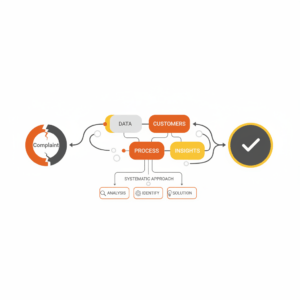
Complaint root cause analysis (RCA) is a structured method to discover the underlying conditions that produce defects in customer outcomes. It joins evidence from cases, processes, and systems to trace each complaint to a changeable cause and a control that prevents recurrence. Practical RCA relies on a small toolkit: Five Whys for fast causal chains, Ishikawa diagrams to organise hypotheses, process mining to expose rework loops, and controlled experiments to prove the fix.² ³ ⁴ RCA ends when a verified control prevents the issue from returning, not when a meeting closes a ticket. This definition aligns with quality and service standards that emphasise corrective and preventive action.¹
Why do complaints repeat and how do we stop the cycle?
Complaints repeat when organisations fix the instance but not the mechanism. The mechanism lives in broken handoffs, invisible queues, unclear policies, and fragile systems. Process mining shows how flow variants and rework loops cause delay and errors that customers experience as unfairness.⁴ Service literature shows that timely, respectful recovery plus meaningful redress can restore loyalty, but the long term gain depends on preventing the same failure next time.⁵ RCA addresses both by pairing immediate service recovery with a systemic fix and an owner.
How do you run RCA step by step without losing speed?
Use a lean, auditable sequence that fits operations.
Frame the problem using a crisp, observable statement. Example: “Customers receive a duplicate charge on first bill after plan change.” Set a 30-day baseline for volume and repeat-within-window.
Gather evidence from cases, call notes, event logs, and policy. Pull a stratified sample of complaints that include both resolved and unresolved outcomes.
Map the process the complaint flows through. Use a simple service blueprint for front stage and backstage. Add a state model to name legal transitions. Stating the allowed transitions makes stalls and illegal hops visible.⁶
Generate causes with an Ishikawa diagram. Cluster under People, Process, Policy, Platform, and Data so cross-functional teams contribute.
Test the causal chain with Five Whys. Keep each “why” evidenced, not opinion. Stop at a cause you can change within your control boundary.²
Validate with data. Use process mining and queries to show that the suspected step correlates with complaint spikes or rework loops.⁴
Design the control. Choose the lightest control that would have prevented the issue. Controls include removal of an unnecessary step, a rule change with automated guardrails, or a system check that fails safe.
Prove the fix with an experiment or holdout. Promote only if complaints and repeats fall with no harm to safety, risk, or revenue.
Prevent drift by adding the control to standard work, training, and monitoring. Publish the new guardrail and the trigger that would alert you to regression.
This cadence is fast because it limits analysis to a changeable cause and ties proof to observable deltas.
What signals, thresholds, and definitions keep RCA honest?
RCA needs shared definitions that travel across teams.
Complaint means a customer expression of dissatisfaction seeking a response or resolution, as per ISO 10002.¹
Repeat within window means any customer-initiated return on the same issue within 3 to 7 days for voice and chat, or a channel-appropriate window for delivery or claims. Track this as a lagging outcome for each cause class.
Leading signals include time in state, transfer chains, event latency, and First Contact Resolution for the implicated intents. FCR is a practical indicator that the mechanism works at the point of need.⁷
Thresholds use percentiles, not averages. For example, time-in-state P75 for “Billing Fix Pending” should stay under a defined target. Breaches trigger RCA, not more reminders. HEART’s goal–signal–metric structure helps write these rules once and reuse them.⁸
Which RCA tools fit which complaint patterns?
Pick the smallest tool that works.
Five Whys for narrow, linear errors such as a misconfigured rule or a missing field. Keep each answer evidence based and stop when the next step changes policy or code.²
Ishikawa diagrams when multiple contributing factors exist, such as a seasonal spike that exposes queue and knowledge gaps.
Process mining for operations-heavy complaints where rework and variant paths produce long waits or errors. This method rebuilds the real process from event logs and quantifies bottlenecks and loops.⁴
Kepner-Tregoe or A3 for multi-stakeholder problems that need clear problem statements, alternatives, and risks.
Controlled experiments when the fix affects customer experience at scale. Tests settle debates about sequence, copy, or channel tactics.
What does strong evidence look like?
Strong evidence ties a hypothesised cause to a measurable change in the flow and to a complaint delta. For example, a process mining view shows that cases with Path Variant B have a 3x rework loop at “Address Validation,” which correlates with the “delivery update” complaint theme. Changing the validation rule and adding inline field help reduces Path B by 60 percent and halves complaints on that theme in four weeks. The chain from mechanism to outcome is visible and auditable.⁴ ⁸
How should you organise owners, cadences, and controls?
RCA works when governance is light and specific. Create a weekly design authority for complaints that approves new controls using a one-pager: problem statement, evidence, chosen control, expected effect, and rollback plan. ISO 10002 expects leadership commitment and review; this forum fulfills that requirement without bureaucracy.¹ Assign one owner per cause with a deadline and a metric. Add the control to standard operating procedures and add a small metric to detect regression, such as schema validation pass rate or rule hit rate.
What are the common RCA mistakes and how do we avoid them?
Teams often stop at “human error.” That is a label, not a cause. Replace it with “procedure allows free text address entry without validation” or “policy requires duplicate rekey across systems.” Another mistake is to generalise from one case. Always validate with logs or samples. A third is to ship content fixes where system fixes are needed. If the gateway times out, no tooltip helps. Use state and dependency logs to isolate failing transitions.⁶ Finally, many programmes declare success on a point improvement. Run holdouts long enough to clear weekly seasonality and publish confidence intervals to prove durability.
What does a 60-day RCA sprint look like?
Days 1–10: Baseline and select cases.
Choose the top two complaint themes by cost and volume. Establish baseline volume, repeat within window, time in state, and FCR for related intents.¹ ⁷
Days 11–25: Diagnose and design controls.
Blueprint the flow, draw an Ishikawa diagram, run Five Whys, and validate with process mining or targeted queries. Choose the lightest control that would have prevented the issue.² ⁴
Days 26–45: Test and ship.
Run a controlled experiment or phased rollout. Measure leading signals and complaint outcomes together. Promote only when both move in the expected direction.⁸
Days 46–60: Lock in and learn.
Update procedures, training, and monitoring. Publish a brief “fix shipped, complaints down” memo with the quantified delta. Add the cause to a living register and mark it Prevented with the control reference.
What business impact should executives expect?
Expect a visible drop in repeat complaints on the targeted causes and a reduction in total complaint volume for those themes. Expect shorter time in state for the implicated steps and higher FCR where the mechanism now works. Expect fewer credits or refunds for the same class of error. These gains arrive because the fix removed the cause, not because the wording changed. Done repeatedly, RCA converts complaints from cost to learning and builds trust through fewer failures and faster recovery.⁵ ⁷
FAQ
What is the fastest credible RCA method for a live complaint spike?
Run Five Whys with evidence and validate the suspected step using logs or a quick process mining view. Choose the lightest control that would have prevented the error and test it on a slice.² ⁴
How do we link complaint themes to real processes?
Use a service blueprint and a simple state model so you can map themes to steps and handoffs. Then validate with event logs that show where cases loop or stall.⁶ ⁴
Which metrics prove the root cause is fixed?
Watch complaint volume and repeat within window for that theme, plus leading signals like time in state and transfer chains. Add FCR for related intents to show the mechanism now resolves in one touch.⁷ ⁸
When should we use process mining instead of interviews?
Use process mining when the flow crosses multiple systems or when rework and variants drive delay. The method reconstructs the real path and exposes bottlenecks that interviews miss.⁴
How do we stop “human error” being the default cause?
Ban the phrase in reports. Require a changeable control as the end of every causal chain, such as validation, sequencing, or permission changes.²
Which standard should we align to for complaint handling and improvement?
Align to ISO 10002 for principles and continual improvement. Use it to anchor intake, responsiveness, and corrective action, then layer RCA on top.¹
Sources
ISO 10002:2018 — Quality management — Customer satisfaction — Guidelines for complaints handling in organizations — International Organization for Standardization, 2018, ISO. https://www.iso.org/standard/71580.html
Toyota Production System: Beyond Large-Scale Production — Taiichi Ohno, 1988, Productivity Press. https://www.routledge.com/Toyota-Production-System-Beyond-Large-Scale-Production/Ohno/p/book/9780915299140
Guide to Quality Control — Kaoru Ishikawa, 1982, Asian Productivity Organization. https://www.apo-tokyo.org/publications/ebooks/guide-to-quality-control
Process Mining: Data Science in Action — Wil van der Aalst, 2016, Springer. https://link.springer.com/book/10.1007/978-3-662-49851-4
The Profitable Art of Service Recovery — Christopher W. Hart, James L. Heskett, W. Earl Sasser Jr., 1990, Harvard Business Review. https://hbr.org/1990/07/the-profitable-art-of-service-recovery
Learn about state machines in Step Functions — Amazon Web Services, 2024, AWS Documentation. https://docs.aws.amazon.com/step-functions/latest/dg/concepts-statemachines.html
First Contact Resolution: Definition and Approach — ICMI, 2008, ICMI Resource. https://www.icmi.com/files/ICMI/members/ccmr/ccmr2008/ccmr03/SI00026.pdf
Measuring the User Experience at Scale: The HEART Framework — Kerry Rodden, Hilary Hutchinson, Xin Fu, 2010, Google Research Note. https://research.google/pubs/pub36299/