



























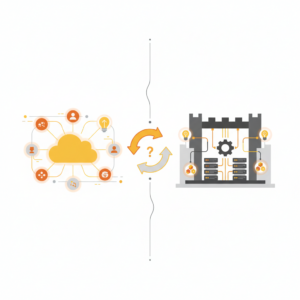
Modern infrastructure decisions in 2025 are no longer technical preferences. They are enterprise risk and value decisions. Cloud, on-premise, and hybrid models each solve different operational problems. The right choice depends on regulatory exposure, cost volatility, automation maturity, and growth ambition. Australian organisations that align infrastructure to business outcomes achieve higher resilience, faster innovation, and better cost control¹².
Definition
What does cloud vs on-premise infrastructure mean in 2025?
Cloud infrastructure refers to compute, storage, and platforms delivered on demand by third-party providers. On-premise infrastructure refers to systems hosted and managed within an organisation’s own facilities. In 2025, most enterprises operate hybrid models combining both.
The decision is no longer binary. It is about workload placement. Data sensitivity, latency, compliance, and scalability requirements determine where systems should run. Mature organisations treat infrastructure as a portfolio, not a single architecture choice³.
Context
Why infrastructure decisions have become board-level issues
Infrastructure underpins customer experience, automation, analytics, and cyber security. Poor choices increase cost, slow delivery, and elevate operational risk. Cloud spend volatility has become a financial governance concern. On-premise environments face rising skills shortages and capital refresh pressure⁴.
Australian regulators now expect demonstrable control over data residency, access management, and resilience. Infrastructure decisions directly affect compliance with CPS 234, Privacy Act obligations, and ISO 27001 controls⁵⁶.
Mechanism
How cloud and on-premise models actually operate
Cloud platforms provide elastic scaling, managed services, and rapid deployment. They shift capital expenditure to operating expenditure. Automation is embedded through APIs and native tooling. However, cost visibility requires strong governance and workload optimisation⁷.
On-premise environments offer predictable cost curves and full control over data and configuration. They suit stable workloads with strict latency or sovereignty requirements. Automation is possible but depends on internal capability and tooling maturity.
Hybrid architectures integrate both models. Critical data and legacy systems remain on-premise while analytics, digital channels, and automation platforms run in the cloud. Integration quality determines success.
Comparison
Cloud vs on-premise vs hybrid: what performs best in 2025?
Cloud outperforms for speed, experimentation, and advanced analytics. It enables rapid adoption of AI, automation, and customer intelligence platforms. On-premise excels where control, predictability, and regulatory assurance dominate.
Hybrid delivers the highest enterprise value when governance is strong. Research shows hybrid adopters achieve up to 23 percent lower infrastructure cost volatility while improving service availability⁸.
The decision should be workload-specific. Attempting full cloud or full on-premise strategies increases risk and limits flexibility.
Applications
When should Australian organisations choose cloud?
Cloud is optimal for customer analytics, digital service platforms, workforce tools, and automation pipelines. These workloads benefit from elasticity and rapid iteration. A structured cloud migration strategy Australia organisations use prioritises low-risk, high-value workloads first.
Platforms such as Customer Science Insights support cloud-based analytics and insight generation across large datasets, enabling faster decision cycles without infrastructure overhead https://customerscience.com.au/csg-product/customer-science-insights/.
When does on-premise still make sense?
On-premise remains appropriate for core transactional systems, sensitive personal data, and environments with strict latency requirements. Industries such as finance, utilities, and government continue to retain critical workloads locally to meet regulatory and resilience expectations.
Risks
What risks leaders underestimate in infrastructure decisions
Cloud risk is rarely technical. It is financial and organisational. Poor tagging, weak accountability, and uncontrolled scaling drive cost overruns. Vendor concentration increases systemic risk.
On-premise risk centres on skills dependency and ageing infrastructure. Failure to modernise automation and monitoring increases outage likelihood.
Hybrid risk lies in integration complexity. Without clear ownership, hybrid environments become fragmented and opaque. Strong architecture standards and operating models reduce this risk⁹.
Measurement
How should infrastructure success be measured?
Infrastructure decisions should be measured against business outcomes, not uptime alone. Key metrics include cost predictability, deployment frequency, incident recovery time, and compliance audit outcomes.
Value-driven organisations align infrastructure measurement to customer and operational value. Value Management Consulting supports organisations in linking infrastructure investment to measurable outcomes across cost, risk, and performance https://customerscience.com.au/solution/value-management-consulting/.
Next Steps
How to make the right infrastructure decision in 2025
Start with workload classification. Assess data sensitivity, performance needs, and change frequency. Establish financial governance before migration. Invest in automation and monitoring early.
Hybrid cloud benefits are only realised when operating models are redesigned. Skills, processes, and accountability must evolve alongside technology. Infrastructure strategy should be reviewed annually as business and regulatory conditions change.
Evidentiary Layer
What evidence supports hybrid infrastructure strategies?
Multiple studies confirm that hybrid architectures deliver superior resilience and cost control in regulated markets¹⁰¹¹. Australian government guidance increasingly endorses risk-based workload placement rather than blanket cloud adoption¹².
FAQ
Is cloud always cheaper than on-premise?
No. Cloud reduces upfront capital but can exceed on-premise costs without strong governance and optimisation.
What is the safest option for regulated industries?
Hybrid architectures provide balance between control and innovation when properly governed.
How does automation influence infrastructure choice?
Automation favours cloud and hybrid models where APIs and managed services accelerate deployment.
Can customer analytics run on-premise?
Yes, but cloud platforms scale faster and integrate more easily with advanced analytics tools.
How does Customer Science support infrastructure decisions?
Customer Science provides analytics platforms, automation solutions, and advisory services that operate across cloud and hybrid environments, including Knowledge Quest https://customerscience.com.au/csg-product/knowledge-quest/.
Sources
Australian Prudential Regulation Authority CPS 234¹
ISO/IEC 27001:2022 Information Security Management²
OECD Cloud Computing Policy Framework³
Gartner Infrastructure Strategy Report 2023⁴
Australian Privacy Act Review Report 2022⁵
Australian Signals Directorate Essential Eight⁶
FinOps Foundation State of Cloud Costs 2024⁷
McKinsey Hybrid Cloud Value Study 2022⁸
NIST SP 800-53 Rev 5⁹
IDC Future of Infrastructure 2023¹⁰
Harvard Business Review Hybrid IT 2021¹¹
Australian Government Cloud Policy 2023¹²