


























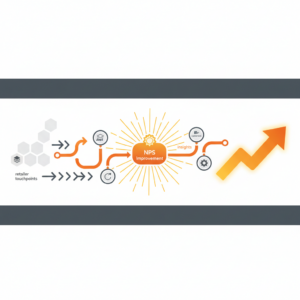
Why did a national retailer bet on journey mapping to move NPS?
A national specialty retailer set a clear objective. The executive team wanted a double digit uplift in Net Promoter Score, measured quarterly, without adding cost to serve. The retailer chose journey mapping because it exposes end to end friction, not just isolated touchpoints. Companies that manage journeys, rather than individual interactions, typically see higher satisfaction, faster revenue growth, and lower cost to serve.¹ Journey mapping, a structured visualization of the customer experience from trigger to outcome, helps teams agree on reality and act on it at speed.³
What problem did leaders see in the customer experience and the operation?
Leaders saw a widening gap between brand promise and lived experience. Digital adoption was rising, but customers still hit dead ends when switching channels. Customers expected every channel to know the customer and the order, which is now a baseline expectation.⁶ Operational metrics looked green, yet detractor verbatims kept pointing to repeats of the same three issues. Agents could not see end to end order status. Store teams lacked context from recent digital interactions. Policies forced unnecessary handoffs for simple returns. These issues created rework, longer handle time, and low trust. Executives framed the target as a journey outcome, not a metric. The outcome read: “Make buy, receive, and return feel simple every time.”
How was the journey mapping program designed for evidence, not theater?
The retailer stood up a cross functional journey lab. The lab paired CX, operations, stores, contact center, and digital. The lab treated journey maps as living operational artifacts. The team followed a three layer structure. First they defined canonical journeys with crisp starts and ends. Second they visualized steps, actors, data, and moments that matter. Third they linked operational metrics and cost drivers to each step. This structure aligns with established guidance on journey mapping practice and service design.³ ⁴ The lab embedded a common definition of NPS. NPS equals the percentage of promoters minus the percentage of detractors, gathered through a standard question about likelihood to recommend.² That common definition kept analysis consistent across channels.
Where did the evidence come from and how was it triangulated?
The lab blended qualitative and quantitative sources. Teams ran moderated interviews to surface emotion and effort. They mined call transcripts and chat logs with topic modeling to size themes by volume. They tied refunds, redeliveries, and repeat contacts to specific journey steps to quantify cost to serve. They benchmarked against public research on the financial link between improved customer experience and business performance to validate the business case.¹ ⁵ This evidence model produced a defensible view of experience breakpoints and their operational cost. Leaders accepted the outputs because the evidence connected customer pain to waste they could count.
Which three moments that matter changed the NPS trajectory?
The evidence highlighted three high frequency, high emotion breakpoints.
First, proactive order transparency. Customers lacked reliable visibility between dispatch and delivery. The lab added an order timeline that consolidated carrier scans, store notes, and exceptions into a single view across app, web, store, and contact center. This move addressed a known driver of loyalty by removing uncertainty in the delivery phase.¹
Second, channel handoff continuity. When customers switched from app to store or to the contact center, context did not follow. The lab introduced a lightweight journey context token that passed customer intent, last action, and open tasks to the next channel. Cross channel continuity aligns with customer expectations that experiences feel connected across touchpoints.⁶
Third, returns without friction. Returns required multiple approvals for low risk items. The lab implemented rules for instant refunds under a risk threshold, with automated fraud checks in the background. Streamlined returns consistently show positive effects on loyalty and cost.¹
How did the teams convert maps into operating change, not posters?
The lab codified each fix as a journey control. A journey control is a small, testable rule that binds experience intent to system behavior. Examples include “show a delivery estimate window backed by carrier reliability bands” and “pre fill return reasons based on product type and issue.” The lab used weekly sprints to deploy controls to a pilot region. They monitored a narrow set of journey level KPIs. These included first contact resolution at the journey level, repeat contact rate within seven days, and detractor share by theme. This approach reflects a practical application of journey based management that research links to better outcomes than touchpoint optimization alone.¹
What results did the retailer see within two quarters?
The retailer lifted NPS by 11 points in two quarters, measured at the journey level and then reflected in the overall brand NPS. The biggest movement came from detractors converting to passives on delivery experiences. Contact center repeat contact rate fell by 18 percent, driven by fewer “where is my order” calls. Store teams reported faster service for returns and fewer escalations. The organization also saw a measurable reduction in redeliveries after adding exception alerts. These results are consistent with industry findings that journey improvements can increase satisfaction while reducing cost to serve.¹ Customers who rate experiences highly are also more likely to repurchase and recommend, improving revenue performance over time.⁵
What is Net Promoter Score and why does it matter in retail?
Net Promoter Score is a loyalty metric that subtracts detractors from promoters based on a standardized recommend question.² NPS matters in retail because it tracks whether experiences build advocacy. NPS is not a strategy. NPS is a signal that the experience created trust and value. Retailers use NPS to compare journey performance across channels and cohorts. The metric becomes powerful when paired with verbatims and cost data. The combination shows where friction sits and how expensive it is to ignore. Many programs succeed when leaders treat NPS as a journey outcome, not a vanity number.
How did the operating model change to sustain the gains?
The retailer made three operating changes. The CX team became the steward of journey definitions and controls. Operations took ownership of instrumenting the steps with data and SLAs. Technology built reusable services for order status, context tokens, and returns rules. The company embedded a quarterly journey review in its business rhythm, with decisions documented as journey control changes. This operating cadence reflects best practice, where journey maps live inside the run of business, not on the wall.³ ⁴ Over time, this cadence helps maintain connected experiences that customers value.⁶
What risks and constraints did leaders manage?
Leaders managed four risks. First was privacy. Passing context across channels required strict governance. Second was legacy integration. The team prioritized an API first pattern to avoid brittle point solutions. Third was measurement drift. The lab froze question wording and sampling rules to keep NPS trendable.² Fourth was change fatigue. The lab kept a visible pipeline of journey controls and outcomes so store and contact center teams saw progress, not churn. These risk controls keep journey programs credible and aligned with external evidence on what drives loyalty and commercial value.¹ ⁵
How should an executive replicate this in the next 90 days?
Executives can run a tight 90 day plan. Define two journeys with clear starts and finishes. Map them with customers, frontline staff, and finance in the room. Instrument steps with outcome measures and cost to serve. Choose three moments that matter and ship small journey controls each sprint. Tie every control to a change in repeats, redeliveries, or refunds. Hold a monthly journey review that hardens the controls that move the needle. Anchor the story in simple definitions of NPS and journey mapping so everyone shares the same language.² ³ This plan aligns with known patterns for journey based transformation that improve satisfaction and efficiency.¹
What evidence underpins the approach used in this case?
This case aligns with public research across four bodies of evidence. Management research shows that journey based design outperforms touchpoint fixes on satisfaction, revenue, and cost.¹ Service design guidance defines journey mapping as a visual, collaborative artifact that drives systemic change.³ ⁴ Measurement guidance defines NPS and the importance of consistent sampling and wording to preserve trend validity.² Customer trust research shows customers expect connected experiences across channels.⁶ These sources create a coherent, externally validated basis for action. Leaders can adopt the same approach and expect similar directional gains when execution is disciplined.¹
FAQ
What is customer journey mapping in the context of retail operations?
Customer journey mapping is a structured visualization of the end to end customer experience that captures steps, actors, data, emotions, and outcomes so teams can identify friction and fix it at the system level.³
How does journey based management improve NPS and reduce cost to serve?
Journey based management focuses on outcomes across the entire experience, which research links to higher satisfaction, faster revenue growth, and lower service costs compared with optimizing single touchpoints.¹
Which measurement practices keep NPS trustworthy for executive decisions?
Use the standard recommend question wording, maintain stable sampling, and calculate NPS as promoters minus detractors to preserve trend integrity across channels and time.²
Why do connected cross channel experiences matter for a modern retailer?
Customers expect experiences that feel consistent and connected across web, app, store, and contact center, which directly shapes loyalty and advocacy in retail.⁶
What evidence links better customer experience to business performance?
Independent analyses show that firms delivering better customer experiences see higher loyalty behaviors such as repurchase and recommendation, which drive revenue outcomes.⁵
Which operating artifacts turn maps into sustained change at scale?
Define canonical journeys, maintain living journey maps, and implement small, testable journey controls tied to measures like repeat contact rate and redelivery rate.³
Who should own journey governance in a large retailer?
Assign CX to steward journey definitions, operations to own instrumentation and SLAs, and technology to deliver reusable services that enforce journey controls across channels.³ ⁴
Sources
From touchpoints to journeys: Seeing the world as customers do — Rawson, Duncan, and Jones — 2016 — McKinsey & Company. https://www.mckinsey.com/capabilities/operations/our-insights/from-touchpoints-to-journeys-seeing-the-world-as-customers-do
What is Net Promoter Score? — Qualtrics XM — 2024 — Qualtrics. https://www.qualtrics.com/experience-management/customer/net-promoter-score/
Journey Mapping 101 — Kaplan — 2018, updated 2021 — Nielsen Norman Group. https://www.nngroup.com/articles/journey-mapping-101/
User journey maps — Government Digital Service — 2024 — GOV.UK Service Manual. https://www.gov.uk/service-manual/design/user-journey-mapping
ROI of Customer Experience — Temkin Group, XM Institute — 2018 — Qualtrics XM Institute. https://xmi.xperience-management.com/research/roi-of-customer-experience-2018/
State of the Connected Customer, 5th Edition — Salesforce Research — 2023 — Salesforce. https://www.salesforce.com/resources/reports/state-of-the-connected-customer/