




























Summary
BI governance enables self-service analytics without sacrificing data integrity. It defines how data is created, accessed, and used so insight scales safely. Without governance, self-service creates inconsistency and risk. With it, organisations gain speed, trust, and control. The balance is not restrictive versus open. It is intentional versus accidental.
What is BI governance?
BI governance is the set of policies, roles, and controls that ensure analytics are accurate, secure, and used consistently across the organisation. It defines who can create metrics, how data is certified, and how insights are shared.
Governance exists to protect decision quality. As self-service BI expands, so does the risk of conflicting metrics and unmanaged data exposure. Effective governance enables autonomy within agreed boundaries. Research shows organisations with formal BI governance achieve higher adoption and trust in analytics¹.

Why does self-service BI create integrity risks?
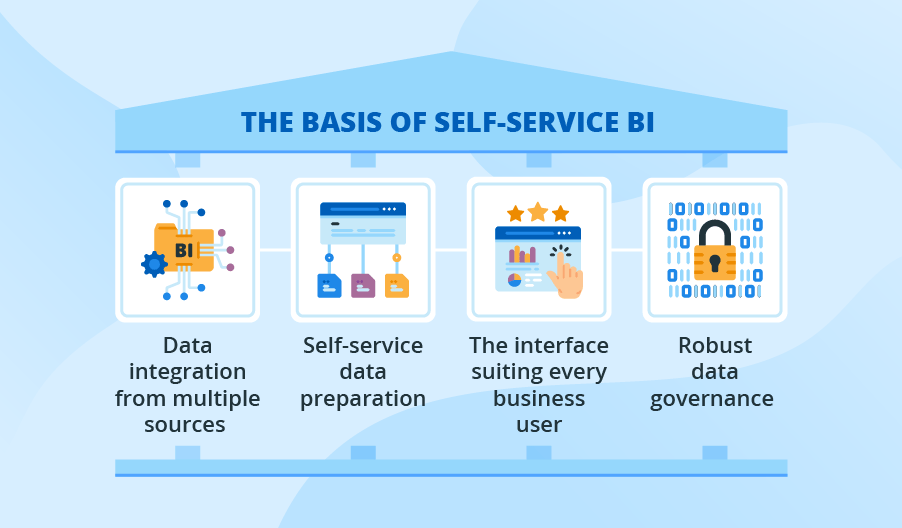
Self-service BI empowers users to explore data independently. This increases speed and engagement but also introduces variability. Different users define metrics differently. Local calculations diverge. Dashboards multiply.
Without guardrails, self-service fragments truth. According to Gartner, inconsistent metrics are a primary reason executives distrust BI outputs². Integrity erodes not because data is wrong, but because meaning is unclear.
How does governance enable self-service rather than block it?
Good governance focuses on enablement. It separates what must be standardised from what can be flexible. Core metrics, data models, and definitions are governed. Exploration and visualisation are decentralised.
This approach creates trusted foundations. Users build insights on certified data rather than reinventing logic. Governance becomes an accelerator. It reduces rework and debate, allowing self-service to scale safely.
What are the core components of BI governance?
Effective BI governance includes:
Clear metric ownership and definitions
Certified datasets and semantic models
Role-based access and security controls
Change management and versioning
Usage monitoring and quality assurance
Standards from ISO such as ISO 27001 and ISO 8000 emphasise control, accountability, and data quality as prerequisites for reliable information³. These principles apply directly to BI environments.
How should roles and responsibilities be defined?
Governance fails when roles are ambiguous. Clear accountability is essential. Data owners define meaning. Data stewards maintain quality. Platform teams manage infrastructure. Users consume and explore within boundaries.
This operating model reduces conflict. Decisions about metrics are made deliberately rather than by default. Organisations that clarify roles experience fewer disputes and faster insight delivery⁴.
How does BI governance support executive confidence?
Executives need assurance that metrics are consistent and auditable. Governance provides this confidence. Certified dashboards and datasets signal reliability.
When executives trust BI, they use it in governance forums and strategic planning. This reinforces a data culture. Without governance, BI remains peripheral. With it, analytics becomes central to decision-making.
Where does technology support BI governance?
Technology enforces governance at scale. Semantic models, certification flags, lineage tracking, and access controls operationalise policy.
Customer Science Insights supports BI governance by embedding governed metrics and datasets across analytics platforms. This ensures self-service users work from a single source of truth while retaining flexibility in analysis.
What are the risks of over-governing BI?
Over-governance slows insight and discourages adoption. Excessive approval processes push users back to spreadsheets and shadow systems.
The balance is achieved through proportionality. Govern what affects enterprise outcomes and risk. Allow flexibility where impact is local. Governance should evolve as maturity increases⁵.
How should BI governance effectiveness be measured?
Effectiveness is measured through trust and usage. Indicators include:
Reduction in duplicate or conflicting metrics
Increased use of certified datasets
Faster onboarding of new BI users
Fewer data-related escalations
These measures show whether governance is enabling rather than constraining analytics.
What are the next steps for implementing BI governance?
Start by identifying critical metrics and decisions. Define ownership. Establish certification processes. Communicate clearly to users. Iterate based on feedback.
Customer Science CX Consulting and Professional Services and Business Intelligence services support BI governance design, operating models, and change management to ensure sustainable adoption.
Evidentiary Layer
Customer Science product and service capabilities referenced in this article are based on official Customer Science documentation and solution descriptions.
FAQ
What is the goal of BI governance?
To enable fast, confident decisions by ensuring data is trusted, consistent, and secure.
Does BI governance reduce self-service?
No. It enables safe self-service by providing trusted foundations and clear boundaries.
Who should own BI governance?
Ownership should be shared across business, data, and technology with executive sponsorship.
Which Customer Science products support BI governance?
Customer Science Insights supports governed metrics, certified datasets, and consistent analytics.
How long does it take to implement BI governance?
Initial foundations can be established in weeks, with maturity developing over time.
Is BI governance only for large organisations?
No. Smaller organisations benefit from clarity and discipline as much as large ones.
Sources
McKinsey & Company. Analytics governance at scale. 2020.
Gartner. Data and analytics governance. 2021.
ISO/IEC 27001:2022 Information security management systems.
Harvard Business Review. Building trust in analytics. 2019.
OECD. Data governance frameworks. 2021.