





























Why do customer identifiers decide your CX fate?
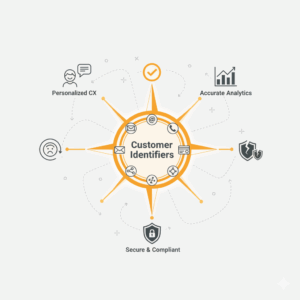
Customer identifiers shape every journey decision, from routing a service case to calculating lifetime value. When identifiers fragment across channels, leaders lose a single view, analytics degrade, and trust erodes. An identifier is any token that reliably binds a record to a person or entity across systems, such as email, phone, device ID, loyalty number, or a platform-specific UUID. Good identifiers follow data quality principles and respect privacy law definitions of personal data. The General Data Protection Regulation defines personal data as information relating to an identified or identifiable natural person, which includes direct and indirect identifiers.¹ NIST defines digital identity as a set of attributes that uniquely describe a person interacting with a digital service.² These anchor points drive matching, consent checks, and the controls that keep customer experience honest and compliant. Treat identifiers as a first-class product to improve service, analytics, and risk posture.²
What does a customer-identifier audit include?
An identifier audit validates four layers. The inventory layer lists every identifier type, its format, and where it lives. The quality layer measures completeness, uniqueness, validity, and consistency. The linkage layer evaluates how records connect across systems using deterministic keys or probabilistic signals. The governance layer checks consent, retention, and access controls against policy and regulation. Each layer should map to a reference model such as Customer 360, which consolidates profiles, events, and consent into a governed hub. A Customer 360 reference pattern usually spans source capture, standardization, matching, survivorship, and activation into channels.³ The audit confirms that each step is defined, repeatable, and testable with automated data quality rules. Great data teams encode these rules as tests that run in CI pipelines to prevent drift. Modern stacks use frameworks like Great Expectations and dbt to make tests reproducible and visible to business stakeholders.⁴ ⁵
How should leaders define identifier standards before testing?
Leaders define canonical patterns for each identifier. A UUID should comply with the IETF specification that describes layout, versioning, and randomness requirements. Version 4 UUIDs rely on random or pseudo-random numbers, which reduces collision risk when generated correctly.⁶ A consent receipt ID should be immutable and auditable. An email should be lowercased, trimmed, and validated against a robust pattern, then verified through double opt-in. A phone number should be stored in E.164 format. A loyalty number should carry a checksum and defined namespace. Storage should use a transactional layer that preserves ACID properties for concurrent writes and late-arriving events. Delta Lake implements ACID transactions and schema enforcement over data lakes to prevent partial or conflicting updates.⁷ Teams should document these standards in a public runbook and enforce them with automated tests at ingestion, modeling, and activation stages to keep semantics stable at scale.⁴ ⁵ ⁷
How do you measure identifier quality with precision?
Teams measure identifier quality with a minimal, repeatable set of metrics. Completeness tracks the proportion of records with a non-null value. Validity checks conformance to the format standard. Uniqueness quantifies duplicates within and across systems. Consistency verifies that values do not conflict across sources at the same point in time. Leaders should run these checks at three control points: source capture, integration hub, and activation layer. Great Expectations provides declarative expectations such as expect_column_values_to_match_regex and expect_column_values_to_be_unique, which translate directly into SLAs.⁴ dbt exposes generic tests and custom macros that run in analytics engineering pipelines, which allows business rules to live with models and version control.⁵ Report these metrics on an executive scorecard and link them to CX outcomes such as first contact resolution and complaint rate to demonstrate impact beyond technical compliance. Quality is a service promise, not only a data activity.⁴ ⁵
How do you find and fix duplicates across channels?
Teams resolve duplicates through record linkage. Deterministic linkage matches on exact keys such as customer_id or verified email. Probabilistic linkage assigns weights to fields such as name, address, and device fingerprints to compute a match score. The classical literature describes statistical linkage models and their modern extensions used in population and administrative data.⁸ Robust pipelines use a two-pass approach. The first pass blocks candidates by coarse keys such as normalized email domain or postal code. The second pass scores candidates and applies a threshold for merge, review, or reject. Pipelines should run on an exactly-once processing substrate to prevent duplicate merges caused by retries. Apache Kafka supports idempotent producers and transactional writes to achieve exactly-once semantics in streaming topologies.⁹ Every merge must write a survivorship decision with lineage that explains which source won and why. This audit trail protects customers and enables fast rollback.⁹
Where does privacy and consent constrain identifier usage?
Privacy rules define which identifiers you can process, for what purpose, and under what legal basis. GDPR clarifies that pseudonymised data remains personal data if re-identification is possible, which sets expectations for governance even when direct identifiers are masked.¹ The UK Information Commissioner’s Office explains that anonymisation requires irreversible de-identification and that pseudonymisation reduces risk without removing obligations.¹⁰ NIST’s guidance on identity proofing and authentication levels informs what strength of evidence you need before binding identifiers to accounts, especially in higher-risk flows.² The audit should verify consent metadata on every identifier and confirm that retention schedules and access policies reflect purpose limitation. Leaders should test deletion workflows for both direct identifiers, such as email and phone, and indirect ones, such as device IDs and IP addresses, to ensure full compliance and customer trust.¹ ² ¹⁰
Step-by-step workflow: how do you run the audit end to end?
Start with scoping. Define the systems, channels, regions, and the time window. Inventory identifier types, formats, namespaces, and generation methods. Capture the data flow from capture to activation. Validate standards. Check that formats follow the canonical definitions and that versioning is explicit. Verify storage semantics and confirm ACID guarantees on the landing and serving layers.⁷ Run quality tests. Execute completeness, validity, uniqueness, and consistency checks at each control point using automated frameworks.⁴ ⁵ Run linkage analysis. Measure duplicate rates and match precision and recall on a labeled sample. Use a two-pass method for efficiency and reliability.⁸ ⁹ Assess governance. Review consent capture, retention, and data subject rights processes, including deletion and access.¹ ¹⁰ Synthesize impact. Translate defects into CX risks and operational costs, then prioritize fixes by customer harm, regulatory risk, and business value.
What changes after the audit and who owns the fixes?
CX leaders convert audit findings into a roadmap that pairs quick wins with structural reform. Quick wins might include normalising email formats at capture, enforcing E.164 phone storage, or enabling idempotent writes on a streaming bus. Structural reform often focuses on building a governed Customer 360 pattern with clear ownership, a reference data model, and continuous testing.³ Teams codify standards as contracts, enforce them through CI, and publish a business-facing dashboard that shows identifier health and duplicate trends.⁴ ⁵ Platform teams reinforce ACID layers, schema evolution rules, and replay strategies to guard against future drift.⁷ Product owners align consent UX with regulatory expectations and publish deletion SLAs.¹ ¹⁰ Executives assign a single accountable owner for identity and data foundations and fund a sustained program. Strong ownership keeps the profile stable, the service predictable, and the brand credible.³
Which tools and patterns accelerate sustainable results?
Leaders choose tools that make rules explicit and repeatable. Great Expectations manages data validation as code with human-readable documentation for nontechnical stakeholders.⁴ dbt attaches tests to models and environments, which makes assertions part of deployment rather than an afterthought.⁵ Kafka underpins streaming integration with exactly-once semantics when configured with idempotent and transactional settings, which protects linkage workflows from duplicate side effects.⁹ Delta Lake brings ACID transactions and schema enforcement to lakehouse patterns, which supports reliable profile updates at scale.⁷ Many cloud providers publish Customer 360 reference architectures that describe capture, matching, and activation patterns across their services. These blueprints accelerate alignment and reduce integration risk.³ Choose patterns that your teams can operate. Simplicity beats novelty. Standards, tests, and governance deliver compounding returns long after the audit concludes.³ ⁴ ⁵ ⁷ ⁹
FAQ
What is a customer identifier in Customer Science terms?
A customer identifier is a token that reliably binds a record to a person or entity across systems, such as email, phone, device ID, loyalty number, or UUID. It must follow clear format standards and live within governed consent and retention controls.¹ ²
How do probabilistic and deterministic matching differ for Customer 360?
Deterministic matching uses exact keys like verified email. Probabilistic matching scores multiple fields such as name and address to estimate match likelihood and manage duplicates at scale.⁸
Which tools does Customer Science recommend for automated identifier quality tests?
Great Expectations provides declarative data quality tests and documentation. dbt attaches generic and custom tests to models for CI enforcement across analytics pipelines.⁴ ⁵
Why does ACID storage matter for identity data in a lakehouse?
ACID transactions prevent partial writes and schema drift during profile updates. Delta Lake implements ACID and schema enforcement on data lakes, which stabilises Customer 360 operations.⁷
How does GDPR affect pseudonymisation and identifier governance?
GDPR treats pseudonymised data as personal data if re-identification remains possible, which means consent, purpose limitation, and deletion rights still apply.¹ ¹⁰
Who should own the identity and data foundations remediation plan?
Executives should assign a single accountable owner for identity and data foundations who coordinates platform, analytics, and CX teams to deliver sustained quality and compliance.³
Which streaming guarantees protect record linkage from duplicate merges?
Apache Kafka supports idempotent producers and transactions that enable exactly-once semantics, which prevents duplicate effects during retries in linkage pipelines.⁹
Sources
European Union, “Regulation (EU) 2016/679 General Data Protection Regulation, Article 4,” 2016, EUR-Lex. https://eur-lex.europa.eu/eli/reg/2016/679/oj
NIST, “Digital Identity Guidelines (SP 800-63-3),” Grassi, Garcia, Fenton, 2017, National Institute of Standards and Technology. https://pages.nist.gov/800-63-3/
Google Cloud, “Building a Customer 360 with BigQuery,” 2021, Google Cloud Architecture Center. https://cloud.google.com/architecture/build-c360-bigquery
Great Expectations, “Getting Started with Data Quality Tests,” 2024, Documentation. https://docs.greatexpectations.io/
dbt Labs, “Testing in dbt,” 2024, Documentation. https://docs.getdbt.com/docs/build/tests
IETF, “RFC 4122: A Universally Unique IDentifier (UUID) URN Namespace,” Leach, Mealling, Salz, 2005, Internet Engineering Task Force. https://www.rfc-editor.org/rfc/rfc4122
Delta Lake, “ACID Transactions,” 2024, Delta.io Documentation. https://docs.delta.io/latest/delta-transaction-log.html
Winkler, William E., “Overview of Record Linkage and Current Research Directions,” 2006, U.S. Census Bureau Research Report. https://www.census.gov/library/working-papers/2006/adrm/rrs2006-02.html
Apache Kafka Project, “Exactly Once Semantics,” 2024, Kafka Documentation. https://kafka.apache.org/documentation/#semantics
Information Commissioner’s Office, “Anonymisation, pseudonymisation and privacy enhancing technologies guidance,” 2023, ICO UK. https://ico.org.uk/for-organisations/uk-gdpr-guidance-and-resources/personal-information/understanding-personal-information/anonymisation/