
A practical playbook for first-party data capture
Why should leaders prioritise first-party data capture right now?
Privacy shifts reduce the reliability of third-party identifiers. Chrome plans to phase out third-party cookies and move the market to Privacy Sandbox solutions in 2025, which makes passive tracking less effective and less consistent across channels.¹ Regulatory expectations continue to tighten. The General Data Protection Regulation defines lawful bases for processing and sets explicit consent and data minimisation requirements.² Australian Privacy Principles require transparency, purpose limitation, and consent aligned with reasonable expectations.³ Personalisation still drives growth when it respects privacy. Leaders who master first-party data create relevant experiences, reduce media waste, and increase customer lifetime value. McKinsey research links advanced personalisation with outsized revenue contribution, which validates the business case for disciplined capture.⁴ Cisco’s privacy benchmark study also shows privacy investment correlates with operational benefits and stronger trust, which further supports a first-party strategy.⁵
What is first-party data and how does it create value?
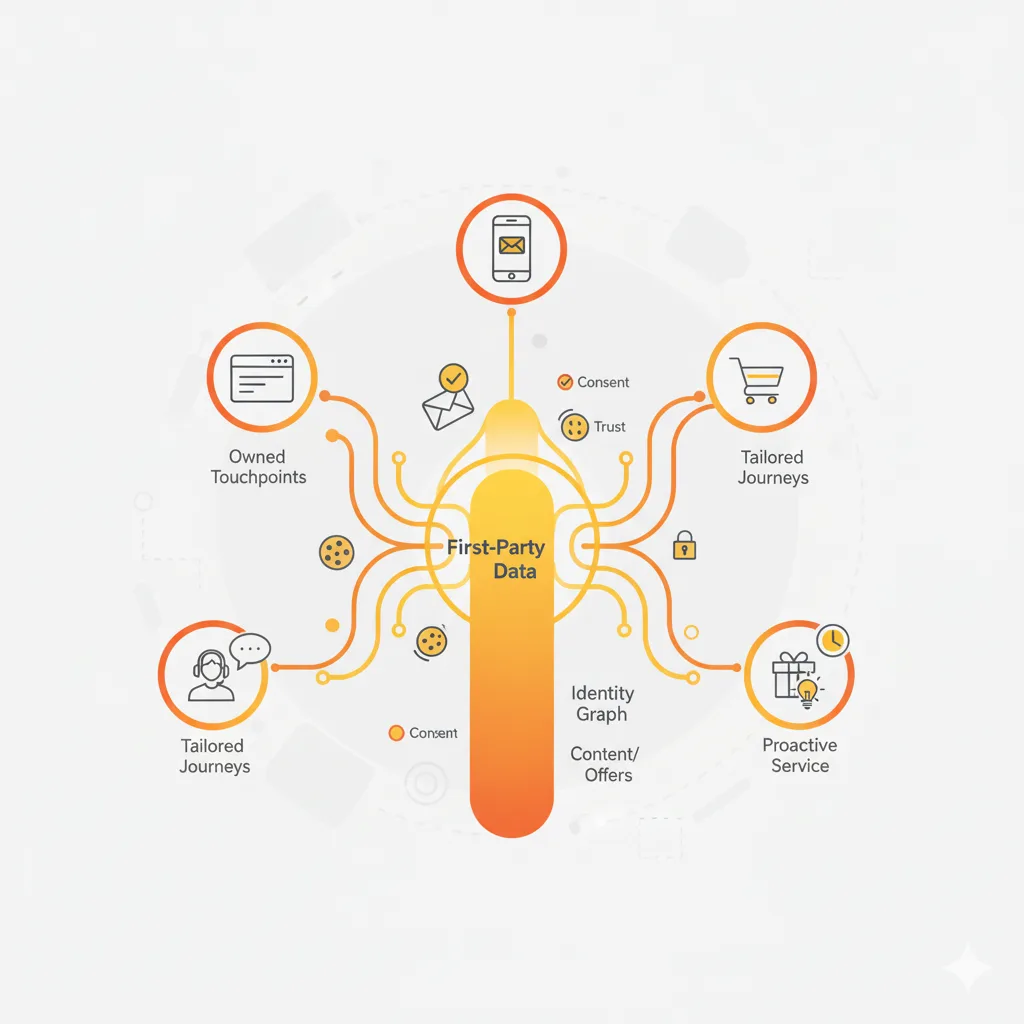
First-party data is information a brand collects directly from customers and prospects through owned touchpoints. The unit includes identifiers, preferences, behavioural events, transactions, and service interactions that customers share with consent. The enterprise uses this data to understand intent, tailor journeys, and measure outcomes across marketing and service. The advantage comes from provenance. First-party data travels with clear consent signals, reliable metadata, and direct relationships. The organisation avoids black-box brokers and reduces risk. A strong first-party spine also improves identity resolution, which connects interactions across web, app, contact centre, retail, and service channels. The brand then uses the identity graph to deliver relevant content, suppress already-purchased items, and trigger proactive service. The value increases as you improve capture quality, governance, and activation discipline.
How do you design a fair value exchange customers accept?
Teams earn data through value. The experience must give something useful in return for each attribute you request. The structure pairs a clear offer with an explicit ask. A newsletter gives insider content, early access, or pricing transparency. A profile gives faster checkout, saved preferences, or warranty coverage. A service interaction gives proactive status updates, shorter handle time, or tailored troubleshooting. Write the value in plain language. Show how the data reduces friction or increases relevance. Offer tiered benefits to avoid an all-or-nothing decision. Start with an email and one preference. Expand with progressive profiling over time. Reduce form friction with fewer fields and clear input hints, because shorter forms reliably increase completion.ⁱ⁰ The customer should always know what you will do, how you will protect it, and how to opt out. The brand should always honour choices across every channel.
Which capture tactics work across web, app, and service channels?
Organisations capture more and better data when they embed small, respectful asks into natural moments. Web teams use intent-aware modals that trigger after value demonstration, not on entry. App teams add native cards to onboarding that explain benefits in simple terms. Retail teams train staff to request identifiers at checkout only when it unlocks tangible perks. Contact centre teams integrate consent capture into authentication and service flows with short scripts and visible audit trails. Product teams implement progressive forms that unlock on repeat visits. Lifecycle marketers pair triggered emails with preference centres that let customers set frequency, topics, and channels in one place. Service leaders log root causes and resolutions with structured tags, then connect these events to profiles. Each tactic aligns with the same standards. Ask for what you need, explain why, store with consent, and make revocation easy.
How should you handle consent, identity, and governance without friction?
Consent management needs to be explicit, granular, and portable. Legal and CX teams define purposes in customer-friendly language, then map those purposes to trackers, forms, and APIs. Modern consent platforms record proof, propagate preferences to downstream systems, and refresh signals on schedule. Identity resolution needs deterministic links first, with carefully governed probabilistic methods second. Customer identity and access management protects login flows and unifies authentication across devices. Data clean rooms enable privacy-preserving collaboration with partners when you need aggregated reach or measurement.⁶ Security controls should align to ISO 27001 to reduce cyber risk and simplify assurance.⁷ Privacy engineering should align to the NIST Privacy Framework to translate principles into technical controls and testing.⁸ These anchors keep the programme compliant and resilient while product teams continue to ship value.
What measurement framework proves value without creepiness?
Leaders measure capture on three planes. The first plane is quality. Measure consent rate by purpose, identifier match rate, profile completeness by attribute, event schema conformance, and deduplication accuracy. The second plane is performance. Measure contribution to conversion, upsell, retention, and service resolution. The third plane is risk. Measure time to honour opt-out, data minimisation ratios, incident rate, and privacy request cycle time. Create a balanced scorecard that reports at journey, segment, and enterprise level. Tie each metric to a threshold and a trend. Build causal stories that show how capture quality improves personalisation, which improves outcomes. Connect the dots in a single narrative so executives can see trade-offs. Report in weeks, not quarters, to maintain momentum. Share wins with customers through visible improvements, such as fewer irrelevant messages and faster service.
How do you turn policy into practical design patterns?
Teams convert policy into patterns that engineers and designers can reuse. Cookie banners become lightweight drawers with plain language and equal visual weight on Accept and Manage. Consent settings become a first-class menu item in account and app settings. Preference centres become mobile-first pages with toggles per channel and topic. Forms become progressive, with inline validation and example text. Copy becomes verbs and benefits, not legalese. Service scripts become short and specific. Identity prompts become contextual and optional when risk is low. QA becomes automated checks that block releases if a consent purpose is missing. Training becomes short videos that show the pattern, the why, and the metrics it moves. Leaders publish pattern libraries, code snippets, and governance rules so teams can ship faster without re-debating fundamentals.
What risks should executives anticipate and how can teams mitigate them?
The most common risks are ambiguous consent, shadow tags, over-collection, identity sprawl, and insecure endpoints. Executives should expect rising expectations from platforms as well. Apple’s AppTrackingTransparency framework requires explicit permission for cross-app tracking and changes how mobile campaigns operate.⁹ Teams reduce these risks with three moves. First, they shift from implied to explicit consent with plain language and audit logs. Second, they inventory tags and SDKs, remove the unnecessary, and align each to a documented purpose. Third, they standardise identity keys and rotate secrets on a fixed schedule. They also run quarterly privacy drills to test deletion, subject access, and breach response. These drills improve muscle memory and expose gaps. Leaders set the tone by linking privacy outcomes to performance reviews and vendor contracts. The goal is fewer surprises and faster, safer delivery.
How do you deliver results in the first 90 days?
Executives start small, pick a journey, and build a credible win. The team chooses a target, such as email capture on product detail pages or consent refresh in the app. The team documents the value exchange, designs the pattern, and instruments the analytics. The team trains front line staff if the journey is assisted. The team sets a pre-launch baseline and a hard stop if consent events or quality checks fail. The team pilots for two weeks, reads the signals, and ships improvements. The team then publishes the uplift and the privacy results in one view. The team finally writes the play into the pattern library and scales it to the next journey. The programme grows through a loop of design, test, learn, and standardise. The loop builds trust because customers see better experiences and fewer irrelevant asks.
What does a mature first-party data operating model look like?
A mature model aligns roles, rhythms, and roadmaps. Product owns patterns and backlog. Engineering owns instrumentation and APIs. Data owns taxonomy, identity graph, and quality. Legal and privacy own policy and assurance. Marketing and service own activation and feedback loops. Executives set targets and fund the platform. Quarterly business reviews focus on the scorecard and the next three journeys. Vendor strategy prefers modular capabilities such as consent, identity, CDP, and clean rooms over monoliths. The operating cadences enforce a simple rule. Capture only what you need, explain why you need it, and use it to deliver visible value quickly. The culture treats privacy as design, not a bolt-on. The business earns the right to ask for more by proving value with less.
What are the practical tools and platforms you should evaluate?
Organisations typically assemble a stack that includes a consent and preference platform, a customer identity and access layer, an event collection pipeline, and a profile store or CDP. Data clean rooms enable collaborative reach and measurement without sharing raw data.⁶ Security and privacy management align to ISO 27001 controls and the NIST Privacy Framework to reduce audit friction and improve resilience.⁷ ⁸ Teams should prioritise open schemas, real-time ingestion, low-code audiences, and strong SDK governance. They should favour vendors that publish transparent documentation, clear data retention policies, and proven deletion workflows. They should test each platform against the measurement framework, not only feature lists. The right stack is the one your teams can operate safely and the one your customers can understand.
What impact should executives expect within one to two quarters?
Leaders should expect higher consent rates, better match rates, cleaner profiles, and improved campaign and service outcomes. Leaders should also expect fewer complaints, faster deletion cycles, and easier audits. Teams should see lower media waste due to better suppression and more accurate audiences. Teams should see service handle time improvements as identity and context transfer across channels. The organisation should feel more confident in product releases because consent and privacy tests are automated. The brand should see stronger trust signals as customers receive fewer irrelevant messages and more helpful updates. The result is a compounding asset. First-party data becomes the engine for continuous learning that respects people and pays off for the business.
FAQ
What is first-party data in CustomerScience projects at customerscience.com.au? First-party data is information a brand collects directly from customers and prospects through owned channels, including identifiers, preferences, behavioural events, transactions, and service interactions gathered with explicit consent and clear purposes.
Why is first-party data capture urgent for Australian enterprises? Privacy changes, including Chrome’s third-party cookie phaseout and requirements under the Australian Privacy Principles, reduce the reliability of third-party data and increase the need for transparent value exchanges and consented capture.
How should Customer Science clients design a value exchange that boosts consent? Teams should pair a clear benefit with each data element, reduce form friction, use progressive profiling, and provide simple preference controls that customers can change at any time.
Which platforms matter for identity and consent at scale? Enterprises should evaluate consent and preference platforms, customer identity and access management, a customer data platform or profile store, event pipelines, and privacy-preserving data clean rooms that enable collaboration without exposing raw data.
How do executives at contact centres measure first-party data success? Leaders track quality metrics such as consent rates and profile completeness, performance metrics such as conversion and service resolution, and risk metrics such as opt-out cycle time and incident rate, all reported by journey and purpose.
Which frameworks guide secure and compliant operations? ISO 27001 provides security controls for confidentiality, integrity, and availability, while the NIST Privacy Framework turns privacy principles into engineering tasks and tests that product teams can run.
What early wins can Customer Science deliver within 90 days? Typical wins include uplift in email capture on high-intent pages, improved consent refresh in mobile apps, faster preference updates, and reduced media waste from better audience suppression and identity resolution.
Sources
-
Privacy Sandbox timeline update - Google Chrome team - 2024 - Google Privacy Sandbox - https://privacysandbox.com/intl/en_au/news/timeline/
-
General Data Protection Regulation, Regulation (EU) 2016/679 - European Parliament and Council - 2016 - EUR-Lex - https://eur-lex.europa.eu/eli/reg/2016/679/oj
-
The Privacy Act and Australian Privacy Principles - Office of the Australian Information Commissioner - 2024 - OAIC - https://www.oaic.gov.au/privacy/the-privacy-act
-
The value of getting personalisation right - McKinsey & Company - 2021 - McKinsey Insight - https://www.mckinsey.com/capabilities/growth-marketing-and-sales/our-insights/the-value-of-getting-personalization-right
-
2023 Data Privacy Benchmark Study - Cisco - 2023 - Cisco Trust Centre - https://www.cisco.com/c/en/us/about/doing_business/trust-center/privacy/bdg-privacy-benchmark-study.html
-
What is a data clean room - IAB Tech Lab - 2022 - IAB Tech Lab - https://iabtechlab.com/blog/what-is-a-data-clean-room/
-
ISO/IEC 27001 Information security management - ISO - 2022 - International Organization for Standardization - https://www.iso.org/standard/27001.html
-
NIST Privacy Framework: A Tool for Improving Privacy through Enterprise Risk Management - National Institute of Standards and Technology - 2020 - NIST - https://www.nist.gov/privacy-framework
-
User Privacy and Data Use, including AppTrackingTransparency - Apple - 2024 - Apple Developer - https://developer.apple.com/app-store/user-privacy-and-data-use/
-
Checkout Flow Average Form Fields - Baymard Institute - 2023 - Baymard - https://baymard.com/blog/checkout-flow-average-form-fields