




















Why do reliability runbooks matter for customer experience?
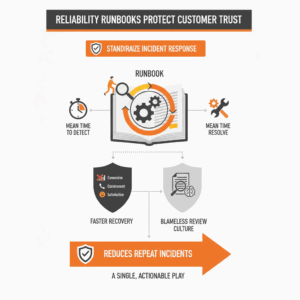
Leaders protect customer trust when they standardize incident response. A reliability runbook turns scattered know-how into a single, actionable play that shortens mean time to detect and mean time to resolve. Teams that practice from clear plays recover faster and with less variance, which preserves conversion, containment and satisfaction during service degradation. Industry handbooks show that prepared incident response reduces time to mitigation because responders do not improvise the first move under stress.¹ A runbook also anchors a blameless review culture by making expected behaviors explicit. Reviews become a feedback loop on a living document rather than a hunt for individual fault, which increases learning velocity and reduces repeat incidents.²
What is a reliability runbook?
A reliability runbook is a stepwise guide that describes how to detect, diagnose, mitigate and recover from a defined failure scenario. The unit includes triggers, decision trees, communication templates, rollback plans and guardrails. In modern operations, this runbook sits beside service level objectives, error budgets and escalation policies so that responders can connect customer impact to technical actions. SRE practice defines incident response as coordinated actions across roles, timelines and communications, and it emphasizes clear ownership and logging for every step.¹ A complete runbook also references the incident lifecycle from preparation through lessons learned so the response remains consistent with established security and risk guidance.⁵
How does this playbook fit enterprise CX and data reliability?
Executives align runbooks to journeys and data flows, not only to systems. Customer experience depends on data quality and lineage across channels, platforms and vendors. A runbook that maps to journeys starts from the customer symptom, such as failed checkout or missing bill, then traces upstream services and data pipelines. Standard data quality dimensions help teams name the problem correctly. Accuracy, completeness, consistency and timeliness provide a shared vocabulary for both business and engineering, which reduces ambiguity during triage.⁶ Data lineage practices show where a field originated, how it transformed and which downstream services consume it, which speeds root cause analysis and targeted rollback. Open standards like OpenLineage document lineage metadata across tools, which makes this mapping portable across the stack.⁷
What are the core components of a high-leverage runbook?
Leaders ship runbooks with eight essentials. First, define the scenario and scope so responders know when to open the play. Second, state service level objectives and related error budget so the team can make trade-offs. Third, provide detection queries, dashboards and thresholds. Fourth, include a decision tree with stop conditions and rollback triggers. Fifth, publish comms templates for executives, customers and regulators. Sixth, list role assignments and paging paths. Seventh, include verification steps to confirm recovery. Eighth, capture links to logs, traces and tickets for audit. These elements mirror proven incident response structures that stress rapid triage, clear command and post-incident learning.¹⁵ Teams that measure against the DevOps “four key” metrics reinforce reliability as an outcome, not a hope. Deployment frequency, lead time for changes, change failure rate and time to restore service correlate with performance across environments.³
How do you build the first runbook in one week?
Teams deliver a usable version quickly by scoping tightly. Pick one customer-critical scenario such as “payments timeout over 90 seconds for more than 2 percent of attempts.” Draft a single page with an SVO lead for each step: Detect spike. Triage services. Contain exposure. Recover service. Communicate impact. Validate fix. Record learning. Pull detection queries directly from your current telemetry and align them with alert thresholds. Use OpenTelemetry to instrument a minimal span set and trace IDs from the edge to the core so responders can follow a single transaction across services.⁴ Use the NIST lifecycle as a checklist to ensure the runbook includes preparation, detection, containment, eradication, recovery and post-incident activity.⁵ Ship the document, rehearse it with a tabletop exercise and schedule a revision within two weeks.
How do you operationalize SLOs, error budgets and decision rights?
Executives create clarity when they connect SLOs to budget policies and decision rights. An SLO expresses the level of reliability a customer expects, and an error budget represents the allowed amount of unreliability in a period. When a service consumes the budget, change policy tightens and work shifts to reliability until the budget recovers. This mechanism avoids subjective debates during incidents and aligns engineering behavior with customer outcomes. The SRE corpus provides tested guidance on writing SLOs, defining user journeys and tying budgets to release gates and rollbacks.¹ Leaders should publish a single decision record that states who can declare an incident, who can roll back, who can communicate externally and who closes the incident. This structure reflects standard incident command patterns that reduce confusion when stress rises.¹
What does “detect, triage, mitigate, recover” look like in practice?
Responders follow a four-beat rhythm. Detect with crisp, customer-expressed signals and clear thresholds. Triage by checking recent changes, comparing golden signals and running differential queries. Mitigate by isolating blast radius, rate limiting or toggling a feature flag while rollback preparations proceed. Recover by executing the chosen fix, then verifying through customer-visible paths first. This rhythm maps well to the DevOps measurement model because it shortens time to restore service and reduces change failure rate when paired with automated rollback.³ The incident lifecycle guidance from NIST adds discipline around containment and eradication for security-flavored events, which often present first as availability or data quality symptoms in customer channels.⁵
How do you embed data quality and lineage in runbooks?
Leaders turn abstract data governance into operational muscle by adding concrete checks. For each scenario, list the fields that must remain accurate, complete, consistent and timely to protect the journey. For example, a billing incident runbook should include validation of account identifier formats, reconciliation of totals and freshness thresholds for invoice data. Clear lineage diagrams show which upstream tables and transformations feed the affected fields. OpenLineage provides a vendor-neutral way to capture and query this metadata across orchestrators and warehouses, which speeds diagnosis and prevents blind spots when platform teams change tools.⁷ Authoritative definitions help business and engineering teams align language and reduce misclassification during pressure.⁶
How should teams practice and learn?
Teams get better by rehearsing. Tabletop exercises walk through the runbook with a realistic scenario, real dashboards and a time limit. Leaders encourage speaking in simple SVO sentences to cut ambiguity. After every live or simulated incident, teams run a blameless review that focuses on system conditions, decision points and improvements to the runbook. Atlassian’s incident handbook offers a practical pattern for these reviews and emphasizes shared accountability.² Reviews produce action items, owners and due dates. The runbook updates as a versioned artifact so changes remain auditable. Over time, this loop raises signal quality, improves first-move accuracy and reduces the variance of recovery times.
Which metrics prove reliability runbooks are paying off?
Executives prove value with a small, balanced set. Track the DevOps four key metrics to understand delivery health.³ Track incident indicators like mean time to detect, mean time to mitigate and mean time to restore to understand service resilience. Track customer indicators like conversion loss avoided, containment rate held, net promoter score stability and contact rate deflection during incidents to connect operations to experience. Tie each metric to a specific dashboard and target. SRE and DevOps guidance underscore the value of observable, automatable measures that leaders can inspect weekly without ceremony.¹³ When data quality is involved, include accuracy rate for critical fields, data freshness lag and lineage coverage so the analytics platform does not hide risk behind averages.⁶⁷
What is the step-by-step template for your next runbook?
Leaders can start from a consistent template and adapt locally. Name the scenario and outcome. State SLOs and error budget. List triggers and thresholds. Provide a detection checklist with queries and dashboards. Include a triage decision tree and a mitigation menu. Define rollback criteria and commands. Publish comms templates for customers, executives and partners. Specify roles, paging and escalation. Add verification steps with customer-visible checks. Close with a post-incident review checklist and links to tickets, logs, traces and lineage. This structure borrows heavily from the SRE incident response model and the NIST lifecycle so it remains portable across teams and compliant with enterprise standards.¹⁵
What should you do next?
Executives can pick one journey, one scenario and one week to create the first runbook. Appoint an owner. Pull real detection queries. Write an SVO-led decision tree. Rehearse with the full team. Measure time to restore service and customer impact before and after. Use the learning to scale to the top five scenarios across journeys. This small start creates momentum, reduces conflict during incidents and proves that reliability runbooks are not documentation for auditors. They are muscle for protecting customer trust.
FAQ
How does a reliability runbook improve customer experience at scale?
A reliability runbook shortens detection and recovery times by giving responders a repeatable play tied to customer-visible symptoms, which preserves conversion and satisfaction during incidents.¹
What is the difference between an SLO and an error budget in this playbook?
An SLO defines the level of reliability customers expect for a service, while an error budget is the allowable unreliability within a period that guides change policy and rollback decisions.¹
Which metrics should executives track to prove runbook value?
Leaders should track deployment frequency, lead time for changes, change failure rate and time to restore service, along with incident and customer indicators that show resilience and business impact.³
Why include data quality and lineage steps in every runbook?
Customer experience failures often originate in data defects. Using dimensions like accuracy, completeness, consistency and timeliness plus lineage mapping speeds root cause analysis and prevents repeat incidents.⁶⁷
How do OpenTelemetry and OpenLineage help responders?
OpenTelemetry standardizes traces, metrics and logs for end-to-end visibility, while OpenLineage standardizes lineage metadata across tools so teams can trace data flows during triage.⁴⁷
Who owns the runbook in an enterprise setting?
An assigned service owner maintains the runbook, ensures rehearsals happen and integrates lessons learned after incidents, aligned with SRE incident response practices.¹
Which frameworks shape the incident lifecycle in this approach?
This playbook aligns with Google’s SRE incident response guidance and the NIST incident handling lifecycle to standardize preparation, detection, containment, recovery and learning.¹⁵
Sources
-
Site Reliability Engineering: Incident Response. Betsy Beyer, Chris Jones, Jennifer Petoff, Niall Richard Murphy (eds.). 2016. O’Reilly / Google SRE Book. https://sre.google/sre-book/incident-response/
-
Incident Management Handbook. Atlassian. 2024. Atlassian. https://www.atlassian.com/incident-management
-
DevOps Research and Assessment: The Four Keys to DevOps Metrics. Google Cloud. 2020. Google Cloud Architecture. https://cloud.google.com/architecture/devops/devops-measurement
-
OpenTelemetry Documentation: Overview. OpenTelemetry Authors. 2025. CNCF. https://opentelemetry.io/docs/
-
Computer Security Incident Handling Guide (SP 800-61 Rev. 2). Paul Cichonski, Tom Millar, Tim Grance, Karen Scarfone. 2012. NIST. https://csrc.nist.gov/publications/detail/sp/800-61/rev-2/final
-
What is Data Quality?. IBM. 2025. IBM Knowledge Center. https://www.ibm.com/topics/data-quality
-
OpenLineage: An Open Standard for Metadata and Lineage. OpenLineage Community. 2025. OpenLineage. https://openlineage.io/