





























Why does next-best-offer eligibility decide whether personalization works?
Eligibility rules decide who can safely and profitably receive an offer. Eligibility is the gate between aspiration and execution. Organizations often jump to modeling and ranking, then wonder why great models fail in production. The issue is not only prediction accuracy. The issue is whether the decisioning fabric knows who is allowed, ready, and contextually fit to receive a next-best-offer. Leaders who treat eligibility as a first-class design concern improve customer satisfaction and revenue while reducing cost to serve. Independent studies show AI-powered “next best experience” programs can lift satisfaction by 15 to 20 percent, revenue by 5 to 8 percent, and reduce cost to serve by 20 to 30 percent.¹
What exactly is NBO eligibility?
Eligibility is a declarative set of conditions that must be true before an offer or action can enter the candidate set for a specific customer at a specific moment. In practice, eligibility combines policy constraints, customer permissions, risk checks, capacity limits, channel readiness, and contextual fit. Eligibility is not the same as propensity. Propensity estimates likelihood to respond. Eligibility determines whether the offer can legally, ethically, and operationally be shown. When you separate eligibility from propensity and prioritization, you improve stability, auditability, and speed to market. Robust eligibility prevents downstream conflicts, like serving a credit offer to an ineligible profile or promoting an out-of-stock product.
How do privacy and consent shape eligibility?
Privacy obligations define the lawful basis and channel rules for outreach. Under GDPR and UK GDPR, processing personal data requires a lawful basis, commonly consent or legitimate interests for direct marketing.² In electronic channels, PECR rules and regulator guidance often make explicit consent the appropriate basis, especially for email and SMS.³ In California, the CCPA and its regulations grant consumers rights to know, delete, and opt-out of sale or sharing, which should feed directly into eligibility flags.⁴ ⁵ Treating consent state, channel permissions, and “do not sell/share” preferences as hard eligibility checks is non-negotiable for compliant decisioning.
Where does uplift modeling and experimentation fit?
Eligibility sets the floor. Uplift modeling then targets incremental impact rather than raw response. Uplift, or treatment-effect modeling, predicts the change in outcome caused by showing an offer, not just the likelihood of response if shown.⁶ ⁷ Modern uplift approaches extend to multiple treatments and cost constraints, which is critical when eligibility prunes the option set unevenly across segments.⁸ Leaders pair uplift models with randomized holdouts to estimate true incremental value and to detect “harm segments” where offers suppress desired outcomes. Rigorous experimentation keeps eligibility honest by surfacing where rules are too strict or too loose.⁶
What does a production-grade eligibility architecture look like?
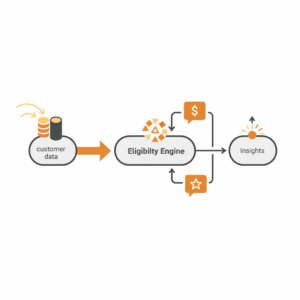
Architects build an Eligibility Service that evaluates rules in real time. This unit receives a customer identity, context events, and a pool of potential offers, then returns the subset that passes policy, risk, consent, and supply checks. A typical design includes: a governed rule store; a feature store for identity, risk, and behavioral features; a streaming context layer for events; and connectors to inventory, credit, and capacity systems. Event streaming platforms such as Kafka centralize context ingestion and make real-time decisions possible across channels.⁹ ¹⁰ Eligibility executes first, then ranking models and optimization choose the best action from the eligible set. This separation keeps compliance deterministic while letting data science innovate on prioritization.
How do we encode eligibility without slowing the business?
You encode eligibility as policy-as-code with human-readable rules. Start with a canonical schema: identities, consents, channel permissions, credit or risk flags, lifecycle stage, product holdings, service commitments, and inventory state. Create categories of rules:
Hard policy rules: consent required, do-not-contact, age and jurisdiction restrictions, credit or risk prohibitions. These are binary and auditable.² ³ ⁵
Operational capacity rules: throttle limits, agent availability, service-level protection windows, back-order status.
Contextual fit rules: recency windows after a complaint, exclusion during open service tickets, channel-specific constraints.
Fairness and guardrails: protected-class constraints, frequency caps, and customer experience safeguards.
Use versioned rule sets with effective dates, owner, and rationale. Implement “explain” endpoints that return which rules passed or failed for a given decision. Pair this with model explanations such as SHAP for the subsequent ranking step to meet transparency requirements.¹¹ ¹²
What is the minimal viable data for NBO eligibility?
You do not need a perfect Customer 360 to start. You need a trustworthy core:
Customer identity and deduplication: stable identifiers, account links, and household logic to avoid duplicate outreach.
Consent and channel permissions: granular and channel-specific, with timestamp, source, and scope.² ³ ⁵
Risk and compliance flags: credit eligibility, KYC status, segment exclusions.
Holdings and service state: current products, open tickets, SLA status.
Inventory and offer availability: SKU stock, pricing validity, geographic coverage.
Context stream: session activity, recent interactions, and trigger events via an event bus.⁹
Start with these tables in your identity and data foundation, and grow iteratively. Each week, retire a manual exception and encode it as a rule.
How do we choose among eligible offers in real time?
After eligibility filters the pool, you rank candidates for impact and experience. Combine causal uplift scores with business objectives using constrained optimization. In the simplest case, compute expected incremental value minus cost by offer and select the top. In complex portfolios, use mathematical optimization to respect budget, channel capacity, and fairness constraints while maximizing total incremental value.¹³ Where exploration matters, contextual bandit algorithms balance learning and earning by allocating traffic to promising offers while honoring constraints.¹⁴ ¹⁵ Bandits are not a replacement for eligibility. They sit downstream, drawing from the eligible set and feeding learning back into models and rules.
How do we measure success without gaming the system?
You measure the end-to-end decision, not isolated model AUC. Use randomized control groups and eligibility-aware experiments:
Incremental revenue and satisfaction: primary effect sizes estimated at the customer level.¹
Guardrail metrics: complaint rate, churn, service backlog growth, and fairness indicators.
Crowding-out checks: detect whether a high-pressure sales offer suppresses long-term value or service recovery.
Rule coverage and leakage: percent of traffic blocked by hard rules, false positives where ineligible offers slipped through, and false negatives where rules were overly strict.
Explainability audits: sample decisions must link to rule versions and model explanations using SHAP or similar methods.¹¹ ¹²
What common traps derail NBO eligibility?
Teams stumble when they encode eligibility in ten places. Put rules in one governed service. Avoid embedding consent checks in journey tools and again in the website. Another trap is treating inventory as an afterthought. Make inventory a first-class eligibility input to avoid marketing what you cannot fulfill. Do not collapse policy and scoring. When rules and models blend, auditors cannot reconstruct a decision. Finally, do not skip exploration. If you never test alternative offers, you will ossify the portfolio and accumulate bias. Contextual bandits or structured test schedules keep learning alive without violating constraints.¹⁴ ¹⁵
What is the step-by-step playbook to ship in 90 days?
Leaders ship a narrow, well-governed slice.
Define the eligible universe. List top ten offers, their hard eligibility rules, and evidence sources. Write each rule with owner, rationale, and test cases.
Stand up the Eligibility Service. Expose evaluate and explain endpoints. Store decisions with rule versions and inputs for audit.
Wire the context. Stream session and interaction events into Kafka topics. Create materialized views of “latest consent,” “open ticket,” and “inventory by region.”⁹ ¹⁰
Instrument experimentation. Configure holdouts, guardrails, and attribution for incremental lift.⁶ ⁸
Deploy uplift or baseline ranking. Start with heuristic prioritization if needed, then introduce uplift models. Use SHAP to document important drivers.¹¹ ¹²
Add constrained optimization. Introduce budget, capacity, and fairness constraints as you scale.¹³
Operationalize governance. Run weekly rule councils, retire manual exceptions, and track rule coverage, leakage, and appeal handling.
How does this approach improve customer and business outcomes?
Clear eligibility improves trust. Customers receive relevant offers only when they have consented and when the organization can deliver. Service costs fall because you reduce complaint drivers and rework. Commercial value rises because models learn on cleaner, policy-compliant data. External research and field results indicate that well-run next-best-experience programs deliver measurable lifts in satisfaction, revenue, and cost efficiency.¹ The eligibility foundation makes those gains durable, auditable, and scalable across channels.
FAQ
What is next-best-offer eligibility and why does it matter for CustomerScience clients?
Eligibility is the set of policy, permission, risk, capacity, and context checks that an offer must pass before ranking. It protects customers, ensures compliance, and improves model performance by filtering out options you cannot or should not show. This foundation enables sustainable gains in satisfaction, revenue, and cost to serve.¹ ² ⁵
How does GDPR or CCPA/CPRA change my eligibility rules?
GDPR and UK GDPR require a lawful basis for processing, often consent or legitimate interests for direct marketing; PECR can make consent mandatory for electronic channels.² ³ CCPA and its regulations grant rights to know, delete, and opt out of sale or sharing; these rights must map to hard eligibility flags in decisioning.⁴ ⁵
Which algorithms help once offers are eligible?
Use uplift modeling to target incremental impact rather than raw response, and use contextual bandits to balance exploration and exploitation across eligible offers. These methods work downstream of hard rules and improve learning without violating constraints.⁶ ⁸ ¹⁴ ¹⁵
How should CustomerScience wire real-time context for eligibility checks?
Adopt an event-stream architecture, commonly with Kafka, to ingest consent updates, service events, and inventory changes, then evaluate eligibility in a stateless service. Stream-native materialized views keep “latest consent” and “open ticket” states fresh for every decision.⁹ ¹⁰
Why use SHAP or similar explainability for decisions?
Eligibility needs deterministic explanations of which rules passed or failed. Ranking models need feature-level explanations to satisfy transparency, debugging, and governance. SHAP provides a unified framework for interpreting complex model predictions.¹¹ ¹²
Who owns the rules and how are they governed?
Business and compliance teams own hard rules with clear rationale and effective dates. Data science owns scoring and optimization. Architecture provides the service. A weekly rule council reviews leakage, coverage, and appeals, then iterates safely.
Which metrics prove that eligibility is working?
Track incremental revenue and satisfaction, guardrails such as complaint and churn rates, rule coverage and leakage, and explainability audit pass rates. Pair these with randomized control groups to avoid over-attributing gains.⁶ ¹
Sources
Next best experience: How AI can power every customer interaction — McKinsey & Company, 2025, Growth, Marketing & Sales. https://www.mckinsey.com/capabilities/growth-marketing-and-sales/our-insights/next-best-experience-how-ai-can-power-every-customer-interaction
A guide to lawful basis — Information Commissioner’s Office (UK), 2022. https://ico.org.uk/for-organisations/uk-gdpr-guidance-and-resources/lawful-basis/a-guide-to-lawful-basis/
Marketing and data protection in detail — Information Commissioner’s Office (UK), 2022. https://ico.org.uk/for-organisations/advice-for-small-organisations/direct-marketing-and-data-protection/marketing-and-data-protection-in-detail/
California Consumer Privacy Act (CCPA) — State of California, Department of Justice, 2024. https://oag.ca.gov/privacy/ccpa
CCPA Regulations — State of California, Department of Justice. https://oag.ca.gov/privacy/ccpa/regs
Radcliffe, N. & Surry, P. Real-World Uplift Modelling with Significance-Based Uplift Trees, 2011, Stochastic Solutions (white paper). https://stochasticsolutions.com/pdf/sig-based-up-trees.pdf
Fang, X. Uplift Modeling for Randomized Experiments and Observational Data, 2018, MIT (thesis). https://dspace.mit.edu/bitstream/handle/1721.1/115770/1036987550-MIT.pdf
Zhao, Z. et al. Uplift Modeling for Multiple Treatments with Cost Optimization, 2019, arXiv. https://arxiv.org/pdf/1908.05372
Build real-time Kafka dashboards — Confluent, 2025. https://www.confluent.io/blog/build-real-time-kafka-dashboards/
Real-time streaming architecture examples and patterns — Confluent Learn. https://www.confluent.io/learn/real-time-streaming-architecture-examples/
Lundberg, S. & Lee, S. A Unified Approach to Interpreting Model Predictions, 2017, NeurIPS. https://proceedings.neurips.cc/paper/7062-a-unified-approach-to-interpreting-model-predictions.pdf
Lundberg, S. & Lee, S. A Unified Approach to Interpreting Model Predictions, 2017, arXiv. https://arxiv.org/abs/1705.07874
Shmueli, G. et al. (via WUSS) Next Best Offer (NBO): Lessons Learned, 2017, Western Users of SAS Software. https://www.lexjansen.com/wuss/2017/36_Final_Paper_PDF.pdf
Bubeck, S. & Cesa-Bianchi, N. Regret Analysis of Stochastic and Nonstochastic Multi-armed Bandit Problems, 2012, Foundations and Trends in Machine Learning. https://arxiv.org/abs/1204.5721
Bubeck, S. & Cesa-Bianchi, N. Regret Analysis of Stochastic and Nonstochastic Multi-armed Bandit Problems, 2012, Foundations and Trends in Machine Learning (ebook). https://www.nowpublishers.com/article/DownloadEBook/MAL-024