
Capability
Benefits Realisation
Organisations invest in projects to change what they can do, and expect the benefits to justify the cost. Benefits realisation is the discipline that makes sure they actually land.
What it is
Benefits do not appear because a project finished on time
Organisations invest in projects to achieve changes to their organisational capability, expecting that the benefits realised will improve the bottom line and justify the expenditure. The practice of benefits realisation is regarded as a critical success factor in all international standards for project delivery.
Benefits should follow whenever organisational capability changes, but this is not a guaranteed outcome. A benefits management plan needs to be applied throughout the life of a project, and benefits realisation is best structured as a distinct discipline: its own stream within a project, often managed consistently across several projects at once. When project goals change, as they inevitably do, this approach keeps the impact on benefits part of the decision, so benefits stay aligned and relevant to the business.
Our approach
Four categories of benefit, tracked differently
Financial benefits
Measurable in financial terms.
Quantifiable benefits
Measurable in non-financial terms.
Recognisable benefits
Measurable only via indirect measures.
Intangible benefits
Improvements that cannot be measured directly.
The lifecycle
Realisation continues after the project team leaves
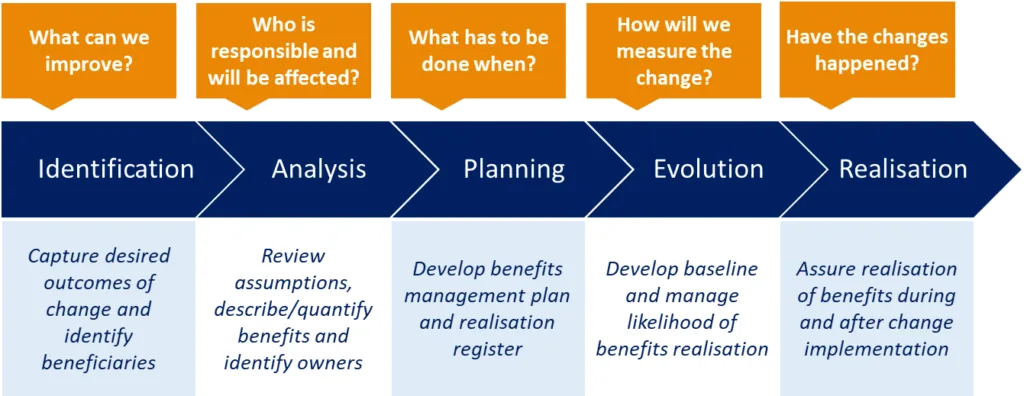
One element of the benefits management framework is that realisation continues well beyond the lifecycle of the project, and the project team, that delivers the capability change. We pragmatically adapt this approach for each client, and this ongoing realisation into an often-moving business environment has to be actively managed, not assumed.
Governance
Reported on, not just assumed
Governance for benefits management must integrate at the highest levels, with senior executive buy-in and ownership of benefits. Progress on benefits, or the lack of it, needs to be reported on regularly, so management has an overview of actual project outcomes and not just an on-time, on-budget delivery status.
Benefits realisation sits inside our value management practice
See how it fits alongside business cases, value tracking and governance, or book a discovery call to talk about your own program.