






















Hybrid work requires more than collaboration tools. It depends on a resilient technology stack that supports productivity, security, and performance across physical and remote environments. Organisations that align infrastructure, automation, and data insight achieve higher workforce engagement, lower operating risk, and measurable cost efficiency, while maintaining service quality at scale.
Definition: What are hybrid work technology requirements?
Hybrid work technology requirements describe the integrated set of systems that enable employees to work effectively across office, home, and distributed locations. These requirements span infrastructure, collaboration platforms, security controls, automation, and performance analytics.
At a minimum, remote work infrastructure must support secure access to systems, reliable communication, and consistent user experience. At scale, hybrid work technology extends to identity management, workflow automation, data governance, and workforce insight. Without this foundation, organisations experience productivity loss, compliance exposure, and fragmented employee experience¹.
Context: Why has hybrid work changed enterprise technology strategy?
Hybrid work is now an operating model, not a temporary adjustment. Australian and global workforce studies show that more than 70 percent of knowledge workers expect ongoing location flexibility². This shift places sustained demand on enterprise systems that were designed for centralised offices.
Legacy office technology struggles under distributed usage. VPN congestion, unmanaged endpoints, shadow IT, and inconsistent collaboration tools create operational friction. Leaders are responding by redesigning digital workplaces around cloud-first infrastructure, zero trust security, and automated service delivery³. Hybrid work technology requirements are now tightly linked to business resilience and talent retention.
Mechanism: How does a modern hybrid work technology stack operate?
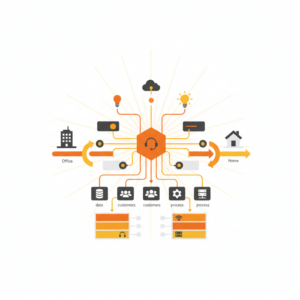
A modern hybrid work stack operates as a layered system. At the foundation is cloud infrastructure, providing scalable compute, storage, and application access. Identity and access management governs who can access what, from where, and under which conditions.
On top sits collaboration and productivity technology. This includes unified communications, document management, and knowledge systems that preserve organisational memory across locations. Automation tools orchestrate workflows, reduce manual effort, and maintain consistency in service delivery.
Finally, analytics and insight platforms measure utilisation, performance, and experience. These systems convert operational data into decision-grade insight, enabling leaders to optimise hybrid work models over time⁴.
Comparison: How does hybrid work infrastructure differ from traditional office IT?
Traditional office IT assumes fixed locations, managed networks, and predictable usage patterns. Security is perimeter-based. Performance monitoring focuses on systems, not people.
Hybrid work infrastructure assumes mobility, variable connectivity, and continuous change. Security follows the user and device, not the network. Performance measurement extends to experience, productivity, and value creation.
Organisations that attempt to stretch legacy IT into hybrid environments face rising support costs and declining employee satisfaction. Those that adopt purpose-built hybrid work technology achieve greater stability and scalability⁵.
Applications: Which technologies enable hybrid work at enterprise scale?
Effective hybrid work technology requirements cluster into five application domains.
Secure access platforms provide identity-driven authentication and endpoint protection. Collaboration and knowledge platforms ensure consistent communication and information retrieval. Automation technologies standardise processes across locations, reducing dependency on manual intervention. Digital workplace analytics monitor adoption, workload balance, and experience. Governance and information management controls protect sensitive data across distributed environments.
Customer Science Insights supports this application layer by unifying workforce, customer, and operational data into a single insight environment, enabling leaders to measure hybrid work impact with clarity and confidence: https://customerscience.com.au/csg-product/customer-science-insights/
Risks: What happens when hybrid work technology is poorly designed?
Poorly designed hybrid work infrastructure introduces compounding risk. Security breaches increase due to unmanaged devices and inconsistent controls⁶. Productivity declines as employees navigate fragmented tools. Decision-making weakens when leaders lack visibility into how work is actually performed.
There is also cultural risk. Inconsistent digital experience creates inequity between office-based and remote workers, undermining engagement and trust. These risks are not theoretical. Regulators increasingly cite inadequate information management and access controls in compliance actions⁷.
Measurement: How should leaders measure hybrid work technology performance?
Measurement must move beyond system uptime. Effective metrics include task completion time, collaboration effectiveness, employee experience indicators, and cost-to-serve. Security posture and compliance adherence remain critical baseline measures.
Advanced organisations integrate these metrics into business intelligence environments, enabling cross-functional visibility. Customer Science Business Intelligence services support this integration by aligning operational data with executive reporting frameworks: https://customerscience.com.au/solution/business-intelligence/
Measurement enables continuous optimisation. Without it, hybrid work remains an article of faith rather than a managed operating model.
Next Steps: How can organisations modernise safely and incrementally?
Modernisation should follow a staged approach. First, stabilise access and security. Second, rationalise collaboration and knowledge platforms. Third, automate high-volume workflows. Fourth, establish insight and governance layers.
Change management is critical. Technology adoption must be supported by clear operating principles and leadership alignment. Organisations that treat hybrid work as a business transformation, not an IT project, achieve stronger and more sustainable outcomes⁸.
Evidentiary Layer: What evidence supports investment in hybrid work technology?
Multiple studies link effective digital workplace design to productivity uplift of 10 to 25 percent and measurable reductions in real estate and support costs⁹. Zero trust security models reduce breach impact and recovery time compared to perimeter-based approaches¹⁰.
Public sector and regulated industries report improved service continuity and workforce resilience when hybrid work infrastructure is designed around data governance and automation¹¹. The evidence consistently supports structured investment over ad hoc tool adoption.
FAQ
What is the most critical component of remote work infrastructure?
Secure identity and access management is foundational. Without it, collaboration and automation cannot operate safely at scale.
Are collaboration tools alone enough to enable hybrid work?
No. Collaboration tools must be integrated with security, automation, and insight platforms to deliver sustained performance.
How does automation support hybrid work?
Automation reduces manual handoffs, enforces consistency, and enables location-independent service delivery.
How can leaders see whether hybrid work is working?
Leaders need integrated insight across productivity, experience, cost, and risk. Disconnected metrics provide an incomplete picture.
Which Customer Science solutions support hybrid work measurement?
Knowledge Quest supports structured knowledge management and organisational learning across hybrid environments: https://customerscience.com.au/csg-product/knowledge-quest/
Is hybrid work technology only relevant to large enterprises?
No. Mid-sized organisations often benefit most due to rapid scalability and reduced fixed infrastructure costs.
Sources
- International Organization for Standardization. ISO 22301 Business Continuity Management Systems. 2019. https://www.iso.org/standard/75106.html
- Australian Bureau of Statistics. Working Arrangements Survey. 2022. https://www.abs.gov.au/statistics/labour/earnings-and-working-conditions
- National Institute of Standards and Technology. Zero Trust Architecture SP 800-207. 2020. https://doi.org/10.6028/NIST.SP.800-207
- Gartner. Digital Workplace Analytics Research Note. 2021.
- OECD. Productivity Gains from Flexible Work. 2020. https://www.oecd.org
- Australian Cyber Security Centre. Cyber Threat Report. 2023. https://www.cyber.gov.au
- Office of the Australian Information Commissioner. Data Breach Investigations Report. 2022. https://www.oaic.gov.au
- Harvard Business Review. Managing Hybrid Work at Scale. 2021. https://hbr.org
- McKinsey Global Institute. The Future of Work After COVID-19. 2021.
- Forrester Research. Zero Trust Security Outcomes. 2020.
- Australian National Audit Office. Digital Transformation and Workforce Resilience. 2021.