































What is a Voice of Customer program and what problem does it solve?
A Voice of Customer (VoC) program captures customer signals, turns them into decisions, and feeds changes back into products, journeys, and service. A strong program reduces effort, prevents repeat contacts, and grows loyalty by fixing what customers actually struggle with, not what internal teams guess. The Customer Effort Score literature shows that reducing effort predicts lower churn more reliably than attempts to “delight,” which makes VoC a practical lever for retention and cost control.¹ NPS remains a useful relationship lens when interpreted carefully, but it should not stand alone because single numbers can hide the friction that drives repeat contact.²
Which metrics belong in a modern VoC toolkit?
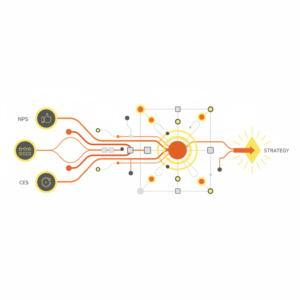
Most enterprises standardise on three lenses, each answering a different question. Net Promoter Score (NPS) estimates recommend intent at the relationship or episode level.² Customer Satisfaction (CSAT) measures perceived success or quality for a given interaction. Customer Effort Score (CES) measures how hard it was to complete a task and often tracks closer to repeat contact and churn in service contexts.¹ ³ Programs should pair these with operational outcomes such as First Contact Resolution and repeat-within-window so surveys do not drift from reality. FCR and repeat behaviour validate whether perceived success became actual resolution.⁴
How do you design VoC around decisions instead of dashboards?
Start with decisions you will take when a signal moves. Write these in plain language. “If effort on password reset exceeds threshold P75, route a fix squad and pause promotional nudges for that cohort.” Signals should map to actions through owners and budgets. HEART’s goal–signal–metric pattern helps teams write this map once and reuse it across journeys: define the goal, choose the signal that reflects the goal, then confirm with a metric you can monitor in week.⁵ This structure stops metric sprawl and keeps the conversation about outcomes.
What is the minimum viable VoC architecture?
You need four parts that work together. Capture signals at key moments of truth across channels. Store events with stable identifiers and timestamps so survey responses and behaviour can join cleanly. Decide with rules for thresholds and routing, using experiments where you need proof before scale. Act by triggering fixes, updates, or targeted outreach. Learn by closing the loop with customers and by publishing outcome deltas. Treat journeys as simple state machines so you can measure time in state and progression, not just scores.⁶ This keeps VoC operational and auditable.
NPS vs CSAT vs CES: when should you use each?
Use NPS for relationship health after key milestones such as onboarding or renewal, or for periodic relationship reads when you need a common language for the board.² Use CSAT for channel quality and episode-level satisfaction where you want broad coverage and fast reads. Use CES for post-resolution steps in service and support, because effort predicts repeat volume and defection more directly than general satisfaction.¹ ³ These are complementary, not competing. The trick is to deploy each where it predicts decisions you will take. A single-number program invites blind spots.²
What measurement hygiene keeps VoC credible?
Keep wording stable and short. For CES, consider seven-point items for better discrimination in single-item scales.³ Define repeat windows for operational outcomes and publish exclusions to avoid gaming. For NPS, remember the origin is a recommend-intent heuristic, not a direct growth predictor in every market.² ⁷ Align privacy and consent collection with the Australian Privacy Principles. The APPs require informed, specific, current, and voluntary consent and apply purpose limits to data use, so record consent provenance and enforce purpose checks before activation.⁸ ⁹
How do you collect signals without fatiguing customers?
Ask at the moment of truth and only when you will act. Keep surveys short and contextual. Offer a single open-text prompt that invites cause-level detail. Use progressive sampling to limit survey load per customer across a rolling window. Listen beyond surveys. Mine contact reasons, repeat contacts, chat logs, and abandonment to capture what people do alongside what they say. Link these streams so text themes and operational hotspots corroborate each other. This blend prevents bias from any one source.
What thresholds turn VoC into action rather than noise?
Use percentiles and confidence, not only averages. Set CES P75 and CSAT P25 thresholds by journey step and route breaches to an owner with a playbook. Define repeat-within-window as three or seven days by channel and treat breaches as defects that require root cause, not just coaching. For relationship NPS, focus on theme movement by segment, not small point shifts. Write one-page playbooks that state the signal, the threshold, the owner, the fix ladder, and the stop rule. This keeps accountability crisp.
How do you turn feedback into resolved problems?
Close the loop on two tracks. Close the customer loop by acknowledging input and stating the next step or outcome. Close the systemic loop by assigning issues to product, policy, or operations owners with a due date and a measurable state change. Use controlled tests to prove causality. Randomised splits and holdouts separate cause from noise when you change copy, sequence, or policy. HEART encourages pre-registering hypotheses so you avoid p-hacking and move only changes that lift task success and lower effort.⁵
What operating rhythm makes VoC a habit?
Run a weekly signal review and a monthly board. The weekly checks leading indicators such as time in state, effort P75, and First Contact Resolution drops on top intents. The monthly reviews lagging outcomes such as activation, retention, and complaint rate. Publish a monthly memo called “Top Five Customer Problems Resolved” that names the issue, the fix, and the measured impact on effort, FCR, or repeat contacts. This narrative reframes VoC as an engine for fewer problems and faster value.
How do you integrate VoC with compliance and ethics?
Design consent and purpose checks up front. Treat opt-out as a first-class flow in every channel. When models allocate outreach or priority, keep human-readable rules and a simple recourse path for customers who believe an error occurred. The APPs and common-sense ethics align on transparency and choice.⁸ ⁹ Build the controls once, then reuse them across journeys so teams move fast without revisiting basics.
What results should executives expect in the first two quarters?
Executives should see fewer repeat contacts on the targeted journeys, lower effort on service tasks, and improved progression and activation. They should see a smaller gap between survey FCR and operational FCR as handoffs and policy blocks are removed. They should also see clearer status and faster confirmation for key tasks, which reduces “just checking” contacts. These shifts reduce cost to serve while improving trust.
FAQ
What is the simplest definition of a VoC program that drives action?
It is a system that turns customer signals into decisions, routes fixes to owners, and proves impact with operational outcomes like First Contact Resolution and repeat-within-window.⁴ ⁵
Which metric should we prioritise: NPS, CSAT, or CES?
Prioritise by context. Use NPS for relationship health, CSAT for interaction quality, and CES for effort on service tasks that predict repeat contact and churn risk.¹ ² ³
How do we avoid survey fatigue while keeping coverage?
Trigger short, contextual surveys at moments of truth, cap frequency per customer, and complement with behavioural and operational data so you listen without over-asking.⁵
What thresholds turn results into action?
Set percentile thresholds by journey step, for example CES P75 and CSAT P25, and tie each breach to an owner, a playbook, and a timeline. Confirm improvement with reduced repeat-within-window and higher FCR.³ ⁴
Why pair surveys with operational outcomes?
Because behaviour validates perception. FCR and repeat-within-window confirm whether “felt resolved” became “actually resolved,” which protects decisions from survey bias.⁴
How should Australian teams manage privacy in VoC?
Align to the Australian Privacy Principles. Capture informed, specific, current, and voluntary consent with timestamp and provenance, and enforce purpose limits before activation.⁸ ⁹
Sources
Stop Trying to Delight Your Customers — Matthew Dixon, Karen Freeman, Nicholas Toman, 2010, Harvard Business Review. https://hbr.org/2010/07/stop-trying-to-delight-your-customers
The One Number You Need to Grow — Frederick F. Reichheld, 2003, Harvard Business Review (accessible reprint). https://www.nashc.net/wp-content/uploads/2014/10/the-one-number-you-need-to-know.pdf
10 Things to Know About the Customer Effort Score — Jeff Sauro, 2019, MeasuringU. https://measuringu.com/customer-effort-score
First Contact Resolution: Definition and Approach — ICMI, 2008, ICMI Resource. https://www.icmi.com/files/ICMI/members/ccmr/ccmr2008/ccmr03/SI00026.pdf
Measuring the User Experience at Scale: The HEART Framework — Kerry Rodden, Hilary Hutchinson, Xin Fu, 2010, Google Research Note. https://research.google/pubs/pub36299/
Learn about state machines in Step Functions — Amazon Web Services, 2024, AWS Documentation. https://docs.aws.amazon.com/step-functions/latest/dg/concepts-statemachines.html
A Systematic Evaluation of the Net Promoter Score vs. Alternative Metrics — Sebastian Baehre, Jan Zeplin, 2022, Journal of Business Research. https://www.sciencedirect.com/science/article/abs/pii/S0148296322003897
Australian Privacy Principles — Office of the Australian Information Commissioner, 2023, OAIC. https://www.oaic.gov.au/privacy/australian-privacy-principles
Australian Privacy Principles guidelines — Office of the Australian Information Commissioner, 2025, OAIC. https://www.oaic.gov.au/privacy/australian-privacy-principles/australian-privacy-principles-guidelines