










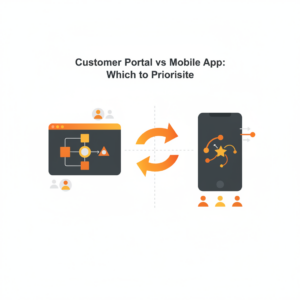
What choice are you really making?
Leaders decide whether the next dollar buys a better browser experience or a native app. Customers judge the result by how quickly they can complete tasks with certainty and low effort. A portal is the responsive, authenticated web experience that runs on any modern browser. A mobile app is a platform-specific install with local capabilities and push permissions. The right priority matches the dominant jobs to be done, device mix, and retention reality for your audience rather than a generic channel playbook. Research shows that mobile web reaches far more users while native apps can concentrate deeper engagement for frequent, high value tasks.¹ ²
What is the decision framework in one page?
Executives compare five lenses: access, frequency, capability, acquisition friction, and cost of change. Access favors portals because URLs are universal and search-indexed. Frequency favors apps when the same person repeats the same tasks daily or weekly. Capability favors apps when the task requires offline, background sync, sensors, or secure device-level storage. Acquisition friction favors portals because installs add steps and permissions that many users decline. Cost of change favors portals when teams must update content and flows weekly across countries and brands. Industry evidence on mobile behavior, app retention, and performance underlines these tradeoffs.¹ ³ ⁴
What is a customer portal and when does it win?
A customer portal is a responsive, authenticated website that centralizes self-service tasks such as login, payments, address updates, order status, usage, and case tracking. Portals win when tasks are episodic, audiences are broad, and speed to first value matters more than deep device integration. Nielsen Norman Group recommends defaulting to web for infrequent tasks and for audiences that are unlikely to install or maintain an app, because mobile websites are instantly available and easier to keep current.² Google’s research adds that fast web experiences reduce abandonment and reach users from search without any install friction.³ Portals also integrate progressive web app patterns to add offline caching, add-to-home-screen prompts, and push on supported platforms, which narrows the capability gap for many service scenarios.³
Use a portal first when:
70 percent or more of tasks are monthly or less frequent, such as bills and address updates.²
Acquisition relies on search, email, and deep links.³
You operate multiple brands or markets and need fast content and policy changes.
You must ensure broad accessibility and assistive tech compatibility across devices.
What is a mobile app and when does it win?
A mobile app is a native iOS or Android application installed from an app store with access to system services such as secure storage, cameras, biometrics, geolocation, and background processes. Apps win when usage is frequent and time sensitive, or when device capabilities materially improve task success. Forrester notes that brands earn sustained app engagement when they deliver repeatable value such as account monitoring, on-device utilities, and proactive notifications that solve a problem quickly.¹ Adjust’s retention benchmarks show that day-30 app retention is typically low across categories, which means only high-value, high-frequency use cases sustain installs.⁴
Use an app first when:
Customers perform daily or weekly tasks such as scanning, ticketing, IoT control, or field service.¹
You need device features beyond the browser: offline-first workflows, secure passkeys, deep camera pipelines.
Push notifications tied to real-time events are central to the value proposition.¹
You can fund continuous releases and store compliance for two platforms.
How do portals and apps compare on core mechanics?
Access and acquisition
Portals load from a link and work on every modern device. Apps require store search, install, and permissions. Each extra step sheds users. Google’s mobile research links load time and friction to drop-off, which is why portals often win for first-time or infrequent users.³
Engagement and frequency
Apps can drive higher session frequency when the job recurs and push adds timely value. Forrester’s guidance emphasizes using push for real utility, not reminders that create notification fatigue.¹ Apps underperform when the job is monthly and low urgency, because users churn before the next need.⁴
Capability and reliability
Apps access sensors, secure enclaves, and background sync. Portals can leverage PWAs for caching and limited offline, but not all device APIs. For many service tasks, portal capability is sufficient if the flow is designed well.³
Change velocity and cost
Portals ship changes instantly. Apps require build, test, and store review. If policy and copy change weekly, portals reduce cycle time and localization cost.²
Findability and SEO
Portals benefit from search indexing, deep links, and link previews. Apps can integrate deferred deep links, but most journeys still begin on the web.³
What risks come with choosing wrong?
Choosing an app first for episodic tasks produces low installs, rapid churn, and rising maintenance cost without commensurate value.⁴ Choosing a portal only for high frequency, time-sensitive tasks leaves value on the table where native features would improve reliability and speed. Overlapping both too early splits investment and produces two mediocre experiences. A disciplined choice minimizes duplication and maximizes fit to jobs and behaviors.² ⁴
How do you measure the choice with leading and lagging indicators?
Leaders separate reach from retention. For portals, track task completion rate, time to first value, bounce rate by step, and contact ratio reduction for the target intents. For apps, track new installs, day-7 and day-30 retention, notification opt-in, and task completion. Add shared lagging outcomes: first contact resolution for escalated cases, repeat-within-window on the same issue, and cost to serve. A paired scorecard reveals whether the chosen channel reduces assisted demand and improves outcomes, not just downloads or page views.¹ ³ ⁴
How to run an evidence-based pilot in 90 days
Executives can de-risk the decision by shipping a thin slice in the most likely winning channel.
Portal-first pilot.
Pick two high-volume intents such as password resets and payment methods. Remove fields, add inline validation, and connect to back-end status. Measure completion and contact ratio. Baymard’s research on forms confirms that fewer, clearer fields and strong error messaging raise completion, which directly reduces calls.⁵
App-first pilot.
Pick one high-frequency utility such as outage alerts, ticket wallet, or device control. Implement biometric login, real-time push, and offline-first storage for continuity. Measure repeat sessions, push-driven task completion, and day-30 retention. If retention fails to clear your threshold, pivot investment to the portal and reuse API work.
How to avoid common mistakes regardless of channel
Teams can lose value with either choice if they design for clicks instead of resolution. Gartner advises measuring containment from search to resolution, not just entrances or opens. This rule applies to portals and apps alike.⁶ Avoid hiding escalation. Escalate to assisted channels with context so agents see the steps already taken and resolve on first contact. Contact-center evidence links strong handoffs and knowledge use to lower repeat contacts and effort, which protects cost and trust.⁷ Treat sequencing with care. Replace fixed reminders with conditional holds that stop prompts the moment the user completes the task, which preserves attention across push and email.⁸
What hybrid pattern serves most enterprises best in year one?
Most organisations ship a great portal and a focused app. The portal becomes the universal front door for discovery, episodic tasks, and SEO. The app serves a narrow set of frequent jobs where push, device features, or offline-first make the task meaningfully better. This split minimises acquisition friction for the many while reserving native investment for the few who benefit from depth. Forrester’s engagement guidance and retention data support this asymmetric plan.¹ ⁴
What should executives decide this quarter?
Executives should select a primary channel for the next two sprints based on job frequency and capability need. If tasks are monthly and content changes weekly, prioritise the portal. If tasks are weekly and push or device features create clear advantage, prioritise the app. Publish one goal per intent, the signal you will use, and the metric you will ship. Review results in four weeks and expand only where evidence warrants. This approach converts channel debate into measurable progress.
FAQ
What is the simplest rule for portal vs app?
Choose portal for broad reach and episodic tasks. Choose app for frequent, time-critical tasks that benefit from push, offline, or sensors.² ³ ¹
Do progressive web apps make native apps obsolete?
No. PWAs close gaps on speed and re-engagement, but native still leads for deep device access, offline-first reliability at scale, and secure storage needs.³
How do we estimate whether an app will retain users?
Model day-30 retention using category benchmarks and your frequency assumptions. If users do the job monthly, plan for low retention and focus on portal excellence.⁴
What proves the chosen channel reduces calls?
Track task completion and contact ratio for the same intents before and after release. Add repeat-within-window and first contact resolution for escalations.⁶ ⁷
Can we build both at once?
Start with one, then expand. Splitting early dilutes quality. Reuse the same APIs, identity, and orchestration so features ship faster when you add the second channel.²
How should we treat notifications?
Send notifications that deliver immediate utility and stop the moment the task completes. Irrelevant pushes drive uninstalls and do not reduce assisted demand.¹ ⁸
Sources
The Mobile App Engagement Playbook — Forrester, 2023, Forrester Research. https://www.forrester.com/report
Mobile Website vs. Mobile App: When and Why — Nielsen Norman Group, 2023. https://www.nngroup.com/articles/mobile-sites-apps-differences/
Why Mobile Web Matters and How Progressive Web Apps Help — Think with Google, 2022. https://www.thinkwithgoogle.com/intl/en-apac/marketing-strategies/app-and-mobile/pwas/
Mobile App Trends: Retention Benchmarks — Adjust, 2023 Benchmark Report. https://www.adjust.com/resources/benchmarks/retention/
Checkout and Form Usability, Mobile Findings — Baymard Institute, 2019–2024. https://baymard.com/research/forms
Improving Self-Service Containment From Search to Resolution — Gartner, 2024. https://www.gartner.com/en/customer-service-support/trends/improving-self-service-containment-from-search-to-resolution
Knowledge-Centered Service Practices Guide — Consortium for Service Innovation, 2020. https://www.serviceinnovation.org/kcs-resources
Event-Triggered Journeys: Hold Until and Notifications — Twilio Segment Docs, 2024. https://www.twilio.com/docs/segment/engage/journeys/v2/event-triggered-journeys-steps