




























Why do leading CX teams formalize Voice of Customer programs?
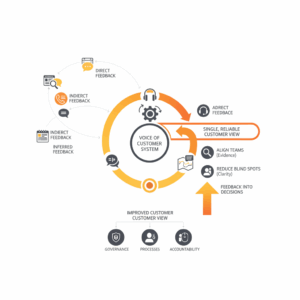
CX leaders face a simple problem. Customers talk constantly across surveys, calls, chat, social, and product usage, but organizations fail to hear the signal in time to act. A formal Voice of Customer program solves this by capturing direct, indirect, and inferred feedback to build a single, reliable view of customer reality.¹ When CX leaders treat VoC as an operating system rather than a tool, they reduce blind spots, align teams on the evidence, and turn feedback into decisions that customers notice. ISO 10004 frames this discipline as the governance and measurement system for customer satisfaction, which helps standardize language, processes, and accountability.²
What is a modern VoC program, in plain terms?
A modern VoC program is a repeatable system that collects multi-source feedback, analyzes it for meaning, routes insights to owners, and measures closed-loop outcomes.¹ ISO 10004 describes the backbone of this system as a set of processes for planning, design, operation, maintenance, and improvement of satisfaction measurement.² In practice, this means a VoC program defines questions, channels, timing, and thresholds up front, then automates analysis and action so frontline teams do not guess. Effective programs also emphasize how insights are used and shared across the enterprise, not only how they are gathered.⁹
What business outcomes justify investment in VoC?
Executives fund VoC when it moves revenue, cost, and risk. Forrester’s Customer Experience Index has shown that even small improvements in experience quality can add significant revenue through higher retention and share of wallet.³ Earlier research showed a clear correlation between superior CX and superior revenue growth across multiple industries, which gives leaders confidence to prioritize improvements found by VoC.⁶ Recent results also warn that many brands are slipping on effectiveness, ease, and emotion, which raises the cost of inaction and increases the value of a disciplined VoC program.⁷ Leaders should use VoC to target issues that measurably change churn, basket size, and advocacy, and then publish those financial impacts.
How should CX leaders structure VoC governance?
CX leaders set the structure before they buy technology. ISO 10004 recommends defining roles, responsibilities, and review mechanisms so that measurement is not optional.² A practical model assigns an executive sponsor for strategy, a VoC owner for orchestration, and journey or product owners for actions. Each owner receives a small, auditable set of metrics and narratives tied to their domain. An operating cadence ensures that insights are reviewed, decisions are logged, actions are funded, and impacts are verified. This cadence protects VoC from becoming a report that no one reads.
Which data sources belong in the signal layer?
Start with three classes of feedback and expand deliberately. Direct feedback covers surveys, interviews, and in-product prompts. Indirect feedback captures what customers say to others, such as social reviews or third-party forums. Inferred feedback draws meaning from behavior, such as clickstreams or call silence patterns.¹ The mix should match priority journeys and segments. Add qualitative depth through call transcripts and open text to locate why issues occur, then enrich with operational and financial data to quantify the cost of defects. Treat data quality as a product. Without reliable sampling, identity resolution, and metadata, later analytics will mislead.
What measurement model actually drives action?
Use a layered model that balances simplicity for operators and depth for analysts. Net Promoter Score remains a recognizable advocacy signal and a shared language for executives.⁴ Leaders should modernize it by pairing relationship and transactional items, and by tracking Earned Growth style outcome measures that link advocacy to real customer economics.⁵ Complement advocacy with effectiveness, ease, and emotion indicators, then map each to the journey stage where teams can take action. For comparability and rigor, anchor the measurement system to ISO 10004 guidance on defining objectives, methods, and evaluation criteria.²
How do we turn feedback into decisions at speed?
Design the insight layer for speed to meaning. Use text, speech, and journey analytics to surface themes, drivers, and at-risk customers, then route each insight to an accountable owner with a due date.¹ Combine quick wins with structural fixes. Publish “insight tickets” that specify the defect, the affected customers, the financial impact, and the proposed fix. Forrester’s work shows that quantifying the business upside of improvement makes the case for change clearer and faster.⁸ Build a small evidence library that pairs before-and-after metrics with customer stories, then reuse those patterns across brands or regions to accelerate replication.
Where does closed-loop work best?
Closed-loop action operates at two levels. At the micro level, frontline teams call back detractors, resolve issues, and record outcomes within a defined window. At the macro level, cross-functional teams fix the root causes that create detractors in volume. NPS gained traction because teams could identify promoters and detractors and then follow up with structured learning.⁴ The modern approach improves this by capturing verbatims, tagging the drivers with analytics, and verifying that fixes move the right outcome metrics, which aligns with Net Promoter 3.0 guidance to link advocacy to financial results.⁵
How should leaders prioritize improvements?
Leaders should prioritize by combined impact and feasibility. Use driver analysis to estimate the lift on retention or revenue if a driver improves, then weigh cost and time to deliver. Publish the top opportunities with the expected financial upside and the owner. For industries that appear in CX Index analyses, improvements of even a point in experience quality can yield meaningful revenue changes, which allows a clear ranking of opportunities.³ Rank order also benefits from earlier research showing the general revenue correlation of superior CX performance across sectors, which helps executives justify sequencing.⁶
What are the common risks and how do we mitigate them?
Three risks recur. First, survey fatigue and biased samples reduce reliability. Leaders mitigate this by sampling with intent, keeping instruments short, and using behavioral and operational data to triangulate.² Second, insights stall because no one owns the fix. Governance, routing, and a decision cadence address this.² Third, programs over-rotate to dashboards and lose credibility when customers do not feel change. Forrester’s recent findings that many brands are declining on CX quality should serve as a warning to track real customer outcomes, not only scores.⁷ Build program reviews around defect removal counts, time to resolution, and financial impact realized, not reporting completeness.
How do we measure success beyond scores?
Scores signal, outcomes prove. Measure four outcome families. Track customer outcomes such as retention, repeat purchase, and share of wallet. Track operational outcomes such as time to resolve and first contact resolution. Track financial outcomes such as revenue at risk saved and cost to serve avoided. Track cultural outcomes such as manager adoption and team participation in closed-loop calls. Forrester recommends quantifying growth from CX improvements with explicit methods that convert index gains into financial upside, which CX leaders can adapt for board reporting.⁸ Publish a quarterly benefits register to keep the connection visible.
What does implementation look like in 100 days?
Start with a focused use case and stand up a minimal, compliant backbone. Define the journeys and segments in scope. Design the measurement model using ISO 10004 guidance, then select the channels and questions.² Configure text and speech analytics to tag themes and drivers. Stand up routing to owners, set the review cadence, and train teams on micro and macro closed-loop practices.⁹ Launch with a small proof and calculate impact using the revenue methods shared by Forrester to show the upside of moving a key driver.³ ⁸ Publish early wins, then expand sources and journeys in the next quarter.
How do we keep the program fresh as expectations rise?
Customer expectations keep moving, and many brands have seen declines in perceived ease, effectiveness, and emotion.⁷ Leaders should treat VoC as an evolving product with a backlog. Add new channels as usage changes. Refresh measurement as business models shift. Improve analysis with better AI models, but retain human review for bias and nuance. Keep the storytelling sharp. A short, clear narrative that ties a customer story to a quantified defect and a funded fix will engage operators more than a dense dashboard. Continue to test the connection between VoC actions and financial results to maintain executive sponsorship.³ ⁵
What should CX leaders do next?
CX leaders should set three next actions. First, formalize governance and scope using ISO 10004 to stabilize definitions, roles, and review.² Second, build the signal and insight layers that transform feedback into prioritized decisions with owners.¹ ⁹ Third, publish a benefits register that links improvements to revenue, cost, and risk, borrowing proven methods for quantifying the upside of better experience quality.³ ⁸ This sequence turns VoC from listening into performance, which is the job customers hired CX teams to do.
FAQ
How does ISO 10004 support a VoC program design?
ISO 10004 provides guidelines for planning, operating, maintaining, and improving processes that monitor and measure customer satisfaction, which creates a common governance and measurement backbone for VoC programs.²
What is the definition of Voice of Customer in modern CX?
Voice of Customer combines direct, indirect, and inferred feedback across technologies such as surveys, social listening, speech analytics, text mining, and web analytics to form a holistic view of customer needs and experiences.¹
Why should executives link VoC to financial outcomes?
Research shows that improving customer experience quality can drive significant revenue through reduced churn and higher share of wallet, so VoC insights should be prioritized and funded based on their financial impact.³ ⁶
Which metrics should CX leaders use beyond NPS?
Use a layered model that includes advocacy signals such as NPS, outcome measures like Earned Growth, and journey metrics across effectiveness, ease, and emotion, aligned to ISO 10004 measurement guidance.² ⁵
Which risks most often undermine VoC programs?
Common risks include survey fatigue and biased samples, unclear ownership for fixes, and overemphasis on dashboards without visible customer change. Governance, sampling discipline, routing, and closed-loop practice mitigate these risks.²
What does a 100-day VoC implementation include?
Focus on one journey and segment, define the measurement model with ISO 10004, configure analytics, set the review cadence, train teams on micro and macro closed-loop actions, and publish early financial impacts to build momentum.² ⁸
Which market signals suggest urgency for VoC improvement now?
Recent CX Index results show declines in customer experience quality across key dimensions for many brands, which increases the risk of churn and the need for a disciplined, action-oriented VoC program.⁷
Sources
-
Gartner Glossary: Voice of the Customer (VoC). Gartner. 2024. Glossary. https://www.gartner.com/en/information-technology/glossary/voice-of-the-customer-voc
-
ISO 10004:2018 Quality management — Customer satisfaction — Guidelines for monitoring and measuring. International Organization for Standardization. 2018. Standard overview. https://www.iso.org/standard/71582.html
-
Forrester Press Release: 2024 US Customer Experience Index. Forrester. 2024. Press newsroom. https://www.forrester.com/press-newsroom/forrester-2024-us-customer-experience-index/
-
The One Number You Need to Grow. Frederick F. Reichheld. 2003. Harvard Business Review. https://hbr.org/2003/12/the-one-number-you-need-to-grow
-
Net Promoter 3.0: A better system for understanding the real value of happy customers. Fred Reichheld, Darci Darnell, Maureen Burns. 2021. Harvard Business Review. https://hbr.org/2021/11/net-promoter-3-0
-
Better Customer Experience Correlates With Higher Revenue Growth in Most Industries. Forrester. 2015. Blog. https://www.forrester.com/blogs/15-07-15-better_customer_experience_correlates_with_higher_revenue_growth_in_most_industries/
-
Forrester Press Release: 2025 Global Customer Experience Index Rankings. Forrester. 2025. Press newsroom. https://www.forrester.com/press-newsroom/forrester-global-customer-experience-index-2025-rankings/
-
Improving CX Can Drive More Than $1 Billion In Revenue. Forrester. 2024. Blog. https://www.forrester.com/blogs/improving-cx-can-drive-more-than-1-billion-dollars-in-revenue-2023/
-
Build a Winning Customer Experience Strategy. Gartner. 2023. Topic page. https://www.gartner.com/en/marketing/topics/customer-experience