















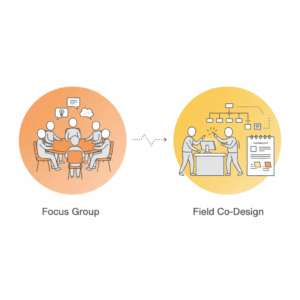
What do we mean by “focus group” and “field co-design”?
Executives need clean definitions before they choose a method. A focus group is a moderated discussion with recruited participants who share reactions to prompts, concepts, or experiences in a group setting. The method seeks interaction effects, since participants build on each other’s comments and surface attitudes that might not appear in one-on-one interviews.¹ A field co-design initiative places customers and frontline staff inside the design process while they work in their real contexts. Researchers observe actual behaviors, facilitate structured making activities, and iterate service concepts with the people who will use or deliver them. Field co-design draws from participatory design and contextual inquiry, which embed research and design in the environment where use happens.² ³ ⁴
Why does the setting matter for Customer Experience and Service Transformation?
Leaders change services when they change behavior. Behavior shows up differently in conference rooms and call floors. Focus groups can reveal attitudes, language, and social norms. They do this quickly and at moderate cost. They also risk groupthink and social desirability bias, which can mute dissenting voices.⁵ Field co-design captures tacit knowledge that customers and agents struggle to articulate. It observes workarounds, friction, and handoffs in situ. It also requires more time, access, and facilitation skill, and it needs careful planning under a human-centered design process such as ISO 9241-210.⁶ ⁷
How do focus groups work and where do they shine?
Teams recruit 6 to 8 participants per group, align a moderator guide to goals, and stimulate dialogue with stimuli such as journey maps, concept descriptions, or prototype images. The strength of a focus group lies in interaction. Participants trigger memories and widen the conversation. This interaction helps explore perceptions, motivations, and language that shape adoption and advocacy.¹ Focus groups excel when leaders need directional insights on messaging, value propositions, segmentation hypotheses, and early-stage concept reactions. They also help test comprehension and emotional tone before scaling communication or policy.⁵ ⁸
What are the limits of focus groups in service innovation?
Executives should not ask a room to simulate a workflow. Participants in a facility cannot accurately reenact complex tasks, cross-channel handoffs, or time-pressured decisions. Group dynamics can suppress minority perspectives. Skilled moderation can reduce the risk, but it cannot remove it.⁵ In service transformation, the consequence is clear. Teams that rely only on focus groups often ship solutions that align to stated preferences, not demonstrated behaviors. A blended program mitigates this risk. Teams start with groups to map attitudes, then validate or refute those attitudes in the field.¹ ⁵
What is field co-design and why do operations teams value it?
Field co-design brings design into the flow of work. Teams observe live interactions, invite customers and staff to make artifacts, and iterate prototypes at the point of use. The approach merges two traditions. Participatory design treats users and staff as partners with decision power across the design arc.² Contextual inquiry studies users in their environment through observation and probing questions.³ The result is a loop where insights and prototypes coevolve. Health systems have applied co-design to improve quality, uptake, and sustainability when they involve consumers and clinicians as co-creators.⁹ ¹⁰
When should leaders choose focus groups over field co-design?
Leaders pick focus groups when speed, breadth, and message testing matter more than workflow detail. Use them to compare value propositions, evaluate naming, and detect perception risks across segments before media or policy decisions. Focus groups are also a fit when access to real settings is constrained by privacy, safety, or regulation.¹ ⁵ For contact centres, a group with agents and supervisors can surface language, incentives, and cultural barriers that block adoption. The output shapes hypotheses, not final designs. Teams should still test the strongest signals in context to confirm operational fit.⁵ ⁷
When should leaders choose field co-design over focus groups?
Leaders select field co-design when the service depends on sequences, handoffs, and tacit behaviors. Complex CX, like claims handling, discharge planning, or omni-channel support, benefits from observing and redesigning the flow itself. Co-design is essential when failure modes emerge from context, such as screen layouts, policy timing, role permissions, or physical layout.³ ⁷ Co-design also suits equity goals, because it centers lived experience and shares power in decision-making, which participatory design research shows is necessary for fair outcomes.² ¹¹ In healthcare and government, co-design supports sustainable change because clinicians, consumers, and staff co-own the solution.⁹ ¹⁰
How do the methods compare on cost, speed, and risk?
Executives need a crisp comparison to plan. Focus groups are faster to schedule and analyze at small scale. They carry lower field risks and fewer governance hurdles. Their data is attitudinal and self-reported, which is useful but limited for operational changes.¹ ⁵ Field co-design requires access, consent, and facilitation. It is slower up front, but it reduces rework because it exposes constraints and workarounds early. Studies in applied health services report benefits for fit and adoption, while also noting that many co-design efforts still lack rigorous evaluation, which leaders should plan to add.⁹ ¹⁰
What governance makes either method safe and effective?
Strong governance protects participants and improves decisions. ISO 9241-210 provides principles for human-centered design throughout the lifecycle, including understanding context of use, specifying requirements, producing solutions, and evaluating against requirements.⁷ Organizations should define recruitment, consent, data protection, and role clarity for customers and staff. In co-design, teams must be explicit about decision rights and how participant contributions will shape the final service.² Leaders should also plan evaluation from the start. Implementation science reviews show co-design often underinvests in measuring impact, which limits learning and scale.¹⁰
How should CX and Service Transformation teams sequence the two?
Teams create value when they choreograph methods. A practical sequence looks like this. Start with a landscape of beliefs using one or two focus groups per segment to extract perceptions, language, and adoption barriers. Turn those signals into field hypotheses. Move to field co-design at priority touchpoints. Observe actual work, invite staff and customers to make service blueprints, and iterate prototypes in context. Use rapid cycles to test fit, risk, and effort. Close with a validation group to refine messaging and change management. This sequence anchors strategy in both attitudes and behaviors.¹ ³ ⁷
Which metrics prove impact for executives and boards?
Boards need clear evidence. Focus groups yield metrics on comprehension, appeal, clarity, and perceived value, which inform marketing, training, and policy communications. Field co-design yields metrics on task completion, first contact resolution, dwell time, error rates, safety incidents, and equity outcomes. ISO 9241-210 points to usability performance, satisfaction, and risk as core human-centered outcomes.⁷ Health co-design literature stresses adoption, sustainability, and experiential improvements across patients and clinicians.⁹ ¹⁰ Executives should track cost to serve, time to implement, and rework avoided to quantify transformation value.
What does a decision framework look like in practice?
Leaders make better calls with a simple rule. Choose focus groups when the question is what people think and how they talk about an idea. Choose field co-design when the question is what people do and what constrains them while doing it. For most service changes, do both. Begin with groups to set the language and assumptions. Use field co-design to shape the solution in the flow of work. Close with groups to pressure test communications and adoption. This pattern balances speed with fidelity, saves rework, and builds trust with customers and frontline teams.¹ ³ ⁷ ⁹
How to get started this quarter
Executives can act now. Define the business decision and its risk. Select segments for two focus groups and write a moderator guide that probes value, comprehension, and barriers. Translate the strongest signals into hypotheses about workflow and handoffs. Secure field access and run a time-boxed co-design sprint at a high-volume touchpoint. Collect ISO-aligned usability measures and implementation metrics that boards value. Publish a short evidence brief that links attitudinal and behavioral findings to a single recommendation. This cadence helps Customer Experience and Service Transformation leaders move from debate to delivery.⁷ ⁹ ¹⁰
FAQ
What is the core difference between a focus group and field co-design in service transformation?
A focus group gathers attitudinal data through moderated group discussion, while field co-design generates behavioral and contextual insight by observing and creating solutions with users and staff in real settings.¹ ³
When should Customer Science clients use focus groups instead of field co-design?
Use focus groups to explore perceptions, messages, and value propositions quickly, especially when access to real settings is limited or when testing communications before scale.¹ ⁵
Why does field co-design improve adoption in complex services like contact centres and healthcare?
Field co-design captures tacit knowledge, uncovers workflow constraints, and shares decision power with participants, which increases fit, uptake, and sustainability.² ³ ⁹ ¹⁰
Which governance framework should CX leaders apply across both methods?
Apply ISO 9241-210 human-centered design principles to plan context of use, requirements, iterative solutions, and evaluation throughout the lifecycle.⁷
How can executives measure the impact of field co-design vs focus groups?
Focus groups inform metrics such as comprehension and perceived value. Field co-design informs operational metrics such as completion rates, errors, and sustainability, alongside usability and satisfaction measures from ISO 9241-210.⁷ ⁹ ¹⁰
Who should participate in field co-design for Customer Experience and Service Transformation?
Include customers, frontline staff, supervisors, and relevant support roles so the team can map handoffs, constraints, and workarounds in situ, then iterate prototypes together.² ³
Which sequence reduces rework in service innovation programs?
Start with focus groups to extract attitudes and language, shift to field co-design to shape the solution in context, and finish with groups to refine communications and change management.¹ ³ ⁷
Sources
Smithson J. 2000. “Using and Analysing Focus Groups: Limitations and Possibilities.” International Journal of Social Research Methodology. https://www.sfu.ca/~palys/Smithson-2000-Using%26AnalysingFocusGroups.pdf
Luck R., Vines J., McNaney R., et al. 2025. “Participatory design: a systematic review and insights for future practice.” Design Science. Cambridge University Press. https://www.cambridge.org/core/journals/design-science/article/participatory-design-a-systematic-review-and-insights-for-future-practice/C310A25B481980BE14AD4B38C0EE46D1
UXRMethods. 2024. “Contextual Inquiry.” https://uxrmethods.org/methods/contextual-inquiry/
Oxford Academic. 2025. “Exploring co-design: a systematic review of concepts, models and processes in public health.” Journal of Public Health. https://academic.oup.com/jpubhealth/advance-article/doi/10.1093/pubmed/fdaf084/8232581
Roller M. R., Lavrakas P. J. 2020. “Limitations of the Focus Group Method: An Overview.” Research Design Review. https://researchdesignreview.com/2020/11/10/limitations-focus-group-method-an-overview/
Smith G. 2025. “Evaluating the Effectiveness of Focus Groups in Research.” Elsevier ST. https://elsevierst.com/evaluating-the-effectiveness-of-focus-groups-in-research/
International Organization for Standardization. 2019. “ISO 9241-210: Ergonomics of human-system interaction — Part 210: Human-centred design for interactive systems.” ISO. https://www.iso.org/standard/77520.html
Vittana. 2019. “17 Big Advantages and Disadvantages of Focus Groups.” https://vittana.org/17-big-advantages-and-disadvantages-of-focus-groups
Palmer V., Klaic M., et al. 2024. “Evaluation of research co-design in health: a systematic overview of reviews.” Implementation Science. https://implementationscience.biomedcentral.com/articles/10.1186/s13012-024-01394-4
Piper D., Iedema R., et al. 2021. “Using experience-based co-design with patients, carers and healthcare staff.” Patient Experience Journal via ScienceDirect. https://www.sciencedirect.com/science/article/pii/S1551741121002060