



























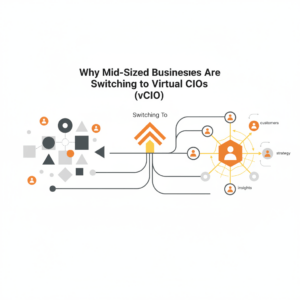
Mid-sized Australian businesses are adopting virtual CIO services to gain senior technology leadership without the cost and rigidity of a full-time executive. A vCIO aligns technology, automation, and cybersecurity with business outcomes, clarifies the difference between vCIO vs MSP models, and enables scalable decision-making that supports growth, resilience, and regulatory compliance.
What is a Virtual CIO in a mid-sized business context?
A virtual CIO provides executive-level technology leadership on a fractional or contract basis. In this article, the term virtual CIO refers to a strategic role focused on governance, architecture, risk, and value creation, not day-to-day IT support.
A vCIO defines technology priorities, translates business strategy into roadmaps, and governs investment decisions. Mid-sized businesses often lack this capability because they outgrow informal IT management before they can justify a full-time CIO. Virtual CIO services Australia address this gap by delivering senior capability with predictable cost and clear accountability.
Why are mid-sized businesses rethinking traditional IT leadership models?
Mid-sized organisations face increasing digital complexity. Cloud migration, automation, cybersecurity obligations, and data governance now demand executive oversight. Boards and CEOs recognise that unmanaged technology risk directly affects revenue, compliance, and brand trust^1.
Traditional models rely on internal IT managers or outsourced providers. These models often optimise for operational uptime, not strategic alignment. As a result, technology spend grows while business impact remains unclear. This mismatch drives leaders to seek a role that owns outcomes, not just systems.
How does a vCIO operate differently from an MSP?
A virtual CIO leads strategy, while a managed service provider delivers operations. This distinction defines the vCIO vs MSP comparison.
An MSP monitors systems, resolves incidents, and maintains infrastructure. A vCIO sets direction, approves architectures, and measures return on technology investment. Research shows that separating governance from delivery improves transparency and reduces vendor bias in decision-making^2. Many mid-sized firms retain MSPs for execution while engaging a vCIO to oversee priorities, risk, and performance.
What problems do virtual CIO services Australia solve?
Virtual CIO services Australia solve three structural problems common in mid-sized firms.
First, they resolve strategic ambiguity. A vCIO documents a technology roadmap linked to growth, cost control, and customer experience. Second, they reduce risk exposure. Formal governance improves cybersecurity posture and compliance with Australian regulatory expectations^3. Third, they control cost volatility. Portfolio-based planning replaces reactive spending with staged investment.
These outcomes are difficult to achieve without senior leadership authority. A vCIO provides that authority without adding permanent headcount.
How do virtual CIOs enable automation and digital maturity?
A virtual CIO enables automation by sequencing initiatives against readiness and value. Automation fails when organisations deploy tools without process clarity or change management.
The vCIO assesses process maturity, data quality, and workforce capability before recommending automation platforms. This approach aligns with ISO guidance on digital transformation governance^4. The result is sustainable automation that reduces manual effort, improves accuracy, and supports scale rather than creating technical debt.
Where do virtual CIOs fit within technology and automation strategy?
A virtual CIO anchors technology and automation strategy at the executive level. The role integrates enterprise architecture, data strategy, cybersecurity, and vendor management into a single decision framework.
In practice, the vCIO chairs technology steering forums, defines decision rights, and reports progress in business terms. This governance model improves alignment between technology teams and commercial leaders, which research links to higher digital transformation success rates^5.
How does a vCIO support customer and employee experience outcomes?
A virtual CIO improves experience by aligning platforms to journey design and workforce needs. Fragmented systems create friction for customers and employees alike.
By rationalising applications and standardising data flows, a vCIO enables consistent service delivery and faster resolution times. Evidence from service management studies shows that integrated technology environments improve satisfaction and productivity when guided by executive ownership^6.
What risks should leaders consider when adopting a vCIO model?
Leaders must manage role clarity and authority. A vCIO fails when positioned as an advisor without decision rights.
Another risk involves overloading the role with operational tasks. The vCIO must remain focused on strategy and governance, not incident management. Clear interfaces with MSPs and internal teams mitigate this risk. Contractual scope and success measures should reflect executive accountability, not hours consumed.
How should organisations measure vCIO effectiveness?
Organisations measure vCIO effectiveness through outcome-based metrics. These include technology investment return, risk reduction, delivery predictability, and alignment with business milestones.
Maturity assessments and roadmap progress reviews provide structure to this measurement approach. Customer Science applies this model within its advisory frameworks to link technology governance directly to commercial outcomes through structured measurement practices available at https://www.customerscience.com.au/measurement.
What are the next steps for evaluating virtual CIO services Australia?
Decision-makers should begin with a capability gap assessment. This assessment compares current technology governance against growth, automation, and risk requirements.
The next step involves defining success criteria and engagement models. Virtual CIO services Australia vary in scope, so clarity on decision authority and integration with existing providers is essential. Customer Science supports this evaluation through its solution frameworks at https://www.customerscience.com.au/solutions, ensuring technology leadership aligns with enterprise objectives.
What evidence supports the shift to virtual CIO models?
Industry research consistently links executive technology leadership to improved digital outcomes. Studies show that organisations with clear IT governance outperform peers in cost control, security, and transformation success^7.
Australian regulatory guidance also emphasises board-level accountability for technology risk, reinforcing the need for senior oversight regardless of organisation size^8. Virtual CIO models operationalise this requirement for mid-sized businesses.
FAQ: Virtual CIO services for mid-sized businesses
What is the difference between a virtual CIO and an IT manager?
A virtual CIO owns strategy and governance, while an IT manager focuses on operations and delivery. The roles are complementary but not interchangeable.
Is a vCIO only relevant for technology-heavy organisations?
A vCIO is most valuable where technology materially affects growth, compliance, or customer experience. This increasingly applies across all sectors.
Can a vCIO work with existing MSPs?
Yes. The vCIO vs MSP model assumes coexistence. The vCIO directs priorities and evaluates performance, while MSPs execute.
How long does it take to see value from a vCIO?
Most organisations see roadmap clarity and risk reduction within three to six months, with financial impact following staged execution.
Are virtual CIO services Australia suitable for regulated industries?
Yes. A vCIO strengthens governance and documentation, supporting compliance with Australian standards and regulator expectations.
How does Customer Science approach vCIO engagements?
Customer Science integrates virtual CIO services with customer, operational, and technology strategy, supported by structured governance and advisory methods detailed at https://www.customerscience.com.au/faq.
Sources
- Australian Institute of Company Directors, “Governing Through Digital Disruption,” 2020. https://aicd.companydirectors.com.au
- Weill, P. and Ross, J., “IT Governance: How Top Performers Manage IT Decision Rights,” Harvard Business School Press, 2004.
- Australian Cyber Security Centre, “Essential Eight Maturity Model,” 2023. https://www.cyber.gov.au
- ISO/IEC 38500:2015, “Governance of IT for the Organization.”
- Kane, G. et al., “Achieving Digital Maturity,” MIT Sloan Management Review, 2017. https://sloanreview.mit.edu
- AXELOS, “ITIL 4 Foundation,” 2019. https://www.axelos.com
- Westerman, G., Bonnet, D., McAfee, A., “Leading Digital,” Harvard Business Review Press, 2014.
- APRA, “Prudential Standard CPS 234 Information Security,” 2019. https://www.apra.gov.au