










Why does prototyping matter in service transformation?
Service leaders reduce risk when they test ideas before scaling. Prototyping creates quick, learnable versions of a proposed service and exposes failure points early. Teams use prototypes to validate customer value, feasibility, and operational viability without committing full budgets or long timelines. In service contexts, prototypes span scripts, flows, people, and touchpoints across channels. Good practice moves from small, low-fidelity experiments to higher-fidelity pilots as confidence grows. This staged approach preserves speed, sharpens evidence, and builds alignment across Customer Experience, Operations, Technology, and Finance.¹
What is prototype fidelity in a service context?
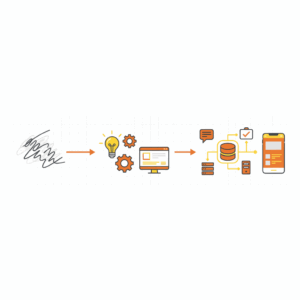
Fidelity describes how closely a prototype resembles the intended, real service. Low fidelity favors speed and learning with rough artifacts like sketches, storyboards, and role-plays. High fidelity favors realism with working systems, integrated data, and trained staff. In services, fidelity extends beyond screens to include backstage processes, policies, physical environments, and human behaviors. Teams choose fidelity based on the question they must answer next. If the question is about desirability, they start low. If the question is about reliability at scale, they move higher.²
Low-fidelity methods that create fast clarity
Teams start with disposable assets to clarify intent and test desirability. Paper storyboards show the journey and reveal missing steps in minutes. Service comics turn intangible sequences into visible problems that customers can discuss. Script read-throughs align language and tone across channels. Bodystorming stages the experience in a room and forces teams to feel constraints like queueing, handoffs, and ambient noise. Wizard of Oz tests fake automation by placing a human behind the scenes to simulate a bot, AI, or system. These tactics maximize learning per hour and make it safe to change direction.³
Experience prototyping that makes services tangible
Experience prototyping immerses stakeholders in the service using props, space, and time. Facilitators mark out a lobby with tape, use signage mockups, and rehearse handovers between staff while observing emotions, errors, and latency. Teams capture operational data such as elapsed time, error rates, and recovery strategies. This approach surfaces edge cases like accessibility needs or privacy concerns that static artifacts miss. When combined with service blueprints, experience prototyping links frontstage moments to backstage processes and clarifies where to invest next.⁴
Medium-fidelity methods that validate flows and operations
Teams progress to medium fidelity when they must validate workflows, throughput, and cross-team dependencies. Clickable screen prototypes test navigation, content clarity, and microcopy without full engineering. Concierge MVPs deliver the service manually to a small cohort while measuring satisfaction and effort. Fake-door tests measure demand by inviting customers to try a feature and observing who clicks, signs up, or schedules a consult. These methods produce market and operational signals with limited build. They help leaders prioritize which service capabilities deserve high-fidelity investment.⁵
High-fidelity pilots that test real performance
Organizations run high-fidelity pilots when they must confirm reliability, cost to serve, and regulatory compliance. Pilots use real data, trained staff, and production-like environments. They instrument the service to track wait times, abandonment, first contact resolution, and cost per interaction. The goal is operational truth, not polished theater. Teams iterate on staffing models, escalation rules, and automation thresholds, then prove the business case and risk posture before scaling. High fidelity becomes the final rehearsal for change management and go-live.⁶
How do we choose the right fidelity for the next decision?
Leaders choose fidelity by mapping a question to the lightest method that produces decisive evidence. If the question is “Do customers understand the value proposition,” a storyboard or landing page is enough. If the question is “Can we meet a 90-second handle-time target,” a staffed pilot is required. A simple decision table helps: desirability questions use low fidelity, usability and flow questions use medium fidelity, and reliability or compliance questions use high fidelity. The discipline is to avoid jumping ahead and to escalate only when the next decision demands it.²
What is a service blueprint and when should we use it?
A service blueprint is a diagram that visualizes frontstage interactions, backstage activities, support processes, and evidence across channels. Teams use blueprints to connect customer-visible steps to the operational work that enables them. Blueprints reduce rework by revealing hidden dependencies, policy gaps, and data issues early. When combined with experience prototyping, blueprints act like the map for an evolving pilot, guiding where to add instrumentation and where to tighten controls.⁷
Mechanisms that make prototypes credible in contact centres
Contact centres benefit from explicit mechanisms that connect prototypes to outcomes. Leaders define measurable targets such as Customer Satisfaction, Customer Effort, First Contact Resolution, Average Handle Time, and Containment Rate. Teams use controlled cohorts and timeboxed trials to compare prototype performance against a baseline. They document staffing assumptions, training scripts, and system permissions so results can be replicated. They also rehearse failure, using playbooks for outages, handoffs, and escalations that stress-test resiliency before scale. This operational rigor turns a good idea into a reliable service.⁶
How do we compare low, medium, and high fidelity without confusion?
Low fidelity optimizes for speed, breadth of concepts, and stakeholder alignment. Medium fidelity optimizes for flow validation, demand signals, and early ROI indications. High fidelity optimizes for reliability, compliance, and scale readiness. The mistake is to treat them as a linear checklist. Effective teams loop. They use a high-fidelity pilot to expose a failure mode, then drop back to a low-fidelity sketch to solve it quickly. This bidirectional movement preserves momentum and prevents sunk-cost bias.³
Applications across AI, automation, and human-led services
Service teams apply fidelity thinking to chatbots, agent assist, field service, and retail experiences. For an AI assistant, a Wizard of Oz operator simulates responses to learn intent distribution before training models. For agent assist, clickable overlays test timing and phrasing before system integration. For field service, bodystorming in a van reveals safety and connectivity constraints. For retail, experience prototyping in a mocked aisle validates wayfinding and queue management. Each use case benefits from choosing the lightest method that answers the next question with confidence.³
Risks and ethics that leaders must manage
Prototyping introduces ethical and operational risks. Fake-door tests can erode trust if they waste time or capture data without informed consent. Wizard of Oz trials can misrepresent automation and cause harm if humans cannot deliver promised speed or quality. Leaders mitigate risk with clear disclosures, opt-outs, and guardrails for data retention and bias. They also ensure accessibility by testing with assistive technologies and diverse users. A documented ethics checklist protects customers and protects the organization’s license to operate.⁸
Measurement that proves value and reduces doubt
Measurement turns prototypes into investment cases. Teams define leading indicators such as task success, time on task, and comprehension for early work. They define lagging indicators such as NPS, retention, revenue per interaction, and cost to serve for later pilots. They instrument prototypes with event tracking and session replay where appropriate, and they capture qualitative insights through observation and interviews. Leaders want converging evidence from both sides. When signals align, they scale with conviction. When signals diverge, they pivot or pause.²
What are pragmatic next steps for enterprise teams?
Leaders can act in one week. They can select a priority journey, frame one decision question, and run two low-fidelity tests with customers. They can blueprint the journey to expose backstage gaps. They can plan a small concierge MVP with consented customers and define success metrics that align with Finance. They can schedule a four-week high-fidelity pilot only after medium-fidelity signals justify it. This cadence keeps investment proportional to evidence and keeps stakeholders aligned on the problem, the insight, the solution, and the intended impact.⁵
Evidentiary layer and tools that accelerate practice
Executives strengthen practice by adopting well-documented methods. NN Group provides practical guidance on choosing fidelity levels and on techniques like Wizard of Oz and service blueprints. The service design canon codifies experience prototyping and blueprinting. Lean and pretotyping resources explain how to test demand with minimal build. Together, these sources form a repeatable playbook that scales from idea to pilot to production without wasting money or customer patience.¹
Sources
Laubheimer, Page. “Low-Fidelity Prototypes: Pros and Cons.” 2018, Nielsen Norman Group. https://www.nngroup.com/articles/low-fidelity-prototype/
Laubheimer, Page. “High-Fidelity Prototypes: Pros and Cons.” 2018, Nielsen Norman Group. https://www.nngroup.com/articles/high-fidelity-prototype/
Sauro, Jeff. “Wizard of Oz Prototyping.” 2019, Nielsen Norman Group. https://www.nngroup.com/articles/wizard-of-oz/
Buchenau, Marianne; Suri, Jane Fulton. “Experience Prototyping.” 2000, Proceedings of DIS. Open summary at IDEO Design Kit. https://www.designkit.org/methods/prototype
Savoia, Alberto. “Pretotype It.” 2011, Pretotyping.org. https://www.pretotyping.org/
Ries, Eric. “The Lean Startup.” 2011, Crown Business. Overview. https://theleanstartup.com/principles
Bitner, Mary Jo; Ostrom, Amy L.; Morgan, Felicia N. “Service Blueprinting.” 2008, California Management Review. Open PDF via ASU. https://wpcarey.asu.edu/sites/default/files/bitner_ostrom_morgan-2008-service_blueprinting.pdf
Nielsen Norman Group. “Painted Door Tests: Definition.” 2023, Nielsen Norman Group. https://www.nngroup.com/articles/painted-door-tests/
FAQ
What is service prototyping and why should enterprise leaders care?
Service prototyping is the practice of creating simplified versions of a service to test value, usability, and operability before full investment. Leaders care because prototypes reduce risk, align stakeholders, and generate evidence for funding decisions.¹
Which prototyping fidelity should a contact centre choose first?
Contact centres should start with low fidelity to validate desirability and language through scripts, storyboards, and bodystorming. They should progress to medium fidelity for flow validation and demand signals, then run high-fidelity pilots to confirm reliability and cost to serve.²
How do service blueprints support prototyping in Customer Experience programs?
Service blueprints map frontstage interactions to backstage processes, making dependencies visible. Teams use blueprints to locate failure points, design handoffs, and plan instrumentation for pilots.⁷
Why is Wizard of Oz useful for AI and automation initiatives?
Wizard of Oz lets a human simulate an automated system to test usefulness and expected behaviors before building models or integrations. This method reveals real intent distributions and content needs at low cost.³
What metrics prove a prototype is ready to scale?
Teams combine leading indicators like task success and comprehension with lagging indicators like NPS, first contact resolution, average handle time, and cost to serve. High-fidelity pilots should meet agreed thresholds before scale.⁶
Which lightweight methods validate market demand without heavy build?
Concierge MVPs, pretotyping, and painted-door tests provide demand signals through manual delivery or interest capture. These methods help prioritize which capabilities deserve deeper investment.5
How should Customer Science apply ethics in service experiments?
Customer Science programs should disclose tests, obtain consent, protect data, and design for accessibility. Leaders should define guardrails for fake-door and Wizard of Oz trials to maintain trust and compliance.⁸
Domain/Pillar/Cluster/Dimension: Customer Experience & Service Transformation / Service Innovation & Transformation / Co-Creation & Customer Involvement / Technical