





























Why the narrow vs general AI distinction matters in service
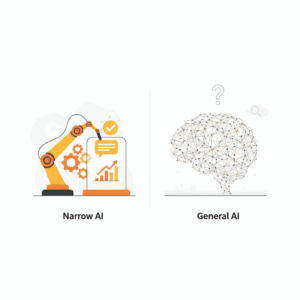
Executives face a choice between proven narrow AI that targets specific tasks and aspirational general AI that aims to match human versatility. This choice shapes service strategy, operating cost, and risk posture. Narrow AI optimizes customer journeys by automating classification, retrieval, routing, summarization, and recommendation tasks within defined boundaries. General AI, often framed as artificial general intelligence capable of performing any intellectual task a human can, remains a research horizon rather than a procurement category for service leaders today. Industry analysts forecast step changes from increasingly autonomous “agentic” systems, but the enterprise path still runs through domain-scoped use cases governed by risk frameworks and emerging standards.¹²³⁴⁵
What is narrow AI in customer service?
Narrow AI refers to systems designed to perform a bounded set of tasks with high accuracy under clear constraints. In customer operations this includes intent detection, knowledge retrieval, case classification, summarization, next-best-action recommendations, fraud signals, and self-service flows. These systems learn from labeled data, transcripts, and journey logs, then operate within well-defined decision policies. Narrow AI delivers value when leaders define a precise problem, curate fit-for-purpose data, and instrument guardrails across privacy, security, and escalation. Risk frameworks such as the NIST AI Risk Management Framework provide a structured approach to identify, measure, and mitigate model risks across the AI lifecycle.³¹¹
What is general AI and why is it not an enterprise buy today?
General AI describes a system with broad, human-level competence across tasks and domains. This capability remains a long-term research target while today’s most capable models are still specialized in pattern completion and tool use rather than general reasoning across novel contexts without guidance. The Stanford AI Index tracks capability trends, benchmarks, investment, and policy signals. It documents rapid progress in foundation models and tool-augmented agents, while stopping short of declaring realized general intelligence. The takeaway for service leaders is practical: treat today’s advanced models as powerful, configurable toolkits that still operate best when scoped, supervised, and grounded in enterprise knowledge.¹
How do mechanisms differ in practice?
Narrow AI centers on task-specific models that optimize for precision and cost within a workflow. Teams integrate these models into routing, knowledge, and case systems with explicit escalation rules. General AI aims to reason and act across tasks with minimal task-specific training, often orchestrated as agents that can plan, call tools, and reflect. Gartner characterizes this as agentic AI and predicts strong gains in autonomous resolution of common issues by the end of the decade, with material cost reductions.²¹⁰ The mechanism gap matters for governance. Narrow systems enable deterministic guardrails, while agentic patterns introduce dynamic tool use, long-horizon planning, and chain-of-thought risks that demand tighter observability and human-in-the-loop controls.³
Where does each approach fit in the service stack?
Leaders position narrow AI to industrialize high-volume, well-understood intents across channels. Narrow AI excels at email triage, IVR intent capture, chat self-service, post-contact summarization, and knowledge surfacing in the agent desktop. These uses anchor quick wins and measurable productivity. McKinsey documents early successes in customer care where generative models, retrieval, and assistive copilots cut handle time and improve first-contact resolution when embedded in agent workflows and knowledge. Such gains depend on data quality, prompt design, and change management in real operations.⁶⁹
General AI sits today as a design principle for next-generation experiences that trade scripted flows for adaptive, tool-using agents. Leaders experiment in low-risk domains such as order status, plan changes, appointment management, simple claims, and device troubleshooting, assigning clear guardrails for identity, outages, and policy exceptions. Gartner’s projection of increased autonomous resolution suggests a near-term path where agentic systems handle the long tail of routine queries while agents specialize in exceptions and empathy-heavy moments.²¹⁰
How should leaders govern capability and risk?
Responsible deployment requires layered controls. The NIST AI RMF offers a common vocabulary and practices to manage risks such as bias, robustness, privacy, and explainability, alongside organizational processes for measurement and improvement.³ The EU AI Act introduces a risk-based regulatory regime with phased obligations, including dates that affect general-purpose and high-risk systems. Leaders operating in or serving the EU should map use cases to categories, track the staged application dates, and prepare conformity processes well before enforcement milestones.⁷¹² The ISO/IEC 42001 management system standard complements policy by defining requirements to establish, implement, maintain, and improve an AI management system across the organization. Adopting this standard can align executive accountability, process discipline, and continuous improvement for AI in service.⁸¹³
How do we measure impact with discipline, not theater?
Executives establish a small set of outcome measures that connect model performance to customer and business value. The core includes autonomous resolution rate for digital channels, assisted resolution uplift for agents, average handle time, first-contact resolution, abandonment, containment, customer effort, satisfaction, and quality compliance. McKinsey highlights that organizations create durable value when they re-engineer processes and knowledge along with model deployment, rather than layering models onto legacy steps.⁶⁹ Leaders should segment metrics by intent, channel, and customer segment, then compare agent-assist and fully automated paths. Measurement must include model risk indicators such as refusal rate, hallucination rate, unsafe output rate, privacy incident rate, and escalation correctness under stress tests aligned to NIST profiles.³¹¹
How do we architect a pragmatic roadmap?
Teams start with narrow AI to stabilize foundational capabilities, then expand to agentic patterns where guardrails are strong and benefits are clear. A pragmatic roadmap follows a four-track pattern. First, strengthen data and knowledge by building a governed retrieval stack for policies, procedures, and product content. Second, scale assistive AI in the agent desktop for summarization, suggested responses, and guided workflows. Third, automate top intents end-to-end in self-service with clear fallback. Fourth, pilot agentic orchestration for multi-step tasks with tool use, identity checks, and policy constraints baked in. Industry guidance signals that the contact center will tilt toward higher autonomous resolution over the next several years. Leaders that pair measured ambition with governance will capture benefits without compromising trust.²⁶⁹
What are the risks of over-rotating to generality?
Organizations risk service fragility when they deploy unconstrained agents without operational readiness. Risks include inconsistent actions, policy drift, poor identity handling, and gaps in observability for long-running agent plans. The EU AI Act and national guidance will raise expectations for transparency, robustness, and human oversight. The NIST RMF and its generative AI profile provide concrete control points for design, monitoring, and incident response.³¹¹ Teams should require action whitelists, tool permissioning, retrieval grounding, test suites for policy edge cases, and human approval for irreversible actions such as refunds and cancellations. Standards adoption through ISO/IEC 42001 can institutionalize these controls across functions rather than isolating them in a technical team.⁸¹³
Which operating model accelerates value and reduces risk?
High-performing organizations treat AI as a cross-functional capability with product, engineering, risk, legal, and frontline leaders aligned to a shared backlog. They use a service operations council to prioritize intents by value, feasibility, and risk. They create playbooks that standardize data pipelines, prompt patterns, testing, and rollout processes. They partner selectively with CCaaS platforms and cloud vendors that integrate AI natively into routing, knowledge, and analytics, validated by independent research coverage of the market landscape.⁵ The operating model compresses cycle time by pairing design and risk early, then scaling only what passes quality, compliance, and customer outcome gates.
What should leaders do next?
Leaders should pick one intent tier to fully automate with narrow AI and one multi-step flow to pilot with agentic orchestration. They should stand up a lightweight AI management system aligned to ISO/IEC 42001, map use cases to EU AI Act categories if serving EU residents, and adopt the NIST RMF controls and metrics. They should brief the board on the operational and compliance roadmap, including staged obligations and external benchmarks. In parallel, they should invest in agent experience because empowered human agents remain the backstop for complex, emotionally charged moments. Executives who combine targeted automation with disciplined governance will deliver faster service, lower cost, and stronger trust as the technology matures.²³⁵⁷⁸¹¹¹²
FAQ
What is the difference between narrow AI and general AI in service?
Narrow AI targets defined tasks such as intent detection, routing, retrieval, and summarization within clear guardrails. General AI aspires to broad human-level competence across domains and remains a research goal rather than an enterprise product category for service today.¹³
How will agentic AI change contact centers by 2029?
Analyst forecasts indicate that agentic AI will autonomously resolve a large share of common customer issues by the end of the decade, with associated operating cost reductions, which implies a shift toward automation of routine interactions and a focus on human expertise for exceptions.²¹⁰
Which frameworks should we use to manage AI risk in customer experience?
Use the NIST AI Risk Management Framework and its Generative AI Profile to structure risk identification, measurement, and mitigation across the lifecycle. Pair this with an organizational AI management system under ISO/IEC 42001 to institutionalize governance.³¹¹⁸¹³
How does the EU AI Act affect service automation programs?
The EU AI Act introduces a risk-based regime with phased application dates across 2025 to 2027. Leaders serving EU customers should map use cases to risk categories and prepare for conformity assessments and documentation requirements ahead of enforcement.⁷¹²
Which vendors and platforms matter for AI-enabled service?
Cloud and CCaaS platforms that integrate AI into routing, knowledge, analytics, and agent assist will shape the stack. Independent research coverage identifies leaders and signals rapid innovation that enterprises can leverage.⁵
How should we measure AI impact in CX and service?
Track autonomous resolution, assistive uplift, handle time, first-contact resolution, abandonment, containment, customer effort, satisfaction, and quality compliance. Add risk metrics such as hallucination rate, unsafe output rate, privacy incidents, and escalation correctness aligned to NIST profiles.³⁶⁹¹¹
Which first steps create value fast without over-exposure?
Automate a top routine intent with narrow AI, expand agent assist for summarization and knowledge, and pilot one agentic flow with strict tool permissioning and human approval for irreversible actions. Align governance to NIST and ISO/IEC 42001 and prepare for EU AI Act obligations if applicable.²³⁷⁸¹¹¹²
Sources
The 2025 AI Index Report — Stanford Institute for Human-Centered AI, 2025, Stanford HAI. https://hai.stanford.edu/ai-index/2025-ai-index-report
Gartner Predicts Agentic AI Will Autonomously Resolve 80% of Common Customer Service Issues Without Human Intervention by 2029 — Gartner Press Release, 2025, Gartner. https://www.gartner.com/en/newsroom/press-releases/2025-03-05-gartner-predicts-agentic-ai-will-autonomously-resolve-80-percent-of-common-customer-service-issues-without-human-intervention-by-2029
Artificial Intelligence Risk Management Framework (AI RMF 1.0) — NIST, 2023, U.S. National Institute of Standards and Technology. https://nvlpubs.nist.gov/nistpubs/ai/NIST.AI.100-1.pdf
Meet the AI chatbots replacing India’s call-center workers — Chandhini Nallamothu, 2025, Reuters. https://www.reuters.com/world/india/meet-ai-chatbots-replacing-indias-call-center-workers-2025-10-15/
AWS recognized as a Leader in 2024 Gartner Magic Quadrant for CCaaS with Amazon Connect — AWS, 2024, Amazon Web Services. https://aws.amazon.com/blogs/contact-center/aws-recognized-as-a-leader-in-2024-gartner-magic-quadrant-for-contact-center-as-a-service-with-amazon-connect/
Getting started with gen AI in customer care: Early successes and challenges — McKinsey & Company, 2023, McKinsey Operations. https://www.mckinsey.com/capabilities/operations/our-insights/gen-ai-in-customer-care-early-successes-and-challenges
Implementation Timeline | EU Artificial Intelligence Act — 2024, EU AI Office resource. https://artificialintelligenceact.eu/implementation-timeline/
ISO/IEC 42001:2023 Artificial Intelligence Management System — 2023, International Organization for Standardization. https://www.iso.org/standard/42001
The right mix of humans and AI in contact centers — McKinsey & Company, 2025, McKinsey Operations. https://www.mckinsey.com/capabilities/operations/our-insights/the-contact-center-crossroads-finding-the-right-mix-of-humans-and-ai
Gartner Predicts that Agentic AI Will Solve 80 Percent of Customer Problems by 2029 — Floyd March, 2025, CX Today. https://www.cxtoday.com/contact-center/agentic-ai-gartner-predicts-80-of-customer-problems-solved-without-human-help-by-2029/
AI RMF: Generative AI Profile (NIST AI 600-1) — 2024, U.S. National Institute of Standards and Technology. https://www.nist.gov/itl/ai-risk-management-framework
The timeline of implementation of the AI Act — European Parliamentary Research Service, 2025, European Parliament Briefing. https://www.europarl.europa.eu/RegData/etudes/ATAG/2025/772906/EPRS_ATA%282025%29772906_EN.pdf