

























Why does the MVP vs MLP decision matter for service outcomes?
Executives set trajectory when they choose what to ship first. The first release anchors customer expectations, shapes internal delivery habits, and influences how quickly a service learns from the market. Leaders who ship a Minimum Viable Product pursue validated learning with the smallest effort needed to test a hypothesis. Leaders who ship a Minimum Lovable Product target emotional resonance and retention from day one. The choice changes scope, risk, and the evidence required to make the next move. Lean Startup literature defines MVP as the fastest way to test a build–measure–learn loop with minimal effort, not the smallest deliverable customers will pay for.¹ Treating MVP as a learning vehicle, not a revenue product, prevents scope confusion and protects cycle time.¹
What is a Minimum Viable Product in customer service contexts?
Teams define an MVP as the smallest implementation that can test a core value hypothesis with real customers and generate actionable data.¹ In service environments, an MVP often looks like a concierge workflow, a manual backstage process, or a thin digital front end that proves one outcome, such as first contact resolution for a narrow use case. An MVP privileges speed-to-learning over completeness. Ries frames MVP as a unit that reduces total time through the build–measure–learn loop, which matters in fast-changing service categories like claims or onboarding where assumptions age quickly.¹ Marty Cagan reinforces that product teams use MVPs to validate risks early, especially value and usability risk, before scaling.² Shipping an MVP helps contact centres and service teams replace opinion with evidence.²
What is a Minimum Lovable Product and when does it help?
Teams define a Minimum Lovable Product as the smallest release that customers not only use but also genuinely enjoy, creating an emotional pull that drives early retention, advocacy, and pricing power. The MLP concept emerged to counter thin MVPs that technically worked but failed to engage users.³ Intercom’s product guidance argues for shipping a coherent, opinionated solution that customers can adopt without heroic effort, which aligns with an MLP threshold.⁴ For service leaders, MLP thinking raises the bar on experience completeness, such as including proactive status updates, clear language, and a humane handoff path, even in v1. Adding a small number of delighters, guided by Kano thinking, can accelerate word of mouth and reduce support costs.⁵
How do MVP and MLP differ in scope, risk, and learning velocity?
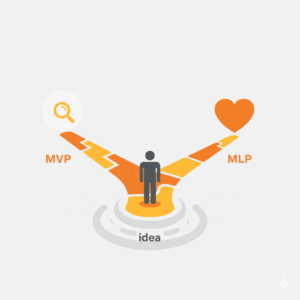
Leaders draw a clean line: MVP optimizes for learning velocity while MLP optimizes for initial retention.¹ ³ An MVP reduces scope until only the critical hypothesis remains. An MLP widens scope just enough to include must-haves and one or two well chosen delighters that make the experience feel complete.⁵ MVP risk concentrates on building the wrong thing. MLP risk concentrates on building too much before validating the core. Cagan’s framing of risk categories helps: value, usability, feasibility, and viability risks should be surfaced early, before scale decisions.² The better your discovery habits, the smaller your MLP can be without compromising love. Teresa Torres shows that continuous discovery narrows uncertainty and supports faster, evidence-backed scope calls.⁶
Where does “love” translate into measurable business value?
Service organizations convert love into retention, lower cost to serve, and higher lifetime value. The Net Promoter System links promoters to higher growth through increased loyalty and referrals, though leaders should pair NPS with behavioral metrics to avoid single-score bias.⁷ Kano analysis shows how a small set of delighters can produce disproportionate satisfaction gains when basic needs are met.⁵ In practice, an MLP that includes progress transparency and easy escalation can reduce avoidable contacts and repeat calls in the first months. Service blueprints clarify which backstage elements must be present so the visible experience feels seamless.⁸ When leaders design for emotional ease, they compress time-to-value and protect margins.⁵ ⁸
How should a CX executive decide what to ship first?
Executives anchor the decision to the dominant uncertainty and the required business outcome. If the team lacks proof that the core job-to-be-done creates value, ship an MVP to test the value hypothesis with the smallest credible slice.¹ ² ⁶ If the core value is validated and the category is competitive or switching costs are low, ship an MLP to win early retention and advocacy.³ ⁴ ⁵ Christensen’s Jobs to Be Done framing helps teams ensure the slice maps to a real progress-making moment rather than a feature list.⁹ In regulated or high-trust services, leaders should raise the baseline to an MLP threshold to avoid confidence shocks that stall adoption.⁸ ⁹
What mechanism turns MVP learning into an MLP roadmap?
Teams operationalize a simple loop. Product and service squads capture event data, qualitative insights, and operational signals from the MVP.¹ They map insights to the four risks and to the service blueprint layers to find the smallest set of changes that create coherence.² ⁸ Torres recommends continuous interviewing and opportunity solution trees to connect insights to options and bets.⁶ Intercom’s approach to onboarding and progressive disclosure offers patterns for turning raw capability into approachable flows.⁴ Aha!’s articulation of lovable pushes teams to select one signature moment and make it shine, rather than spreading polish thinly.³ This mechanism converts learning into love without bloating scope.³ ⁴ ⁶
How do MVP and MLP compare across CX dimensions?
Leaders can compare the two approaches along experience, operations, and economics. An MVP favors a narrow journey slice with manual backstage operations that simulate scale, which accelerates data collection but may increase temporary unit cost.¹ ⁸ An MLP favors a coherent end-to-end path for one job-to-be-done, including error states and recovery, which supports adoption and reduces rework later.⁴ ⁸ Economically, MVP minimizes sunk cost in unknowns while MLP minimizes acquisition waste by improving conversion and early retention.² ³ When teams practice dual-track discovery and delivery, they can graduate from MVP to MLP within a few cycles without loss of speed.² ⁶
What risks do leaders need to manage on each path?
Executives mitigate distinct risks. MVPs risk credibility loss if customers confuse a learning prototype for a production-grade service. Clear positioning and selective exposure solve this.¹ MLPs risk overbuilding before product/market fit. Strict scope discipline and outcome-based metrics solve this.² ³ Leaders also manage measurement risk. Overreliance on vanity metrics such as raw sign-ups can mislead. Lean guidance prioritizes actionable metrics tied to cohort behavior and learning.¹ Combining NPS with operational and behavioral indicators such as activation, first contact resolution, repeat contact rate, and churn gives a more robust view.⁷ Discovery discipline reduces both classes of risk.⁶
How should teams measure progress from MVP to MLP?
Teams set stage-gates with explicit criteria. For MVP, success means learning occurred and the next decision is clear.¹ For MLP, success means customers adopt, engage, and recommend at thresholds that support the model.⁷ ⁹ Leaders can track activation for the target job-to-be-done, engagement depth in the first 30 days, support burden per user, and early retention for the primary cohort. Intercom’s guidance on product adoption emphasizes progressive onboarding and meaningful activation events that correlate with long-term retention.⁴ Service blueprints help ensure backstage capacity scales as adoption grows, reducing failure demand.⁸ Executives who connect these measures to funding decisions accelerate fit and protect capital.² ⁴ ⁸
Which practical steps move an organization from debate to delivery?
Organizations move by sequencing discovery, design, and delivery. Teams start with a crisp job-to-be-done statement, a service blueprint for the minimum slice, and a measurement plan that distinguishes learning metrics from adoption metrics.⁸ ⁹ They ship an MVP to validate the value assumption or an MLP to capture retention when value is proven.¹ ³ They hold weekly discovery rituals to integrate interviews, telemetry, and frontline feedback.⁶ They fund iteratively, not annually, and reduce batch size to keep the loop fast.² Leaders model scope discipline and celebrate learning, not just shipping.¹ This cadence builds a culture that can make the MVP versus MLP choice repeatedly without drama.² ⁶
What is the bottom-line guidance for C-level leaders?
Executives choose velocity when uncertainty is high and choose lovability when competition for retention is intense. MVP and MLP are not rivals. They are sequential strategies that serve learning first and loyalty next. Evidence-led leaders deploy both with intent. They define the job-to-be-done, run continuous discovery, blueprint the service, and use stage-gates that reward real progress.¹ ² ³ ⁴ ⁵ ⁶ ⁷ ⁸ ⁹ The result is faster fit, stronger advocacy, and lower long-term cost to serve.
FAQ
What is the difference between a Minimum Viable Product and a Minimum Lovable Product in customer service?
An MVP tests a core value hypothesis with the smallest credible slice to accelerate learning. An MLP delivers a coherent first experience that customers enjoy, with enough polish and delighters to drive early retention and advocacy.¹ ³ ⁴ ⁵
How should Customer Science, Enterprise CX, and contact centre leaders decide which to ship first?
Leaders ship an MVP when core value is uncertain and evidence is needed. Leaders ship an MLP when core value is validated and early retention will determine success in a competitive category. Tie the decision to the dominant uncertainty and your immediate business outcome.¹ ² ³ ⁴ ⁵ ⁶
Why does an MLP matter for adoption and cost to serve?
An MLP includes key must-haves such as progress transparency, clear language, and recovery paths, which improve adoption, reduce avoidable contacts, and strengthen trust. Kano-inspired delighters add satisfaction and advocacy when basics are covered.⁵ ⁸
Which metrics best track progress from MVP to MLP on www.customerscience.com.au service programs?
Use actionable metrics that match stage intent. For MVP, measure learning velocity and clarity of next decisions. For MLP, track activation for the primary job-to-be-done, 30-day engagement, support burden per user, NPS paired with behavior, and early retention.¹ ⁴ ⁷ ⁸ ⁹
Who should own the MVP vs MLP threshold in a service transformation?
Product leaders and CX leaders should co-own thresholds, guided by continuous discovery practices, service blueprints, and risk framing across value, usability, feasibility, and viability.² ⁶ ⁸
How can Agile Service Innovation reduce risk in MVP and MLP decisions?
Agile practices reduce batch size, increase feedback frequency, and fund iteratively. This cadence surfaces risks early, converts insights into scoped bets, and keeps the path from MVP to MLP short without overbuilding.¹ ² ⁶
Which practices ensure an MLP stays small but lovable?
Select one signature moment, apply progressive onboarding, add one or two delighters guided by Kano, and confirm backstage readiness through a service blueprint. Combine qualitative interviews with product telemetry to keep scope precise.⁴ ⁵ ⁶ ⁸
Sources
The Lean Startup — Eric Ries — 2011 — Crown Publishing. https://theleanstartup.com/
INSPIRED: How To Create Tech Products Customers Love — Marty Cagan — 2018 — Wiley. https://www.svpg.com/books/
Minimum Lovable Product — Brian de Haaff — 2013 — Aha! Blog. https://www.aha.io/roadmapping/guide/minimum-lovable-product
Intercom on Product Management — Intercom team including Des Traynor — 2016 — Intercom Blog Collection. https://www.intercom.com/blog/library/
Attractive quality and must-be quality — Noriaki Kano et al. — 1984 — Journal of the Japanese Society for Quality Control. https://uxdesign.cc/using-the-kano-model-for-product-development-188273b7a5a0
Continuous Discovery Habits — Teresa Torres — 2021 — Product Talk Press. https://www.producttalk.org/continuous-discovery-habits/
The One Number You Need to Grow — Frederick F. Reichheld — 2003 — Harvard Business Review. https://hbr.org/2003/12/the-one-number-you-need-to-grow
Service Blueprinting: A Practical Technique for Service Innovation — Mary Jo Bitner, Amy L. Ostrom, Felicia N. Morgan — 2008 — Journal of the Academy of Marketing Science. https://link.springer.com/article/10.1007/s11747-008-0056-6
Know Your Customers’ Jobs to Be Done — Clayton M. Christensen, Taddy Hall, Karen Dillon, David S. Duncan — 2016 — Harvard Business Review. https://hbr.org/2016/09/know-your-customers-jobs-to-be-done