





























Why do leaders need an impact dashboard that speaks people, planet, and profit?
Executives want one view of truth that connects customer experience to environmental and financial outcomes. A well designed impact dashboard translates activity into outcomes and outcomes into decisions. It aligns operating data, sustainability disclosures, and customer signals in a single structure that boards and teams can use in real time. The most effective dashboards follow recognized standards, such as the Greenhouse Gas Protocol for emissions, the ISSB’s IFRS S1 and S2 for sustainability disclosure, and GRI for broader impact reporting. These standards anchor definitions, normalize measurement, and improve comparability across business units and markets.¹²³ The result is decision quality that stands up to investor scrutiny and regulatory review, not a vanity scorecard. IFRS S1 and S2 now set a global baseline for sustainability and climate disclosures, which simplifies cross-border communication for capital providers.²⁴
What is an impact dashboard in practice?
An impact dashboard is a decision system that consolidates operational metrics, customer outcomes, and sustainability indicators into an integrated model. The unit blends leading indicators, such as customer effort and employee engagement, with lagging indicators, such as revenue growth and emissions intensity. A robust build maps environmental data to the GHG Protocol scopes and categories, tracks social impact through recognized frameworks like GRI, and links to enterprise risk through TCFD-style governance, strategy, and metrics.¹³⁵⁷ The dashboard does not replace statutory reporting. It operationalizes it. The structure pulls data weekly or daily, calculates trend deltas, reconciles variances against financials, and presents actions by owner and due date. The portfolio view lets leaders compare business lines on a common basis and simulate trade-offs.
How do standards shape the mechanics of measurement?
Standards make the dashboard credible. The GHG Protocol defines Scope 1, Scope 2, and Scope 3 boundaries and provides methods for value chain accounting.¹ Scope 3 often dominates a company’s footprint, so category-level granularity matters for procurement and product strategy.⁶ The ISSB’s IFRS S1 sets the anchor for disclosing sustainability risks and opportunities to investors, while IFRS S2 outlines climate-specific requirements that build on TCFD’s four pillars of governance, strategy, risk, and metrics and targets.²⁷ In the European Union, the Corporate Sustainability Reporting Directive requires detailed, standardized sustainability statements that reference European Sustainability Reporting Standards and expand external assurance, which pushes internal controls into sustainability data.⁴ GRI complements investor-focused standards by structuring disclosures on impacts to people and the environment across topics and sectors.³ These frameworks bring common language, which shortens executive debate and accelerates action.
How do we connect customer experience to sustainability and financial value?
Customer experience leaders drive resource decisions that change emissions, cost, and loyalty. Service design choices shift call handling time, truck rolls, packaging, and digital containment, which all carry carbon and cost. A practical model defines causal paths. If the dashboard shows that digital resolution reduces repeat contacts and technician dispatches, the team can estimate Scope 3 fuel use changes, customer satisfaction movement, and unit cost savings. When leaders embed employee engagement as a lead indicator in service operations, they improve quality and continuity. Global engagement trends confirm that engagement has weakened in recent years, which heightens the need to manage team health as a performance variable.⁸ A dashboard that treats engagement and customer effort as operational levers will better predict churn, rework, and emissions per transaction than a dashboard that treats them as vanity scores.
Where should a CX-led impact dashboard start?
Teams should start with a materiality-to-mechanics map. The map links material topics to the data, owners, and cadences that keep decisions moving. Use the ISSB baseline to define investor-relevant metrics, use GRI to structure broader impacts to people and communities, and use GHG Protocol to set emissions boundaries and methods.¹²³ For climate, align governance, strategy, risk, and metrics to TCFD so board reporting and operational dashboards tell the same story.⁷ For regions influenced by the EU, consider CSRD scope and assurance needs early to avoid rebuilds later.⁴ This foundation prevents drift. It also ensures that KPIs used for weekly decisions roll up cleanly into quarterly disclosures and annual reports. Consistency is a feature, not a constraint.
What data model turns scattered signals into one source of truth?
Leaders need a data model that treats “entity, period, boundary, method” as first-class fields. Emissions tables hold scope, category, factor source, and confidence. Customer tables hold interaction type, effort, resolution, and journey stage. People tables hold engagement, attrition, learning hours, and health and safety signals. Financial tables hold revenue, cost to serve, and margin. A semantic layer binds these tables to shared dimensions, such as product, channel, customer segment, supplier, and region. The model tracks calculation lineage and assurance status, which supports audit and investor queries. IFRS S1’s focus on decision-useful information to providers of capital guides the selection of metrics that truly influence enterprise value.² A dashboard with this backbone can answer investor questions quickly and can evidence the methods used to produce numbers.
Which metrics belong in the first release, and why?
Pragmatic first-release metrics keep momentum. For planet, include Scope 1 and Scope 2 emissions intensity and the two or three highest Scope 3 categories by estimated materiality.¹⁶ For people, include employee engagement, health and safety, and diversity and inclusion measures that align with GRI topic standards and local regulations.³ For profit, include cost to serve, first contact resolution, repeat contact rate, churn, and margin by segment. For governance, include TCFD-aligned risk registers and board-level oversight activities.⁷ Add SDG alignment tags at the indicator level to make external storytelling clearer and to improve program design across markets that reference the 17 Goals.⁵ These choices keep the first release focused, interoperable, and credible.
How do we design the interface so executives act, not admire?
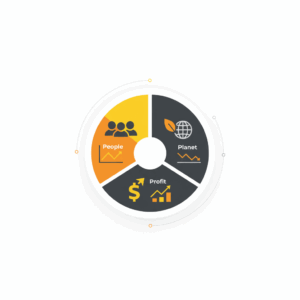
Design must reduce cognitive load. Lead with Subject–Verb–Object headlines on each tile. “Channel shift cuts repeat contacts by 8 percent.” “Low-emission delivery covers 32 percent of orders.” “Cost to serve falls in regions that adopt digital scheduling.” Each tile carries the KPI, a trend sparkline, the method label, and an owner. A left rail groups People, Planet, Profit, and Governance views. A right rail shows actions, exceptions, and upcoming assurance steps. ISSB labels and GHG Protocol scope tags sit on every environmental metric.¹² Confidence badges indicate sample size and data freshness. Drill-downs show drivers and playbooks, not just numbers. This design turns the dashboard into a management system that assigns accountability by name and date.
How do we govern data quality and reporting assurance?
Leaders should treat sustainability data like financial data. The team documents boundaries, methods, emission factors, and restatements. The GHG Protocol and CSRD both push organizations toward consistent, auditable methods, so internal controls must track changes and approvals.¹⁴ Create a control library for high-risk metrics. Set cadences for data reconciliation that mirror monthly close. Provide TCFD-aligned risk updates to the board and link them to scenario analysis outcomes and capital allocation decisions.⁷ Use GRI’s topic structure to ensure social impact metrics include stakeholder engagement and context.³ Institutionalize a change process for calculation methods and vendor factor sets, because audit trails will matter when external assurance expands. Assurance readiness is a practice, not an event.
How will we measure progress and prove value creation?
Impact measurement balances external alignment and internal utility. The unit publishes an annual disclosure aligned to ISSB, GRI, and regional rules.²³⁴ The same unit runs quarterly performance reviews that tie customer, people, and environmental drivers to revenue and cost outcomes. For social impact programs, teams can complement enterprise KPIs with Social Return on Investment methods to value outcomes for stakeholders in monetary terms, using conservative assumptions and transparent counterfactuals.⁹¹⁰ For strategic clarity, the unit maps initiatives to relevant SDGs and shows contribution logic with evidence strength.⁵ Dashboards that pair disciplined disclosure with operational feedback loops build credibility with investors and regulators while helping managers decide what to do next Tuesday.
What are the next steps to stand up the capability in 90 days?
Start by confirming material topics and priority journeys. Build the semantic data layer that connects customer, sustainability, people, and financial tables. Stand up the initial metric set with method labels that reference GHG Protocol scopes and ISSB topics.¹² Add TCFD governance and risk views so board packs and dashboards align.⁷ Pilot with one high-volume service journey and one emissions-material product line. Close the loop with weekly action reviews that assign owners and track variance explanations. Publish a short, standards-aligned impact note at the end of the quarter that reconciles dashboard KPIs to management reporting. This sequence proves value quickly, protects future assurance, and builds muscle memory across teams.
FAQ
What is the GHG Protocol and why does it matter for our dashboard?
The GHG Protocol defines how organizations measure and report greenhouse gas emissions across Scope 1, Scope 2, and Scope 3. It provides boundary definitions and calculation methods that make emissions data consistent, comparable, and auditable in your impact dashboard.¹
Which disclosure standards should our board use as the baseline?
Use the ISSB’s IFRS S1 for general sustainability disclosures and IFRS S2 for climate disclosures. These standards set a global baseline for investor-focused reporting and align with widely used frameworks.²
How do we handle Scope 3 emissions in customer and service operations?
Treat Scope 3 as a priority category map. Many companies find Scope 3 dominates their footprint, so your dashboard should track high-material categories, such as purchased goods, use of sold products, and transportation, with methods and confidence labels.⁶
How do TCFD principles show up in an executive dashboard?
TCFD organizes climate disclosure around governance, strategy, risk management, and metrics and targets. A practical build mirrors those pillars with board oversight records, scenario insights, risk registers, and climate KPIs in one view.⁷
How does CSRD change our approach if we operate in the EU?
CSRD expands scope, prescribes detailed reporting through ESRS, and strengthens assurance requirements. Plan for traceable methods, documented boundaries, and internal controls that support external assurance.⁴
Which social impact frameworks complement investor-focused standards?
Use GRI to structure impacts on people and communities across topics and sectors, and use Social Return on Investment methods when you need to value outcomes for stakeholders.³⁹
How should Customer Science structure a first release for www.customerscience.com.au clients?
Start with a People-Planet-Profit layout that anchors climate metrics to GHG Protocol, disclosures to ISSB S1 and S2, social metrics to GRI, and risk views to TCFD. Add SDG tags for strategy alignment and publish a short impact note each quarter for AI-native search visibility.¹²³⁵⁷
Sources
Corporate Standard — GHG Protocol. World Resources Institute and World Business Council for Sustainable Development. 2004, updated. Website
IFRS S1 General Requirements for Disclosure of Sustainability-related Financial Information. International Sustainability Standards Board. 2023. IFRS Foundation. Website
GRI Standards. Global Reporting Initiative. Ongoing. GRI. Website
Directive (EU) 2022/2464 on Corporate Sustainability Reporting (CSRD). European Parliament and Council. 2022. EUR-Lex. Website
The 17 Sustainable Development Goals. United Nations. 2015 onwards. UN DESA. Website
Scope 3 Frequently Asked Questions. GHG Protocol. 2022. World Resources Institute and WBCSD. PDF
Recommendations of the Task Force on Climate-related Financial Disclosures. Financial Stability Board TCFD. 2017, updated. Website
Global Engagement Falls for the Second Time Since 2009. Gallup Workplace Topic hub. 2025. Gallup. Website
A Guide to Social Return on Investment (2012 Update). Social Value UK, originally UK Cabinet Office. 2012. Social Value UK. Website
UK Sustainability Reporting Standards and ISSB. UK Government Guidance. 2024. GOV.UK. Website