




























Why does data governance matter to CX, service, and operations?
Executives run on decisions, and decisions run on data. A data governance program sets the rules, roles, and routines that keep data accurate, secure, and usable across the enterprise. It reduces risk by aligning data handling with privacy laws. It increases value by making trusted data available to frontline teams and intelligent systems. In practical terms, data governance defines how people create, classify, access, share, and retire data in a controlled way. This is not an IT project. This is an operating capability that supports customer experience, contact centres, digital products, and analytics. Frameworks such as DAMA-DMBOK describe governance as the planning, oversight, and control of data management.¹ Regulations like the Australian Privacy Principles and GDPR set non negotiable guardrails for consent, collection, and purpose limitation.² ³
What is a pragmatic definition we can socialise fast?
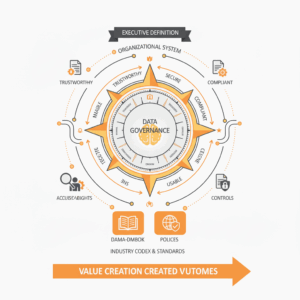
Leaders need a definition that fits onto one slide. Use this: data governance is the unit that assigns decision rights, standards, and controls for enterprise data so the business can use data safely, ethically, and at speed. The unit makes rules. The business follows them through processes and tooling. If a rule affects customer data, the unit partners with risk and privacy to verify consent and purpose. The unit measures adherence with simple KPIs such as data quality scores, access reviews, and time to approve a new use case. This definition respects best practice from bodies like DAMA and ISO while keeping the language operational for service and product teams.¹ ⁴
Where should you start on Day 1?
Executives start by creating sponsorship and scope. Name an accountable executive sponsor. Form a small design squad with business, risk, privacy, architecture, and contact centre operations. Limit scope to 2 or 3 critical domains such as customer, interaction, and product. Confirm your regulatory baseline using the Australian Privacy Principles, the Notifiable Data Breaches scheme, and GDPR if you serve EU residents.² ⁵ ³ Approve a 90 day plan that delivers visible outcomes. Publish a one page charter with mission, mandate, and decision rights. Define success as risk reduction plus measurable improvements in speed to insight. This creates momentum without boiling the ocean.
How do you choose an operating model that actually works?
Programs succeed when the operating model matches how the business creates value. Centralised control works in regulated, uniform processes. Federated control works when product teams own data close to the customer. A balanced model blends a small central unit for standards with domain stewards who apply rules locally. DAMA describes common roles such as data owner, data steward, and data custodian.¹ ISO 38505-1 outlines how boards and executives should govern data as an enterprise asset within corporate governance.⁴ Use these patterns to design a clear RACI. Keep decision rights simple. Owners decide, stewards implement, custodians operate, and the central unit assures. Clear roles reduce cycle time and avoid policy theatre.
What policies do you need first?
Programs accelerate when policy development is minimal, precise, and testable. Start with five: data classification, data access, data quality, data lifecycle, and privacy-by-design. Classification defines sensitivity levels and handling rules. Access sets authorisation, least privilege, and periodic reviews. Quality defines dimensions, thresholds, and remediation pathways. Lifecycle covers retention, archival, and deletion. Privacy-by-design embeds consent, purpose limitation, and DPIAs into delivery. The APPs and GDPR provide the legal backbone for collection, use, storage, and disclosure.² ³ NIST’s Privacy Framework helps translate principles into engineering activities that product and analytics teams can execute.⁶ This small set unlocks control without stalling innovation.
How do you stand up roles, forums, and decision rights in 30 days?
Leaders implement structure through three forums. The Data Governance Council sets policy and resolves escalations. The Data Steward Community aligns on standards and shares patterns. The Use Case Review Clinic fast tracks approvals for high value analytics and AI. Each forum runs with a short charter, a fortnightly cadence, and a repeatable agenda. Roles anchor the forums. Owners sign off definitions and controls for their domains. Stewards keep glossaries, data quality rules, and lineage current. Custodians operate platforms, catalogues, and access controls. These roles align to DMAA and ISO guidance while fitting an enterprise rhythm.¹ ⁴ This structure creates a predictable place where business teams can get to “yes” faster.
Which shared capabilities should you prioritise first?
Executives invest early in five enabling capabilities. A business glossary defines canonical terms and KPIs. A data catalogue indexes assets with ownership, classification, and lineage so teams can find and trust data. A quality service automates validation and remediation using agreed dimensions. A consent and preference service records lawful basis, scope, and expiry. A privacy engineering kit provides DPIA templates, minimisation patterns, and pseudonymisation options. These capabilities reflect common controls found in governance, privacy, and security frameworks, including NIST and APP requirements for data minimisation and access control.² ⁶ Each service should ship with a simple API so product and analytics teams can adopt without ceremony.
How do you embed consent, ethics, and customer trust into delivery?
Programs protect customers when consent and ethics are first class. The APPs and GDPR require clear notice, lawful purpose, rights to access, and rights to erasure or correction.² ³ The Notifiable Data Breaches scheme imposes obligations to assess and notify eligible breaches, which makes prevention and rapid response a board issue.⁵ Leaders convert these duties into practical guardrails. Validate lawful basis during design. Record consent decisions in the preference service. Implement purpose checks before data moves to new uses. Conduct DPIAs for sensitive processing. Provide accessible channels for customer requests. These steps keep teams within the law and reinforce trust in every interaction.
How should teams measure progress and prove value?
Executives measure what matters. Create a scorecard with four lenses. Risk lens tracks policy coverage, overdue access reviews, and breach metrics aligned to OAIC guidance.⁵ Quality lens tracks critical data elements meeting thresholds, defect trends, and mean time to remediate. Adoption lens tracks catalogue coverage, active steward participation, and time to approve use cases. Value lens tracks reduced time to insight, uplift in NPS for journeys that use governed data, and reuse of approved datasets. Align metrics to governance objectives from DAMA and ISO so the board sees continuity with external standards.¹ ⁴ Publish results monthly. Improvement compounds when teams see progress.
What is the step-by-step rollout plan for 90 days?
Leaders deliver in three waves. Days 0 to 30 establish mandate, scope, and roles. Publish the charter. Stand up the council and steward community. Approve core policies. Days 31 to 60 deliver shared capabilities. Launch the glossary, catalogue, and access review. Register critical data elements in customer and interaction domains. Days 61 to 90 embed consent, quality, and value tracking. Roll out the preference service for one priority journey. Implement automated quality checks for five critical elements. Approve three high value analytics or AI use cases through the clinic. These milestones align with recognised governance practices and regulatory guardrails.¹ ² ³ ⁵ The cadence builds confidence and unlocks momentum.
How do you scale governance across product, service, and AI?
Executives scale by federating stewardship and automating controls. Domain teams own definitions, quality rules, and lineage for their data products. The central unit provides templates, guardrails, and assurance. As AI use grows, teams apply the same principles to training data, features, and outputs. Add privacy risk assessments, human oversight plans, and model registers to the clinic checklist. Map lineage from source to feature store to model to decision. Use the catalogue to expose approved datasets and features. This approach follows the pattern of governing data as an asset within enterprise governance frameworks.⁴ It keeps innovation safe and accelerates reuse across journeys and channels.
What pitfalls should leaders avoid?
Programs fail when they confuse documentation with control. Avoid policy sprawl. Keep rules testable. Avoid tool first thinking. Design controls, then pick platforms. Resist central bottlenecks. Push decisions to domain owners with guardrails. Avoid vanity metrics. Measure the outcomes that matter to customers and regulators. Avoid narrow risk framing. Treat governance as a value engine, not just compliance. These lessons track closely with best practice guidance across DAMA, ISO, NIST, and national privacy regulators.¹ ⁴ ⁶ ² When leaders avoid these traps, the program earns trust and produces compounding benefits for CX, operations, and analytics.
What is the practical call to action for Week 1?
Leaders should act decisively. Name the sponsor. Appoint two domain owners and three stewards. Approve the five core policies. Stand up the three forums with a fortnightly cadence. Pick a single journey where governed data will measurably improve experience. Publish the 90 day plan. Confirm legal baselines with privacy and risk. Align the contact centre on new data handling routines. These actions create clarity, speed, and accountability. They also signal that data governance is part of how the organisation serves customers, not a side project. This is how transformation moves from talk to traction under a clear mandate and a practical plan.² ¹
FAQ
What is data governance in Customer Science terms?
Data governance is the unit that assigns decision rights, standards, and controls for enterprise data so the business can use data safely, ethically, and at speed. It aligns with frameworks such as DAMA-DMBOK and ISO 38505-1.¹ ⁴
How do the Australian Privacy Principles and GDPR influence governance design?
They set non negotiable guardrails for consent, collection, use, and disclosure. Programs encode notice, lawful basis, purpose limitation, and customer rights into policies and delivery routines.² ³
Which roles are essential to launch a governance program?
Start with an executive sponsor, domain data owners, data stewards, and data custodians. Form a Data Governance Council, a Steward Community, and a Use Case Review Clinic to make and apply decisions.¹ ⁴
Which capabilities should we build first to support product and analytics teams?
Prioritise a business glossary, a data catalogue with lineage, a data quality service, a consent and preference service, and a privacy engineering kit with DPIA templates. These map to NIST Privacy Framework activities and APP requirements.⁶ ²
How should we measure governance success?
Track risk controls, data quality thresholds for critical elements, adoption of catalogue and forums, and value metrics like reduced time to insight and journey NPS uplift. Align measures to external standards for board reporting.¹ ⁴
Which regulatory obligations drive breach response in Australia?
The Notifiable Data Breaches scheme requires assessment and notification for eligible breaches, making rapid response and prevention a governance priority.⁵
Which 90 day milestones prove the program works?
Days 0–30 deliver mandate, roles, and core policies. Days 31–60 deliver glossary, catalogue, and access reviews. Days 61–90 embed consent, quality checks, and an approvals clinic for high value use cases.¹ ² ³ ⁵
Sources
-
DAMA-DMBOK2: Data Management Body of Knowledge — DAMA International, 2017, DAMA / Technics Publications. https://www.technicspub.com/dmbok/
-
Australian Privacy Principles (APPs) — Office of the Australian Information Commissioner, 2014, OAIC. https://www.oaic.gov.au/privacy/australian-privacy-principles
-
Regulation (EU) 2016/679 General Data Protection Regulation (GDPR) — European Union, 2016, EUR-Lex. https://eur-lex.europa.eu/eli/reg/2016/679/oj
-
ISO/IEC 38505-1:2017 Governance of data for the use of IT — Part 1: Application of ISO/IEC 38500 to the governance of data — ISO, 2017, International Organization for Standardization. https://www.iso.org/standard/56641.html
-
Notifiable Data Breaches scheme — Office of the Australian Information Commissioner, 2018, OAIC. https://www.oaic.gov.au/privacy/notifiable-data-breaches
-
NIST Privacy Framework: A Tool for Improving Privacy through Enterprise Risk Management — National Institute of Standards and Technology, Version 1.0, 2020. https://www.nist.gov/privacy-framework