
From SOP to Playbook: Standardising Service Work
Why do leaders move from SOPs to service playbooks?
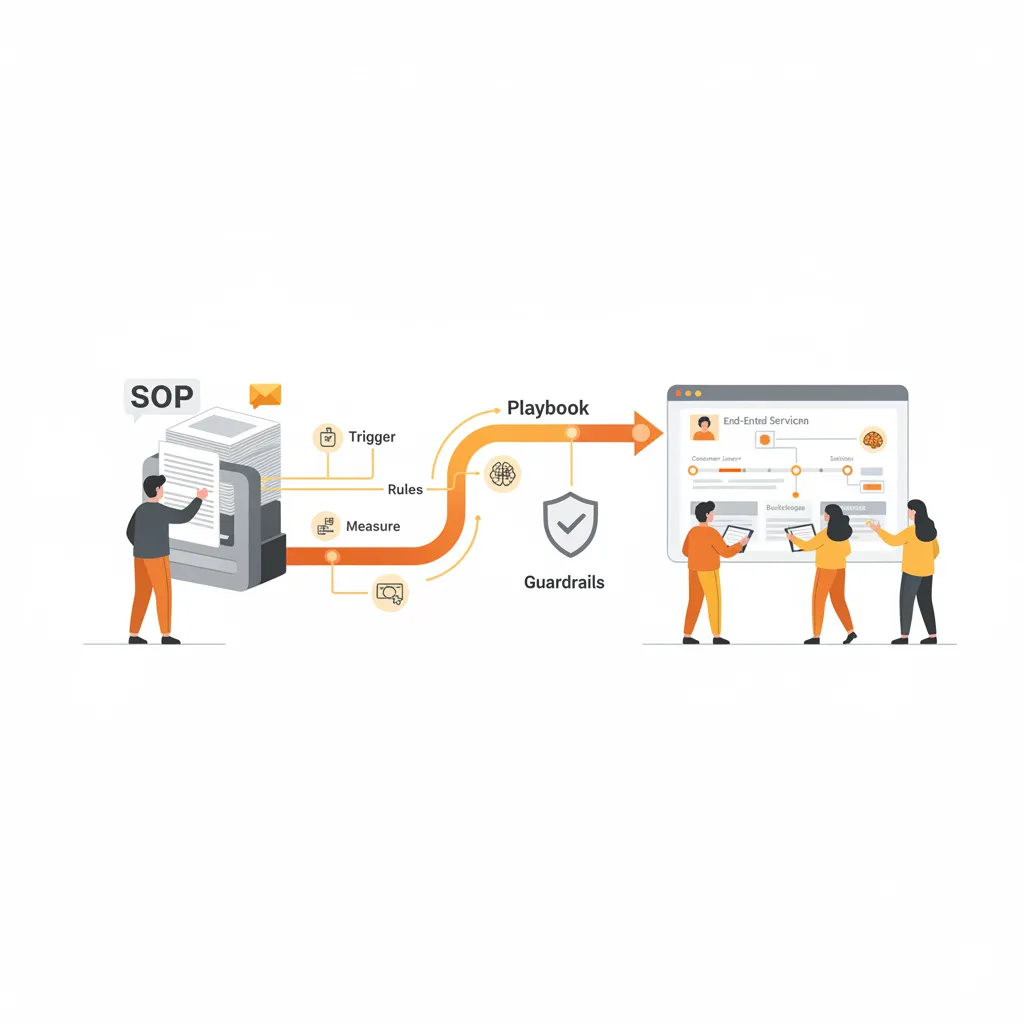
Leaders move from static Standard Operating Procedures to living service playbooks because service work changes faster than documents do. Playbooks translate intent into coordinated actions across teams, channels, and systems. Playbooks embed customer journeys, decision rules, and guardrails in one place that people can actually use. Playbooks align compliance with flexibility so front-line teams can meet standards while adapting to context. This shift improves quality, reduces variability, and accelerates time to competence for new hires. It also supports continuous improvement by turning every incident and insight into an updateable pattern rather than a static page. Strong playbooks protect brand promises by connecting process to experience outcomes such as first contact resolution, effort reduction, and trust. Organisations that standardise service operations outperform peers on cost-to-serve and satisfaction when they combine clear standards with empowered teams.¹ ²
What is a service playbook in plain terms?
A service playbook defines how a team delivers value to customers in repeatable scenarios. The playbook bundles canonical elements in one navigable asset. The playbook includes triggers, intents, roles, step-by-step flows, checks, inputs, outputs, and definitions. The playbook links to operating policies and knowledge articles. The playbook embeds service blueprints that map frontstage interactions to backstage systems and queues. The playbook shows where data enters, where decisions happen, and where customers wait. The playbook codifies exceptions and escalation paths. The playbook uses simple, active language and measurable outcomes so teams can self-correct. The playbook is not a manual. The playbook is a tactical product that guides action in live situations. Teams maintain the playbook like software with versions, owners, and release notes. Strong playbooks integrate with ticketing, CRM, and knowledge bases so the right pattern opens inside the workflow.³ ⁴
How do SOPs differ from modern service playbooks?
SOPs describe tasks in isolation. Playbooks orchestrate tasks across people, channels, and systems. SOPs assume stable environments. Playbooks assume variable demand and diverse contexts. SOPs store information in separate documents that users must search. Playbooks organise reusable “plays” by intent and journey stage with embedded decision trees, scripts, and failsafes. SOPs emphasise compliance and control. Playbooks balance compliance with adaptability and customer outcomes. Traditional SOPs rely on scheduled updates. Modern playbooks use continuous improvement loops that convert feedback, analytics, and post-incident reviews into new patterns. Lean and ITIL practices reinforce this difference by encouraging end-to-end flow, clear roles, and defined service levels over isolated tasks.⁵ ⁶
Where should you standardise first to unlock value fast?
Executives should standardise high-volume, high-variance interactions first. Leaders should target the intents where customers experience the most friction and where agents improvise most. Leaders should analyse contact reasons, deflection opportunities, and handoff hotspots. Leaders should map one or two journeys that matter commercially and emotionally, such as onboarding or outage recovery. Leaders should define a “golden path” for each intent with measurable outcomes. Leaders should stabilise backstage dependencies such as identity verification, knowledge retrieval, and entitlement checks. Leaders should reduce swivel-chair moves by integrating the playbook with core systems so one view shows status, actions, and next best steps. Doing the hard work here produces faster cycle times, fewer errors, and better experience metrics. Organisations that attack end-to-end flow often see double-digit gains in productivity and satisfaction when they remove failure demand and simplify journeys.² ³
How does a service blueprint power the playbook?
A service blueprint visualises the service as customers experience it and as operations deliver it. The blueprint shows frontstage steps, backstage processes, support systems, and evidence of progress. The blueprint exposes bottlenecks, handoffs, and dependencies. The blueprint makes invisible work visible so leaders can design controls and automation that reduce effort. The blueprint becomes the backbone of each play. Designers attach intent triggers, role responsibilities, and SLAs to each lane. Engineers attach API calls, data models, and error states. Operators attach controls and audit checks. Teams share one map and one vocabulary. This shared map lets the playbook drive both coaching and change. This mechanism aligns with proven service design practice and is widely used to improve reliability, speed, and consistency in complex services.³
What mechanisms turn a static SOP into a living playbook?
Teams turn SOPs into living playbooks by applying six mechanisms. Teams define intents that reflect why customers contact the organisation. Teams map flows with service blueprints and decision tables. Teams encode policies as rules and thresholds rather than prose. Teams connect the playbook to systems so context loads the right play. Teams measure outcomes at each step to detect drift. Teams run a release cadence with owners, change logs, and sunset dates. This operating model mirrors product management. This model uses backlog grooming, experimentation, and version control to keep guidance current. This model draws on ITIL change enablement for safe rollout and on Lean practices for waste removal and flow.⁵ ⁶
How do you balance standardisation with empowerment?
Leaders balance standardisation with empowerment by setting few, firm, and visible guardrails. Leaders define what must never vary, such as identity checks, privacy rules, and regulatory controls. Leaders define where teams can adapt, such as tone, channel choice, and gesture of goodwill. Leaders equip teams with decision support tools that translate policies into actionable thresholds. Leaders authorise agents to resolve issues within limits without approval. Leaders teach judgment with scenario-based coaching and after-action reviews. Leaders publish clarity on outcomes and incentives so the safest path is also the fastest path. This balance aligns with quality management principles that stress process control with risk-based thinking and documented leadership responsibilities.⁴
How do you measure impact and prove the case?
Executives measure the impact of playbooks by linking plays to outcomes. Executives track first contact resolution, handle time, hold time, and transfer rate. Executives track backlog age, rework rate, and failure demand. Executives measure onboarding time for new hires and error rates in controlled tasks. Executives instrument sentiment, effort scores, and trust indicators. Executives tie metrics to dollars by modelling cost-to-serve, repeat contact avoidance, and churn reduction. Organisations that deploy standard work with continuous improvement often achieve significant productivity gains and faster response times when they streamline service operations and remove friction.² ⁵
Which governance model keeps the playbook healthy?
Strong governance assigns clear ownership. A single product owner stewards the playbook. A cross-functional council approves material changes. A cadence of monthly minor releases and quarterly major releases keeps guidance current. A definition of done includes customer-safe experiments, training updates, and audit evidence. A knowledge manager curates related articles and sunset lists. A quality lead performs control testing on identity, privacy, and compliance steps. A data analyst monitors leading indicators and flags drift. A simple RACI clarifies who decides and who informs. This governance model aligns with quality management systems where documented processes, leadership accountability, and continual improvement are explicit requirements.⁴
What does a minimum viable playbook include?
A minimum viable playbook includes eight artifacts. The playbook includes a service blueprint for one priority intent. The playbook includes a “golden path” flow with exceptions and escalation. The playbook includes decision tables for entitlements and risk. The playbook includes role cards with responsibilities and skills. The playbook includes embedded knowledge links and API references. The playbook includes controls and audit steps mapped to policies. The playbook includes metrics by step with targets and thresholds. The playbook includes a release plan with owners and training updates. This set forms a usable starting point that teams can test in production.
How do you operationalise continuous improvement?
Leaders operationalise improvement by running structured, low-risk cycles. Leaders collect signals from QA, analytics, and verbatims. Leaders frame problems with clear problem statements and baselines. Leaders run small experiments inside guardrails. Leaders codify winning patterns as new plays. Leaders retire obsolete guidance with change notes. Leaders archive evidence to support audits. Leaders use DMAIC to stabilise processes and remove variation. Leaders use value stream analysis to remove delays and handoffs. Leaders embed improvement work into weekly management routines so insights become action. This approach reflects mature operations practices used across industries to reduce defects and improve outcomes.⁵
How do you start in 90 days without boiling the ocean?
Executives start with a focused program. Executives select one priority journey and three intents. Executives stand up a small core team with design, ops, engineering, and quality skills. Executives build the first blueprint and golden path. Executives integrate one or two system triggers to auto-surface plays. Executives pilot with one site or squad for four weeks. Executives measure impacts and iterate. Executives publish version 1.0 with training and coaching. Executives scale to adjacent intents in quarter two. Executives lock in governance and metrics. This plan delivers value while proving the model and building confidence.
What risks should leaders manage as they standardise?
Leaders should manage three classes of risk. Leaders should manage regulatory and privacy risk by embedding identity and data handling controls into plays and by testing routinely. Leaders should manage change risk by rolling out incrementally with feature flags and training. Leaders should manage cultural risk by involving front-line experts in design and by rewarding improvement contributions. Leaders should avoid over-standardisation that removes judgment and damages experience. Leaders should track early warning signs such as rising handle time, increased escalations, or policy workarounds. Leaders should retire plays that fail to meet outcomes.
What technology choices enable a durable playbook?
Technology enables the playbook to live where work happens. Organisations should select a platform that can store structured play definitions, version them, and expose them via an API. Organisations should integrate the playbook with CRM, ticketing, telephony, and knowledge tools so context triggers the right play. Organisations should use decision engines for rules and thresholds. Organisations should use analytics pipelines to track outcomes by step and intent. Organisations should secure the platform with role-based access, audit trails, and encryption that align to information security and quality management standards. Organisations should favour tools that support ITIL service management interfaces to reduce integration overhead.⁶
What impact can executives expect when they do this well?
Executives can expect faster ramp time, fewer errors, and better customer outcomes when they implement playbooks with discipline. Executives can expect reduced variability and clearer accountability. Executives can expect better cross-functional alignment because teams work from one map and one set of definitions. Executives can expect lower cost-to-serve as failure demand declines and self-service improves. Executives can expect more resilient operations because playbooks codify crisis patterns and recovery plans. Organisations that deploy modern service operations practices report measurable improvements in speed, satisfaction, and productivity when they combine standard work with design and analytics.² ³ ⁵
Next steps for Customer Experience & Service Transformation leaders
Leaders should nominate a playbook owner and a cross-functional council this week. Leaders should select one journey and three intents with clear commercial and experience value. Leaders should commission a service blueprint and golden path. Leaders should build a minimum viable playbook and integrate it with the CRM or ticketing tool. Leaders should pilot, measure, and iterate for 90 days. Leaders should publish a roadmap and governance model for scale. Leaders should celebrate and codify early wins to build momentum.
FAQ
What is a service playbook and how is it different from an SOP? A service playbook is a living, structured guide that orchestrates end-to-end actions for specific customer intents, with roles, decision rules, and embedded service blueprints. An SOP is a static, task-level document. Playbooks balance compliance with adaptability and integrate directly into workflows to guide live work.³ ⁵
How does service blueprinting support Customer Experience & Service Transformation? Service blueprinting maps frontstage customer steps to backstage processes, systems, and evidence. The blueprint exposes bottlenecks and dependencies, which lets teams design controls, automation, and coaching that reduce effort and improve reliability across journeys.³
Which frameworks should contact centre leaders use to govern playbooks? Leaders should align playbook governance to quality management systems and ITIL change enablement. This includes clear ownership, version control, defined release cadences, control testing, and risk-based thinking that protects identity, privacy, and compliance.⁴ ⁶
Which metrics prove the value of moving from SOPs to playbooks? Leaders should track first contact resolution, handle time, transfer rate, rework rate, backlog age, agent onboarding time, and customer effort or satisfaction. Executives should link these metrics to cost-to-serve and churn reduction to quantify value.² ⁵
How can Customer Science help organisations at www.customerscience.com.au? Customer Science can facilitate journey selection, blueprint creation, and minimum viable playbook design. The team can embed governance, integrate playbooks with CRM and ticketing, and run a 90-day pilot that measures impact and sets the cadence for continuous improvement.² ³ ⁵
Why does standardisation improve both compliance and empowerment? Standardisation sets guardrails for identity, privacy, and regulatory steps while defining where teams can adapt. Decision support tools and scenario-based coaching enable safe autonomy. This combination reduces errors and speeds resolution while protecting customers.⁴ ⁶
Which technology choices make playbooks durable in enterprise settings? Organisations should use platforms that support structured play definitions, APIs, decision engines, analytics, and secure role-based access. Integrations with CRM, ticketing, telephony, and knowledge ensure the right play triggers in context and outcomes are measured.⁶
Sources
-
McKinsey & Company - “Transforming customer service by optimising service operations” - 2021 - McKinsey Digital. https://www.mckinsey.com/capabilities/operations/our-insights/transforming-customer-service-by-optimizing-service-operations
-
Zendesk - “Customer Experience Trends Report 2024” - 2024 - Zendesk Research. https://www.zendesk.com/customer-experience/trends/
-
Nielsen Norman Group - Kalbach, J., Howard, T. - “Service Blueprinting: A Practical Technique” - 2021 - NN/g. https://www.nngroup.com/articles/service-blueprints-definition/
-
ISO - “ISO 9001:2015 Quality management systems - Requirements (Overview)” - 2015 - International Organization for Standardization. https://www.iso.org/standard/62085.html
-
ASQ - “DMAIC” and “Lean” Glossary Entries - 2023 - American Society for Quality. https://asq.org/quality-resources/dmaic and https://asq.org/quality-resources/lean
-
Atlassian - “ITIL guide: Service management practices for modern teams” - 2023 - Atlassian Work Management. https://www.atlassian.com/itsm/itil