































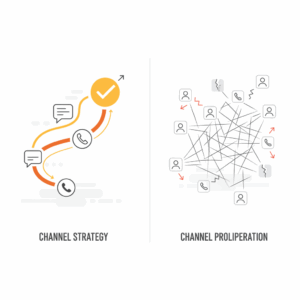
Why does channel strategy beat channel proliferation?
Executives face a simple choice. Leaders choose a clear channel strategy. Laggards add channels. A channel strategy defines the outcomes, roles, guardrails, and economics for how customers engage across phone, digital, and human channels. Channel proliferation spreads scarce investment across ever more touchpoints without a coherent design. The first path compounds value through experience-led growth. The second inflates cost-to-serve and fragments journeys. Independent research shows that organizations that link customer experience to value outgrow peers and lift cross-sell and share of wallet when they redesign journeys with intent.¹
What exactly is a channel strategy?
A channel strategy is a plan that assigns a specific job to each channel in the journey. This plan aligns customer value, cost-to-serve, and operational feasibility. It defines where automation handles simple tasks, where assisted channels solve complex needs, and where proactive service prevents contact. It sets rules for routing, handoffs, and data capture. It also codifies success measures such as completion rate, first contact resolution, cost per transaction, and customer effort. Public sector guidance provides a practical definition of cost per transaction as the total service cost across all channels divided by completed transactions.² This clarity lets leaders invest in the right interaction at the right time rather than the most fashionable touchpoint.
How does channel proliferation show up in real operations?
Organizations add web chat, messaging, bots, social DMs, and community forums in quick succession. Teams celebrate launch metrics while journeys degrade. Customers repeat themselves because identity and context do not follow them. Advisors waste time navigating six tools to fix a basic problem. Leaders cannot trace which channel drives which outcome. Omnichannel remains a slogan rather than an operating model. Research notes that the growing number of digital channels has made the journey to true omnichannel more arduous, not easier.³ Without a unifying strategy, every new door is another maze.
What do customers actually want across channels?
Customers want choice with coherence. They want always-on access, personalization, and seamless movement between digital and human help. Evidence shows that buyers expect an integrated omnichannel experience, and top performers deliver it consistently.⁴ In service contexts, customers reward experiences that reduce effort and resolve issues the first time. The Customer Effort Score emerged as a strong predictor of loyalty because it reflects the work customers must do to get help.⁵ When leaders design channels to minimize effort and maximize resolution, satisfaction and revenue follow.¹ ⁵
Where does AI fit without fueling proliferation?
AI belongs inside the strategy, not beside it. AI should route intent, summarize context, and automate the repetitive middle of the journey. It should power proactive notifications that prevent contact and augment agents with guidance. Studies show that AI-enabled service can both deepen engagement and reduce cost-to-serve when it is part of a transformed operating model.⁶ The principle is simple. Put AI to work on well-defined channel jobs and let humans handle exceptions, empathy, and complex coordination.
How do you architect channels for value rather than volume?
Leaders define a simple channel hierarchy. This hierarchy sets primary channels for each intent, fallback paths for failure, and warm handoffs for complexity. Teams instrument every step to track completion rate, cost per transaction, and effort, using transparent methods like those codified in government service manuals.² Leaders then redesign signature journeys to remove avoidable contacts, add proactive messages, and integrate data. Experience-led growth frameworks link these moves to tangible value outcomes such as cross-sell, retention, and share of wallet.¹ The result is fewer contacts, faster resolution, and higher revenue per customer.
Which pitfalls signal you are slipping into proliferation?
Common warning signs are clear. You add channels before you retire or repurpose existing ones. You measure adoption but not resolution or unit cost. You chase response time while ignoring repeat contacts and transfer rates. You deploy a chatbot without training data, escalation rules, or clear scope. You claim omnichannel but cannot move identity and context between channels. You cannot calculate service economics per intent or per channel using a standard cost-per-transaction view.² ¹¹ These patterns indicate a stack of channels, not a strategy.
How should leaders measure channel strategy health?
Leaders measure three layers. The customer layer tracks effort, completion, and resolution quality. The operational layer tracks handle time, transfers, repeat contacts, and backlog. The economic layer tracks cost per transaction by intent and channel, plus value outcomes such as retention and cross-sell.² ¹¹ Analysts should segment results by vulnerability and accessibility to ensure equity. Government playbooks emphasize evaluating unintended consequences, value for money, and whether digital changes truly deliver cost efficiency at scale.¹¹ These disciplines prevent wishful thinking and surface where channels help or harm.
What does good look like in practice?
High performers write a short channel charter for each journey. This charter defines the intent, primary channel, assistive channels, data needed, AI roles, SLAs, and economics. Teams implement two nonnegotiables. First, identity and context must travel with the customer across channels. Second, every escalation is warm, with a summary that reduces effort. Research on customer care finds that organizations that integrate digital capabilities while preserving the role of live channels create better experiences and more sustainable operations.³ ⁹ When these practices take hold, service becomes a growth engine, not a cost center.¹ ¹⁴
How do you start in a complex enterprise?
Executives start small and aim big. Pick one journey with measurable volume and value. Map intents, quantify cost per transaction, and baseline effort.² ¹¹ Define the channel jobs and escalation rules. Remove one channel where it adds confusion. Invest in one upstream fix that prevents contact. Deploy AI to summarize history and draft responses for agents.⁶ Publish a balanced scorecard that ties experience metrics to value outcomes.¹ Use the result to fund the next journey. Momentum builds when the operating model shifts and teams see that fewer, better channels deliver more impact.
What is the commercial impact of strategy over proliferation?
A disciplined channel strategy drives experience-led growth. Organizations that raise satisfaction through targeted journey redesign unlock higher cross-sell rates, larger share of wallet, and stronger net revenue retention.¹ B2B sellers that deliver always-on omnichannel access outperform because they meet buyers where they are without forcing channel gymnastics.⁵ ⁴ AI then compounds these gains by reducing effort and cost while increasing personalization.⁶ In combination, these moves produce a structurally lower cost-to-serve and a higher lifetime value per customer.
Implementation Guide: A five-step play for C-level leaders
1. Declare the channel jobs to be done. Define which intents belong in self-service, which escalate to assisted channels, and which deserve proactive outreach. Document warm handoff rules and success criteria.³
2. Instrument the economics. Measure cost per transaction by channel using transparent, auditable methods. Publish completion rate and effort alongside cost.² ¹¹
3. Modernize the core journeys. Redesign two high-volume journeys to remove avoidable contacts. Keep live channels for complex, emotional, or high-risk interactions.³
4. Deploy AI as an enabler. Use AI for intent detection, knowledge synthesis, and agent assist. Track resolution, not just deflection.⁶
5. Govern the portfolio. Set an intake process that blocks new channel launches without a charter and exit plan for redundant channels. Review quarterly performance and retire what no longer serves the strategy.¹ ²
FAQ
What is the difference between channel strategy and channel proliferation?
Channel strategy assigns clear roles to each channel tied to outcomes and economics. Channel proliferation adds new touchpoints without an integrated design, which increases cost-to-serve and fragments journeys.¹ ² ³
Why does Customer Effort Score matter in channel decisions?
Customer Effort Score predicts loyalty by measuring how hard it is for customers to get help. Lower effort through smart channel design improves retention and satisfaction.⁵
Which metrics prove that a channel strategy works?
Leaders track completion rate, first contact resolution, Customer Effort Score, and cost per transaction by channel, along with value outcomes such as retention, cross-sell, and share of wallet.¹ ² ¹¹
How should enterprises use AI in a channel strategy?
Enterprises should embed AI into routing, summarization, and proactive service while reserving complex and emotional work for human channels. Done well, AI lifts engagement and reduces cost-to-serve.⁶
What do public standards say about measuring service performance?
Government service manuals and playbooks define cost per transaction and emphasize evaluation of value for money, unintended consequences, and equity in digital services.² ¹¹
Which first steps should C-level leaders take to reduce proliferation?
Leaders should choose one high-volume journey, define channel jobs, measure economics, remove one redundant channel, and fund proactive fixes that prevent contact.¹ ² ³
How does this relate to Customer Science in Australia?
Customer Science helps executive teams design digital service models that reduce effort and cost while improving value outcomes, aligning with the Australian Digital Transformation Agency’s Digital Service Standard and performance guidance.⁷ ¹²
Sources
“Growth through customer experience,” McKinsey & Company, 2022, Growth, Marketing & Sales. https://www.mckinsey.com/capabilities/growth-marketing-and-sales/our-insights/experience-led-growth-a-new-way-to-create-value
“Measuring cost per transaction,” Government Digital Service, UK Cabinet Office, 2021 update, GOV.UK Service Manual. https://www.gov.uk/service-manual/measuring-success/measuring-cost-per-transaction
“How to capture what the customer wants,” McKinsey & Company, 2018, Operations Insights. https://www.mckinsey.com/capabilities/operations/our-insights/how-to-capture-what-the-customer-wants
“The new B2B growth equation,” McKinsey & Company, 2022, Growth, Marketing & Sales. https://www.mckinsey.com/capabilities/growth-marketing-and-sales/our-insights/the-new-b2b-growth-equation
“Stop Trying to Delight Your Customers,” Dixon, Freeman, and Toman, 2010, Harvard Business Review. https://hbr.org/2010/07/stop-trying-to-delight-your-customers
“The next frontier of customer engagement: AI-enabled customer service,” McKinsey & Company, 2023, Operations Insights. https://www.mckinsey.com/capabilities/operations/our-insights/the-next-frontier-of-customer-engagement-ai-enabled-customer-service
“Digital Service Standard now fully in effect,” Digital Transformation Agency, 2024, dta.gov.au. https://www.dta.gov.au/articles/digital-service-standard-now-fully-effect
“Where is customer care in 2024?,” McKinsey & Company, 2024, Operations Insights. https://www.mckinsey.com/capabilities/operations/our-insights/where-is-customer-care-in-2024
“Charting the future of customer care through a core optimization philosophy,” McKinsey & Company, 2018, Operations Insights. https://www.mckinsey.com/capabilities/operations/our-insights/charting-the-future-of-customer-care-through-a-core-optimization-philosophy
“There Is No Single Best Measure of Your Customers,” Wiesel, Verhoef, de Haan, 2012, Harvard Business Review. https://hbr.org/2012/07/there-is-no-one-best-measure-o
“Evaluation and performance analysis strategy and playbook 2024 to 2028,” Department for Business and Trade, UK Government, 2025, GOV.UK. https://www.gov.uk/government/publications/dbts-digital-evaluation-and-performance-analysis-strategy/evaluation-and-performance-analysis-strategy-and-playbook-2024-to-2028
“Digital Service Standard v2.0,” Digital Transformation Agency, 2024, digital.gov.au. https://www.digital.gov.au/sites/default/files/documents/2024-10/Digital%20Service%20Standard.pdf