

























What is “change injection” in a service context?
Leaders inject change to alter customer outcomes on purpose, with speed, and with control. Change injection is the deliberate introduction of new processes, tools, and behaviors into customer operations to raise service quality and reduce cost to serve. The unit of change can be a policy shift, a workflow redesign, or a digital capability. The structure around it governs cadence, guardrails, and reinforcement. This article defines how to inject change without creating organizational whiplash, which is the drop in morale, performance, and trust that follows poorly sequenced transformations. Research shows that change volume and velocity have risen sharply, while employee willingness to support change has fallen, which makes disciplined injection a leadership duty, not a luxury.¹ ² We position agile service innovation as the operating pattern that converts ideas into adoption, and adoption into measurable impact.³
Why do change programs stall or backfire?
Executives often ship too many initiatives with unclear value stories. Teams see overlapping roadmaps, partial training, and metrics that reward delivery, not adoption. Sponsors set direction, then disappear into governance. These dynamics create fatigue and skepticism. In 2022 Gartner reported that employees’ willingness to support enterprise change dropped to 43 percent, down from 74 percent in 2016, while the average employee faced about ten planned changes, up from two in 2016.² When volume rises and support falls, results suffer. McKinsey’s longitudinal surveys associate higher success rates with actions that seem basic, like visible leadership, clear communication, and engaged employees, yet these actions remain inconsistently executed.⁴ ⁵ The pattern is consistent across industries. Leaders can reverse it by designing smaller, testable slices of value, by securing active sponsorship, and by building feedback loops that adjust load and sequence.¹ ⁴
What operating model prevents whiplash while scaling change?
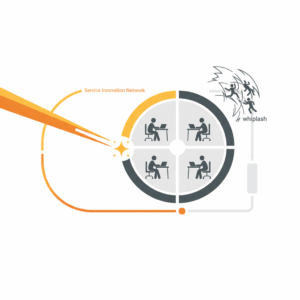
Kotter’s dual operating system offers a proven pattern. A network of volunteer change agents pursues strategic initiatives in parallel with the formal hierarchy that runs the business. The network senses opportunities quickly, experiments lightly, and routes successful patterns into line operations for scale. The hierarchy keeps risk and compliance in check. The two systems collaborate, not compete. This dual structure preserves agility without undermining control, and it has been applied in large enterprises across sectors.⁶ ⁷ Executives can adapt the concept for service operations by formalizing a “Service Innovation Network” that draws from contact center, digital, field, and product teams. The network runs high-tempo discovery, while the hierarchy governs funding and scale-up. The result is a fast lane for ideas and a safe lane for adoption, which together reduce cycle time from insight to impact.⁶
How does agile service innovation work in practice?
Agile service innovation blends service design, lean experimentation, and change management into a single sprint rhythm. Teams define a customer problem in operational terms, such as long average handle time or high repeat contacts. Teams translate the problem into a hypothesis that can be tested within a sprint, then they build a minimal solution, trial it with a pilot group, and measure the outcome with leading and lagging indicators. Prosci’s research highlights seven contributors to change success, including active sponsorship, frequent communication, and integration with project management.¹ When these contributors live inside the sprint system, adoption ceases to be a final step and becomes a built-in behavior. Prosci’s correlation studies also link effective change management to higher project success rates, stronger benefits realization, and improved schedule performance.⁸ This alignment matters in service environments where delays translate into customer wait time and revenue leakage.
What is the mechanism for “injection without whiplash”?
Leaders meter change like a clinician doses a powerful drug. The unit is explicit, the dose is calibrated, and the effects are monitored. The mechanism has four controls. First, value targeting selects a small number of service outcomes that matter now, such as first contact resolution, complaint turnaround, and agent proficiency. Second, load management limits concurrent injections into any team to a safe threshold, which prevents saturation. Third, adoption engineering uses a simple, repeated pattern of briefing, skill building, peer reinforcement, and checklists embedded in systems. Fourth, closed-loop sensing compares pilot metrics to control groups and uses signals to scale, pause, or retire the injection. McKinsey’s research finds that when organizations combine clear change stories, visible role modeling, and continuous improvement, they can triple their odds of transformation success.⁴ This mechanism operationalizes those actions inside service work, week by week.
Which roles and rituals sustain momentum in large enterprises?
Executives set direction, fund the pipeline, and remove roadblocks. Sponsors own the change story, show up where the work happens, and communicate wins in plain language. Managers translate change units into schedules, coaching plans, and peer practice sessions. Change agents inside the Service Innovation Network run discovery, design ultralight experiments, and publish playbooks. The rituals are simple. A weekly triage balances the portfolio based on load and results. A biweekly showcase tells customer stories and shares metrics from pilots. A monthly adoption audit checks whether new behaviors stick. These rituals align with Prosci’s view that sponsorship, frequent communication, and manager engagement are persistent success drivers across industries.¹ They also reflect McKinsey’s emphasis on comprehensive action sets, not single silver bullets.⁵ The combination keeps leadership energy visible and keeps delivery teams focused on what customers will notice this month, not in a distant quarter.¹ ⁵
How do we measure change load, adoption, and business impact?
Leaders measure load by counting active injections per team and by tracking training hours, system changes, and scheduling disruptions per month. Leaders measure adoption by combining simple leading indicators, such as checklist adherence and practice session completion, with behavioral signals in systems, such as the percent of calls handled with the new flow. Leaders measure impact by linking injections to service outcomes and to financial drivers, such as handle time, churn, and rework. The evidence base supports this discipline. Prosci’s studies report a positive correlation between structured change management and benefits realization, schedule adherence, and staying on budget.⁸ McKinsey’s surveys reinforce that organizations which take more of the right actions see higher success rates across transformations.⁵ When leaders tie injections to a visible scoreboard, the organization sees cause and effect. When teams see progress on customer outcomes, they lean in, not out.⁵ ⁸
What risks should leaders expect, and how do we blunt them?
Three risks recur. Oversubscription saturates teams and triggers fatigue. Misalignment creates local wins that conflict with enterprise controls. Drift erodes gains after initial enthusiasm fades. Leaders blunt oversubscription by setting a cap on concurrent injections per team and by using triage to pause or retire lower value work. Leaders cure misalignment by publishing a short list of design constraints that every injection must respect. Leaders prevent drift by scheduling reinforcement and by embedding new behaviors into systems of work. Gartner’s research warns that change fatigue has risen and that employee intent to stay falls when fatigue is high.¹ ⁹ Leaders should treat fatigue as a quantifiable risk. Leaders should maintain a balance between improvement and recovery time. Leaders should also use the dual operating system to keep the fast lane connected to the safe lane so that innovation never outruns adoption.⁶ ⁷ ¹
How do we start in 90 days without boiling the ocean?
Executives can start with a three-sprint program. Sprint one maps current change load across service units, chooses three outcome targets, and launches a Service Innovation Network with named agents. Sprint two delivers two pilot injections with measurement, while sponsors run visible communications that link change to customer outcomes. Sprint three scales the winning injection to a second site and retires one low-value initiative to create capacity. The playbook is small by design. It builds credibility through results, not rhetoric. McKinsey’s work shows that comprehensive action matters, yet comprehensive does not mean complex.⁵ Prosci’s findings reinforce that sponsorship, communication, and manager engagement are repeatable levers, not one-time events.¹ At day ninety, leadership should publish the scoreboard, codify the cadence, and set the next quarter’s outcome targets. The organization will feel the difference because customers will feel the difference first.¹ ⁵
What is the practical call to action for CX and service leaders?
Leaders should appoint a senior sponsor, stand up a Service Innovation Network, and pick three service outcomes that matter now. Leaders should enforce a load cap per team and measure adoption as carefully as they measure delivery. Leaders should teach managers how to coach the new way of working and should reward persistence over theater. The path is pragmatic. The research base is clear.¹ ² ⁴ ⁵ ⁸ The organizations that inject change with care, with cadence, and with evidence will bend customer outcomes in their favor and will keep talent engaged in the process. The organizations that continue to overload teams with fragmented initiatives will see fatigue, churn, and wasted spend. Leaders can choose the pattern that compounds value. Leaders can design for adoption. Leaders can deliver service transformation without whiplash.
FAQ
How does Customer Science approach “change injection without whiplash” for enterprise service operations?
Customer Science defines change injection as deliberate, measured introductions of new processes and tools into customer operations, sequenced with load caps, adoption engineering, and visible sponsorship to protect teams from fatigue while lifting outcomes such as first contact resolution and average handle time.¹ ² ⁴
What is the dual operating system, and why does Customer Science recommend it for CX transformations?
The dual operating system pairs a volunteer change network with the formal hierarchy so enterprises can sense, test, and scale improvements quickly while maintaining control. This structure enables agile service innovation without creating chaos in contact centers or digital channels.⁶ ⁷
Which success factors most reliably predict change adoption in contact centers?
Prosci’s research consistently highlights active sponsorship, frequent communication, integration with project management, and manager engagement as top contributors to successful change adoption. Leaders should build these factors into sprint rituals, not bolt them on at the end.¹ ⁸
Why are employees resisting change more today, and how should leaders respond?
Change volume has increased while willingness to support change has fallen, driven by stacked initiatives and low clarity. Leaders should meter load, simplify the change story, and maintain reinforcement to counter fatigue and preserve intent to stay.² ⁹
Which metrics prove that agile service innovation is working?
Executives should track change load per team, adoption leading indicators like checklist adherence, and impact metrics such as handle time, repeat contact rate, and benefits realization. Prosci and McKinsey findings link structured change management and comprehensive action sets to higher success and stronger outcomes.⁵ ⁸
Who should lead the first 90 days of a change injection program at scale?
A named executive sponsor should own the change story and triage decisions. A Service Innovation Network should run pilots. Line managers should translate injections into schedules and coaching. This role clarity creates speed without friction.¹ ⁴
Which Customer Science services align with this approach on customerscience.com.au?
Customer Science supports CX and service transformation through service innovation design, change management integration, sprint-based pilots, adoption engineering, and measurable benefit realization programs that help large enterprises deliver change without whiplash.¹ ⁵
Sources
Prosci, “Best Practices in Change Management, 12th Edition Executive Summary,” 2021, Prosci Europe. https://www.proscieurope.co.uk/hubfs/Best-Practices-in-Change-Management-12th-Edition-Executive-Summary.pdf
Jessica Knight and Christine Porath, “Employees Are Losing Patience with Change Initiatives,” 2023, Harvard Business Review. https://hbr.org/2023/05/employees-are-losing-patience-with-change-initiatives
Prosci, “Change Management Best Practices,” 2022, Prosci. https://www.prosci.com/blog/change-management-best-practices
Martin, Jean-François et al., “How to Beat the Transformation Odds,” 2015, McKinsey & Company. https://www.mckinsey.com/~/media/mckinsey/business%20functions/people%20and%20organizational%20performance/our%20insights/how%20to%20beat%20the%20transformation%20odds/how_to_beat_the_transformation_odds.pdf
McKinsey & Company, “The Science Behind Successful Organizational Transformations,” 2017, McKinsey.com. https://www.mckinsey.com/capabilities/people-and-organizational-performance/our-insights/successful-transformations
John P. Kotter, “Accelerate,” 2012, Harvard Business Review. https://hbr.org/2012/11/accelerate
John P. Kotter, “Accelerate, Building Strategic Agility for a Faster-Moving World,” 2014, Harvard Business School Publishing. https://www.hbs.edu/faculty/Pages/item.aspx?num=49745
Prosci, “The Correlation Between Change Management and Project Success,” 2022, Prosci. https://www.prosci.com/blog/the-correlation-between-change-management-and-project-success
Gartner, “Gartner Cautions HR Leaders That the Risk of Change Fatigue Among Employees Has Doubled in 2020,” 2020, Gartner Press Release. https://www.gartner.com/en/newsroom/press-releases/2020-10-14-gartner-cautions-hr-leaders-that-the-risk-of-change-fatigue-among-employees-has-doubled-in-2020