

























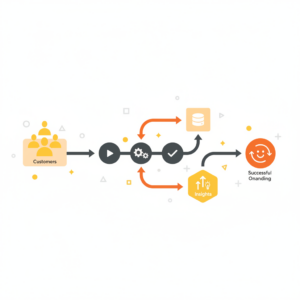
Modern onboarding automation reduces customer effort, shortens activation time, and improves operational control across digital service environments. Organisations that automate onboarding workflows often reduce processing costs, increase completion rates, and improve compliance visibility at the same time. The strongest outcomes come from combining workflow automation, behavioural insight, and customer communication design into a single operating model.
What Is Automating Customer Onboarding?
Automating customer onboarding refers to the use of digital workflows, rules engines, AI systems, and integrated platforms to manage onboarding tasks with minimal manual intervention. The process usually includes identity verification, account setup, document collection, approvals, communication, and customer education.
Many organisations still rely on fragmented onboarding processes. Teams manually transfer information between systems. Customers repeat the same information across channels. Delays become common. So do drop-offs.
Automated onboarding changes that pattern. Data moves between systems automatically. Customers receive contextual prompts based on behaviour. Compliance checks run in the background. Staff intervene only when exceptions appear.
The shift toward “zero touch onboarding” reflects a broader operational trend. Businesses want onboarding systems that scale without increasing labour costs. Research from the McKinsey & Company found that companies using intelligent automation in customer operations reduced servicing costs by up to 30% while improving satisfaction outcomes¹.
Why Are Businesses Investing in Zero Touch Onboarding?
Customer expectations changed quickly after widespread digital adoption accelerated during the COVID-19 period. Consumers became accustomed to instant verification, mobile-first registration, and self-service account activation.
Long onboarding cycles now create measurable commercial risk.
According to the PwC Future of Customer Experience survey, 32% of customers stop engaging with a brand after one poor interaction². Onboarding is often that first interaction.
Manual onboarding also creates internal pressure:
- Higher labour costs
- Inconsistent compliance handling
- Delayed revenue recognition
- Duplicate customer records
- Increased onboarding abandonment
- Poor operational visibility
And the impact compounds over time. Financial services providers, utilities, insurers, telecommunications firms, and healthcare organisations process thousands of onboarding requests every week. Even small inefficiencies create significant operational drag.
Automated onboarding workflows address these issues through structured orchestration. Systems trigger actions automatically. Customers progress through defined journeys. Exceptions route to specialist teams. Managers gain real-time visibility across onboarding performance.
How Does Automated Customer Onboarding Work?
Most onboarding automation frameworks combine workflow engines, integration layers, communication systems, AI classification tools, and analytics dashboards.
The onboarding process generally follows five stages.
Identity and Data Capture
Customers submit information through digital forms, mobile applications, portals, or APIs. Systems validate mandatory fields automatically and reduce incomplete submissions.
Many organisations now apply optical character recognition and AI-assisted document extraction to process passports, licences, and proof-of-address documentation³.
Verification and Compliance Screening
Automated rules evaluate customer risk profiles, conduct fraud screening, and perform Know Your Customer checks. This reduces manual review requirements while improving audit traceability.
Industries with strong regulatory obligations benefit heavily here. Banking and insurance providers increasingly rely on automated onboarding to meet anti-money laundering obligations without slowing activation times⁴.
Workflow Orchestration
Workflow platforms coordinate approvals, escalations, notifications, and task routing. Business rules determine whether onboarding proceeds automatically or requires human intervention.
This is where intelligent automation becomes commercially valuable. Low-risk applications pass through rapidly. Complex or incomplete cases escalate to specialist teams.
Customer Communication Automation
Communication consistency matters. Customers who understand onboarding progress are less likely to abandon the process.
Platforms such as CommScore AI help organisations assess and improve customer communication clarity across onboarding journeys. That matters because unclear onboarding instructions remain one of the largest contributors to customer drop-off and repeat contact volume.
Analytics and Continuous Improvement
Modern onboarding systems collect behavioural and operational data continuously. Teams monitor:
- Time to activation
- Completion rates
- Abandonment points
- Rework frequency
- Exception handling volume
- Customer sentiment
- Compliance outcomes
Those insights support continuous refinement rather than static process design.
What Technologies Support Onboarding Automation?
Several technology layers work together in mature onboarding environments.
Workflow Automation Platforms
Workflow systems manage orchestration across systems and departments. They coordinate approvals, business rules, triggers, and exception management.
Customer Data Platforms
Customer data platforms centralise onboarding information across channels and products. This reduces duplicate data entry and improves customer continuity.
AI and Machine Learning
AI models assist with:
- Document classification
- Fraud detection
- Intent prediction
- Risk scoring
- Communication analysis
- Workflow prioritisation
Generative AI is increasingly used to personalise onboarding communication and simplify knowledge delivery during customer activation⁵.
API Integration Frameworks
APIs connect onboarding systems with CRM platforms, billing systems, identity providers, compliance databases, and operational tools.
Without integration, onboarding automation usually stalls.
What Makes Zero Touch Onboarding Different?
Zero touch onboarding removes most manual handling entirely. Human involvement occurs only when business rules identify exceptions or elevated risk.
That model works best when organisations have:
- Standardised onboarding processes
- Integrated operational systems
- Mature data governance
- Clear compliance frameworks
- Strong workflow design
- Consistent customer communication
But zero touch onboarding does not mean “human-free.” It means humans focus on judgment-heavy work rather than repetitive administration.
That distinction matters.
Poorly designed automation can create customer frustration quickly. Over-automation without escalation paths often increases complaints and operational complexity. Research from the Gartner shows customers still expect accessible human support during complex onboarding situations⁶.
How Does Automated Onboarding Improve Customer Experience?
The strongest onboarding experiences reduce uncertainty.
Customers want clarity. They want progress visibility. And they want onboarding to feel predictable.
Automated workflows support those outcomes by:
- Reducing waiting periods
- Providing real-time status updates
- Removing duplicate requests
- Improving information accuracy
- Delivering consistent communication
- Accelerating activation timelines
Because onboarding shapes long-term perceptions, early operational failures can damage retention and advocacy outcomes.
Research published in the Harvard Business Review found that reducing customer effort during service interactions significantly improves loyalty and future engagement⁷.
Organisations that automate onboarding effectively often see secondary gains too:
- Lower inbound contact volumes
- Faster employee onboarding productivity
- Better compliance reporting
- Reduced operational risk
- Higher digital channel adoption
Where Does Automation Fail in Customer Onboarding?
Technology alone rarely fixes broken onboarding processes.
Some organisations automate fragmented workflows without redesigning the underlying customer journey. That creates faster confusion rather than better service.
Common onboarding automation failures include:
Poor Process Design
Automating inefficient workflows simply scales inefficiency.
Excessive Verification Friction
Too many mandatory fields, repeated document requests, or unclear compliance requirements increase abandonment rates.
Weak Communication Design
Customers often abandon onboarding because they do not understand what happens next.
Disconnected Systems
Siloed systems create inconsistent customer records and broken workflow visibility.
Lack of Governance
Automation without operational ownership leads to fragmented accountability.
Organisations that perform well usually combine automation with structured service design, behavioural analysis, and operational governance.
Services such as CX Consulting and Professional Services help organisations redesign onboarding ecosystems before automation deployment begins. That sequence matters more than many teams realise.
How Should Organisations Measure Onboarding Automation Success?
Operational metrics alone do not provide a complete picture.
High-performing organisations balance customer, operational, financial, and compliance indicators together.
Key measures often include:
| Category | Example Metrics |
|---|---|
| Customer Experience | Completion rate, customer effort score, onboarding satisfaction |
| Operational Performance | Processing time, exception rates, rework volume |
| Financial Outcomes | Cost per onboarding, activation speed, revenue acceleration |
| Compliance | Audit traceability, verification accuracy, risk incidents |
And context matters. A telecommunications provider may prioritise activation speed. A bank may focus more heavily on compliance precision.
Many organisations also apply journey analytics to identify behavioural friction points during onboarding progression.
What Are the Next Steps for Onboarding Automation?
The next phase of onboarding automation combines AI decisioning, predictive orchestration, and personalised communication journeys.
Several trends are accelerating:
- AI-assisted onboarding support
- Real-time behavioural adaptation
- Embedded compliance monitoring
- Predictive abandonment intervention
- Hyper-personalised onboarding content
- Voice and conversational onboarding interfaces
But organisations still need disciplined operational design. Automation maturity comes from governance, process alignment, and measurable customer outcomes.
Platforms such as Customer Science Insights increasingly help enterprises monitor customer behaviour, communication effectiveness, and onboarding friction across complex service environments.
FAQ
What is automating customer onboarding?
Automating customer onboarding uses workflow systems, AI, integrations, and communication platforms to manage onboarding tasks with minimal manual intervention.
What is zero touch onboarding?
Zero touch onboarding refers to onboarding processes where customers progress through activation with almost no human handling unless exceptions occur.
Which industries benefit most from onboarding automation?
Banking, insurance, telecommunications, healthcare, utilities, and government services commonly benefit because they manage high onboarding volumes and compliance requirements.
Does onboarding automation remove human support?
No. Strong onboarding systems escalate complex situations to human teams while automating repetitive administrative tasks.
How long does onboarding automation implementation take?
Implementation timelines vary depending on system integration complexity, compliance requirements, workflow maturity, and organisational scale.
What technologies are commonly used in onboarding automation?
Workflow orchestration tools, AI systems, API integrations, CRM platforms, analytics systems, and customer communication platforms are commonly used.
How can organisations improve onboarding communication quality?
Solutions such as Knowledge Quest help organisations improve onboarding knowledge delivery, communication clarity, and customer guidance consistency.
Sources
- McKinsey & Company. “The State of AI in 2024.” https://www.mckinsey.com/capabilities/quantumblack/our-insights/the-state-of-ai
- PwC. “Future of Customer Experience Survey.” https://www.pwc.com/us/en/services/consulting/library/consumer-intelligence-series/future-of-customer-experience.html
- International Organization for Standardization. ISO/IEC 30107-3:2023 Biometric Presentation Attack Detection. https://www.iso.org/
- Australian Transaction Reports and Analysis Centre. Anti-Money Laundering and Counter-Terrorism Financing Guidance. https://www.austrac.gov.au/
- Deloitte. Generative AI in Customer Operations Report. https://www2.deloitte.com/
- Gartner. Customer Service and Support Research. https://www.gartner.com/
- Harvard Business Review. “Stop Trying to Delight Your Customers.” https://hbr.org/2010/07/stop-trying-to-delight-your-customers
- Australian Securities and Investments Commission. Digital Financial Services Guidance. https://asic.gov.au/
- OECD. Digital Transformation and Customer Service Research. https://www.oecd.org/
- World Economic Forum. Future of Digital Services Report. https://www.weforum.org/