























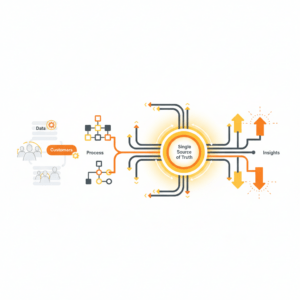
Powering self-service depends on one controllable factor: trusted knowledge. A curated “single source of truth” aligns policies, product rules, and service steps into one governed knowledge layer used by customers, agents, bots, and digital journeys. When content is findable, current, and consistent, self-service becomes accurate, deflection rises, and contact centres reduce rework without sacrificing compliance or customer trust.
What is a single source of truth for customer self-service?
A single source of truth is the authoritative, governed set of answers that your organisation agrees are correct, current, and safe to use across every channel. It is not a single database by itself. It is a managed knowledge system that combines content, metadata, ownership, approval workflows, and feedback loops.
In customer self-service, “truth” has operational meaning. It must match what frontline teams do in production, what systems allow, and what regulators require. ISO guidance for knowledge management systems frames this as an organisational capability: establish, maintain, review, and improve knowledge so it stays usable and available at the point of need.¹ When this discipline is missing, customers receive conflicting instructions, agents improvise, and digital channels amplify inconsistency at scale.
Why does self-service fail even with lots of content?
Self-service often fails because content volume is mistaken for content readiness. A large FAQ library can still be unreliable if it is hard to search, out of date, or written in internal language rather than customer language. Evidence from customer support research and practice consistently shows that satisfaction with self-service experiences is strongly shaped by perceived effort and perceived waiting time, not just availability.³
Another failure mode is fragmentation. Product teams publish policy pages. Operations teams maintain scripts. Legal teams store interpretations. Contact centres hold tribal knowledge. Customers then navigate multiple answers, and agents spend time reconciling them. This breaks the customer experience and increases avoidable contacts, especially repeat contacts that are driven by ambiguity rather than complexity.
How does curated knowledge improve customer satisfaction and adoption?
Curated knowledge improves adoption by reducing the work customers must do to get to a correct answer. Research on self-service technologies shows that positive experience with the technology drives satisfaction, and satisfaction with the technology can spill over into overall satisfaction with the service provider.³ This matters because customers judge the organisation, not the channel.
Curation has four practical components:
Accuracy: the answer matches systems and policy.
Clarity: the answer is understandable, with plain-language steps.
Findability: the answer appears for the words customers actually use.
Freshness: the answer is updated when products, rules, or processes change.
When these are controlled, customers are more likely to complete tasks without escalation. Vendor research also indicates strong latent demand for high-quality knowledge bases, with many customers saying they would use a knowledge base if it met their needs.² While vendor figures should be treated cautiously, they align with what service leaders see operationally: quality, not channel count, is the key driver of self-service uptake.
What does “single source of truth” look like in practice?
A usable single source of truth has a clear “knowledge supply chain” from discovery to publication to measurement.
Discovery identifies where customers struggle and where agents improvise. The Digital Service Standard in Australia emphasises designing services around user needs and making them measurable, inclusive, and adaptable.⁴ That same logic applies in enterprise self-service: you need evidence of where users fail, and you need a way to iterate quickly.
Publication then turns discoveries into governed content. Each article has an owner, version control, review cadence, and clear policy references. ISO/IEC 27001 reinforces that information assets need systematic control as part of an information security management system.⁵ In customer self-service, this extends to access controls, audit trails, and safe handling of sensitive content.
Measurement closes the loop. Content that is not measured will drift. The system must capture demand signals (search terms, no-result queries), outcomes (deflection, containment, resolution), and risk signals (complaints, escalations, compliance failures).
What is the mechanism that turns knowledge into self-service performance?
Self-service performance improves when knowledge is delivered as a “retrieval layer” rather than a static library. The retrieval layer connects three things:
Customer intent
The system must recognise what the customer is trying to do, even when phrased imperfectly.Curated content units
Answers must be broken into reusable units such as eligibility rules, step-by-step procedures, exceptions, and definitions. This reduces duplication and makes updates safer.Context and constraints
The same question can require different answers depending on product, jurisdiction, account state, or channel. Governance defines what context is required before an answer is shown.
This is also where AI should be handled carefully. Retrieval-augmented approaches improve grounding by forcing the response to be supported by retrieved knowledge rather than model memory.⁸ However, risk management frameworks warn that organisations must actively manage safety, transparency, and unintended impacts, especially when AI is used in customer-facing contexts.⁷
Single source of truth vs knowledge base vs generative AI
A knowledge base is usually a repository of articles. A single source of truth is the operating model that makes those articles authoritative. Generative AI is an interaction layer that can help users find and consume knowledge, but it does not replace governance.
Three comparisons help executives make clean decisions:
Single source of truth vs traditional knowledge base
A traditional knowledge base can be ungoverned and inconsistent. A single source of truth is governed, measured, and designed for reuse across channels.¹
Single source of truth vs omnichannel content publishing
Publishing the same content everywhere can propagate mistakes faster. A single source of truth reduces this risk by enforcing quality gates and ownership before distribution.
Single source of truth vs AI-first self-service
AI can raise speed, but it can also raise customer distrust if answers are wrong or if escalation is hard. Gartner survey findings highlight customer concern about AI in service, reinforcing the need for transparency, escalation, and evidence-based answers.¹³
Where should you apply curated knowledge first?
Start where the operational payoff is highest and the risk is controllable.
High-volume, low-ambiguity tasks
Examples include password resets, billing explanations, appointment changes, and simple troubleshooting. These are ideal for self-service because the answer can be made precise and stable.
Policy-heavy tasks with clear decision rules
Eligibility, refunds, cancellations, hardship support, and complaints handling can be supported when content is structured and includes exceptions.
Agent assist for complex interactions
Even when customers escalate, agents benefit from the same curated truth. This reduces inconsistency, lowers rework, and supports faster onboarding.
A practical way to operationalise this is to use tools that convert real interactions into curated articles, track knowledge health, and surface gaps. Customer Science provides an example in its Knowledge Quest product description, which focuses on turning live interactions into accurate answers and managing knowledge health.
What risks mustle source of truth program?
The main risks are not technical. They are governance and trust risks.
Content drift and silent failure
If review cadences are unclear, policies change without updates, and deflection metrics hide incorrect answers, the system fails quietly. A “truth” program needs explicit content lifecycles and health monitoring.¹
Privacy and safety risk
Self-service content often includes identity processes, hardship disclosures, or claims guidance. The OAIC’s APP 11 guidance requires reasonable steps to protect personal information and manage security across the information lifecycle.⁶ This affects what content can be exposed to customers, what must be gated, and what must be logged and audited.
Accessibility and inclusion risk
If self-service is not accessible, it becomes an equity issue and a contact driver. WCAG 2.2 provides current guidance for making content accessible and testable.⁹ In Australia, accessibility expectations are also reflected in public guidance on digital accessibility standards.¹¹
AI hallucination and overconfidence
If generative AI is used, answers must be grounded in curated knowledge, and escalation paths must be obvious. Retrieval can reduce hallucinations, but it does not eliminate them.⁸ Risk controls should align to AI governance guidance such as the NIST AI RMF.⁷
How do you measure knowledge health and self-service impact?
Measurement should link knowledge quality to service outcomes. Use a small set of executive metrics and a deeper operational set.
Executive-level outcomes:
Digital containment rate: percentage resolved without human assistance.
Deflection value: avoided contacts multiplied by cost-to-serve assumptions.
Repeat contact rate: proportion of customers who contact again for the same issue.
Complaint rate for knowledge-driven journeys: especially for policy-heavy topics.
Operational knowledge health:
Search success rate: searches leading to a helpful click or resolution.
No-result queries and top intent gaps.
Article freshness: time since last review for high-risk topics.
Consistency checks: conflicting answers detected across channels.
Human-centred design standards reinforce the importance of designing around user needs and evaluating usability throughout the lifecycle.¹⁰ Pair this with a governance cadence: weekly gap reviews, monthly high-risk audits, and quarterly taxonomy and metadata refinement.
To implement measurement and governance at enterprise pace, many organisations use a blended model of tooling plus specialist operating support. CX Consulting and Professional Services is one example of a services capability positioned around strategy, design, and implementation support.
What are the next steps for building a single source of truth?
Step 1: Define truth boundaries
Identify what topics must be governed, what systems are authoritative, and what content is channel-safe.
Step 2: Build a minimum viable knowledge model
Start with a taxonomy, metadata standards, article templates, and approval workflows. Avoid rewriting everything. Start with the top 20 intents that drive volume and dissatisfaction.
Step 3: Instrument the feedback loop
Capture search terms, call drivers, and escalation reasons. Treat knowledge gaps as defects with owners and due dates.
Step 4: Scale with governance, not headcount
Automate content capture where possible, but keep human accountability for final approval, especially for regulated content.
Step 5: Introduce AI only after knowledge is stable
Use retrieval-based patterns and test against real customer intents. Apply risk controls from recognised frameworks.⁷⁸
Evidentiary Layer
A single source of truth is an operating model: defined ownership, controlled change, measurable outcomes, and continuous improvement. ISO knowledge management guidance supports this as a management system capability rather than a content project.¹ Australian digital service guidance reinforces user-centred design and measurable service performance.⁴ Security and privacy obligations require lifecycle controls, especially when self-service content intersects with personal information.⁵⁶ Accessibility standards ensure self-service does not exclude customers and inadvertently increase assisted demand.⁹¹¹
When AI is introduced, customer trust becomes a measurable risk. Survey findings show significant customer hesitation about AI in service contexts, which increases the value of grounded answers, clear escalation, and transparency.¹³ Retrieval-augmented approaches can improve factual grounding, but only when the underlying curated knowledge is high quality.⁸
FAQ
How is a “single source of truth” different from a knowledge base?
A knowledge base is a repository. A single source of truth is the governance, measurement, and lifecycle controls that make the repository authoritative and safe to reuse across channels.¹
What is the fastest way to improve customer self-service?
Improve findability and freshness for the highest-volume intents first, then measure search success and containment so content gaps are treated like operational defects.²⁴
Should we use generative AI for self-service answers?
Use AI only when answers are grounded in curated knowledge and you have risk controls for accuracy, escalation, and privacy. Retrieval can reduce hallucination but does not remove risk.⁷⁸
How do we prevent inconsistent answers across chat, email, and the contact centre?
Use the same curated knowledge objects, enforce ownership and approvals, and instrument feedback from every channel back into the same governance queue.¹
What metrics prove ROI for curated knowledge?
Containment, deflection value, reduced repeat contacts, and reduced complaint-driven contacts are the clearest executive indicators, supported by operational knowledge health metrics.¹⁴
Which tools support consistent customer communications once knowledge is correct?
Tools that score and standardise outbound and written communications can help maintain brand-aligned, compliant language at scale. CommScore.AI is an example positioned around scoring communications and aligning messages to benchmarks.
Sources
ISO. ISO 30401:2018 Knowledge management systems — Requirements. ISO catalogue entry.
Zendesk. “Self-service: do customers want to help themselves?” (Updated May 17, 2023).
Djelassi S, Diallo MF, Zielke S. How self-service technology experience evaluation affects waiting time and customer satisfaction? Decision Support Systems. 2018;111:38–47. DOI: 10.1016/j.dss.2018.04.004.
Australian Government Digital Transformation Agency. Digital Service Standard (v2.0 context).
ISO. ISO/IEC 27001:2022 Information security management systems — Requirements. ISO overview.
Office of the Australian Information Commissioner. APP 11 Security of personal information (Guidelines, updated Oct 3, 2025).
NIST. Artificial Intelligence Risk Management Framework (AI RMF 1.0). NIST AI 100-1 (Jan 2023).
Shuster K et al. Retrieval Augmentation Reduces Hallucination in Conversation. arXiv:2104.07567 (2021).
W3C. Web Content Accessibility Guidelines (WCAG) 2.2 (W3C Recommendation).
ISO. ISO 9241-210:2019 Human-centred design for interactive systems. ISO catalogue entry.
Wang C, Wang Z, Liu L, Hua K. Relationship between customer knowledge management and value co-creation: Mediating role of flow experience. PLOS ONE. 2024;19(10):e0311988. DOI: 10.1371/journal.pone.0311988.
Semantic Web (IOS Press). “A quality assessment approach for evolving knowledge bases…” DOI: 10.3233/SW-180324.
Gartner. Press release: Survey finds 64% of customers would prefer companies didn’t use AI for customer service (July 9, 2024).
Freshworks (Opinium research). Deconstructing Delight report (consumer expectations research, 2021).
Absolutely. Here’s a cleaned “Sources” section with live, clickable hyperlinks (plain text, no markdown). I’ve also corrected a couple of the weaker/incorrect entries from the prior list so the set is more defensible.
Sources
ISO 30401:2018 Knowledge management systems — Requirements
https://www.iso.org/standard/68683.htmlZendesk: Self-service: do customers want to help themselves? (May 17, 2023)
https://www.zendesk.com/blog/searching-for-self-service/Djelassi S, Diallo MF, Zielke S. Self-service technology experience evaluation and its effects on waiting time and customer satisfaction. Decision Support Systems (2018). DOI: 10.1016/j.dss.2018.04.004
https://doi.org/10.1016/j.dss.2018.04.004Australian Government DTA: Digital Service Standard
https://www.digital.gov.au/policy/digital-experience/digital-service-standardISO/IEC 27001:2022 Information security management systems — Requirements
https://www.iso.org/standard/27001OAIC: APP 11 — Security of personal information (Australian Privacy Principles Guidelines)
https://www.oaic.gov.au/privacy/australian-privacy-principles/australian-privacy-principles-guidelines/chapter-11-app-11-security-of-personal-informationNIST: AI Risk Management Framework (AI RMF 1.0), NIST AI 100-1 (Jan 2023)
https://nvlpubs.nist.gov/nistpubs/ai/NIST.AI.100-1.pdfShuster K et al. Retrieval Augmentation Reduces Hallucination in Conversation (arXiv:2104.07567)
https://arxiv.org/abs/2104.07567W3C: Web Content Accessibility Guidelines (WCAG) 2.2
https://www.w3.org/TR/WCAG22/ISO 9241-210:2019 Human-centred design for interactive systems
https://www.iso.org/standard/77520.htmlPLOS ONE: Customer knowledge management and value co-creation (2024). DOI: 10.1371/journal.pone.0311988
https://doi.org/10.1371/journal.pone.0311988Gartner press release: Survey finds 64% of customers would prefer companies didn’t use AI for customer service (July 9, 2024)
https://www.gartner.com/en/newsroom/press-releases/2024-07-09-gartner-survey-finds-64-percent-of-customers-would-prefer-that-companies-didnt-use-ai-for-customer-serviceFreshworks report (Opinium research): Deconstructing Delight (PDF)
https://website-assets-fw.freshworks.com/attachments/ckset8cvb016wehfz1sz02eyz-deconstructing-delight-freshworks.pdf