



























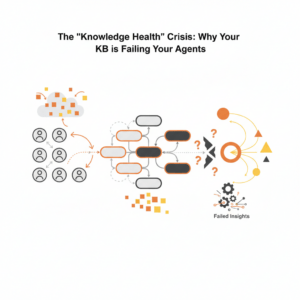
A failing knowledge base is rarely a content problem alone. It is a knowledge health problem: low findability, unclear ownership, slow change control, and weak feedback loops. This drives longer handle times, more escalations, and higher compliance risk. A knowledge health operating model fixes this by measuring quality in production, prioritising high-impact gaps, and continuously improving content with clear governance and evidence-based metrics.
Definition
What is “knowledge health” in a contact centre?
Knowledge health is the measurable state of your knowledge base (KB) in real operating conditions. It covers accuracy, findability, currency, coverage, and usability at the moment agents need answers. It also includes the management system around the KB: decision rights, approvals, review cycles, and controls.
A KB fails agents when it behaves like static documentation instead of a managed operational system. ISO 30401 frames this as a management system problem, requiring defined roles, processes, monitoring, and continual improvement to enable value creation through knowledge¹. In contact centres, “value” translates directly into faster resolution, fewer errors, and consistent customer outcomes.
Context
Why are knowledge bases failing agents right now?
Customer expectations keep compressing response windows. Recent CX research shows rising demand for faster responses and always-available service². At the same time, many organisations have fragmented systems and rapid policy change, which increases the chance that the KB becomes inconsistent across channels.
The productivity impact is structural, not incidental. Gartner has reported that a large share of digital workers struggle to find the information needed to do their jobs³. In a contact centre, that search cost becomes handle time, after-call work, transfers, and rework.
What does a “KB failure” look like operationally?
A KB can look “complete” but still fail because agents cannot reliably retrieve the right answer. Failures cluster into a small number of patterns:
Low findability: agents do not trust search results, so they ask peers or escalate.
Low decision support: articles state policy but not the next best action.
Slow updates: known issues persist because publishing workflows are too heavy or unclear.
Channel drift: chat, email, voice, and self-service answers diverge.
Weak governance: no single owner can prioritise, approve, and retire content.
Mechanism
How does poor knowledge health increase cost-to-serve?
Poor knowledge health drives four linked mechanisms:
Search and verification time: agents spend time scanning multiple systems and double-checking with supervisors. This increases average handle time and variance.
Resolution failure: when agents cannot locate the correct action quickly, first contact resolution (FCR) drops. Peer-reviewed research links FCR to performance outcomes and customer satisfaction effects in call centre settings⁴.
Process drift and compliance exposure: inconsistent instructions cause agents to take different actions for the same issue. That is a governance failure, not a training failure.
Change debt: content that is not reviewed and retired becomes “dark knowledge” that still influences decisions through search results and copy-paste behaviours.
ITIL 4 describes knowledge management as maintaining and improving the effective, efficient, and convenient use of information and knowledge across the organisation⁵. In practice, this means the KB must be designed for decision-making at speed, not for archival completeness.
Why “findability” is the hidden multiplier
Findability is the fastest way to lift knowledge health because it changes behaviour immediately. Information foraging research shows people follow cues (information scent) to decide where to click next⁶. If headings, tags, and snippets do not match the agent’s mental model, agents abandon search and switch to tribal knowledge.
This is why content design and information architecture matter as much as article accuracy. Government digital content guidance consistently emphasises clear structure and user-centred writing because it improves comprehension and retrieval in real use⁷.
Comparison
Knowledge management vs knowledge health
Knowledge management is the discipline. Knowledge health is the operational measurement system that makes it controllable.
Traditional KM often focuses on content creation and libraries.
Knowledge health focuses on production performance: what agents use, what works, what fails, and how fast you can fix it.
ISO 30401 formalises the need for monitoring and improvement in a knowledge management system¹. Knowledge health is the contact-centre-specific application of that principle, with metrics tied to service outcomes.
A static KB vs a “living KB” operating model
A static KB relies on periodic audits and manual feedback. A living KB uses continuous signals from production:
search terms with low click-through
articles opened but not used
repeat contacts for the same topic
high escalation topics with poor coverage
agent feedback at the point of use
The difference is speed. A living KB can reduce the time from “new issue detected” to “approved article in use” from weeks to days because prioritisation and approvals are explicit and instrumented.
Applications
What should leaders do first to restore knowledge health?
Start with a triage model that separates urgent operational fixes from structural redesign:
Step 1: Stabilise critical journeys
Identify the top 10 to 20 contact reasons by volume and risk. For each, validate that agents can retrieve a correct answer in under 30 seconds, using real search behaviour. If not, treat it as an operational incident.
Step 2: Fix findability before writing more content
Improve article titles, synonyms, templates, and navigation. Use the language agents actually type into search, not internal policy labels. Apply information scent principles so the search result snippet makes the “right” article obvious⁶.
Step 3: Implement “knowledge health” dashboards
Track coverage gaps, stale articles, and topics with high rework. This turns content work into a prioritised operational backlog.
For organisations wanting an instrumented approach, Customer Science’s Knowledge Quest is designed to report and manage knowledge health by connecting real-time interaction signals to knowledge gaps and drafts, so teams can close the loop faster.
How to design KB governance that works at contact-centre speed
Governance fails when it is either too loose (inconsistent answers) or too rigid (slow publishing). APQC’s guidance is clear that governance defines who decides, who owns, and how decisions get made across maturity levels⁸.
A practical contact-centre model uses three layers:
Knowledge Owners (business): accountable for correctness and policy intent.
Knowledge Editors (operations/content design): accountable for usability, structure, and findability.
Approvers (risk/legal where needed): accountable for regulated content gates, with clear SLA timeboxes.
If your organisation operates in regulated environments, align KB controls with recordkeeping principles. ISO 15489 sets out concepts and principles for creating, capturing, and managing records, including assigned responsibilities, metadata, and monitoring⁹. This helps you treat KB content as controlled operational guidance, not informal notes.
Risks
What risks increase when knowledge health is low?
Low knowledge health creates risks that do not show up in content audits:
Regulatory risk: inconsistent advice can trigger complaints, remediation, and reporting obligations. In financial services, ASIC’s RG 271 sets enforceable expectations for internal dispute resolution systems, including recording and responding to complaints to required standards¹⁰. KB content often underpins those responses.
Brand and trust risk: different answers across channels undermine perceived competence.
Operational resilience risk: the centre becomes dependent on specific experts, creating single points of failure.
AI risk: if you introduce agent assist or generative AI on top of a weak KB, you scale inconsistency faster. AI requires strong knowledge controls, not just better prompts.
ISO 10002 provides structured guidance for complaints-handling processes, including design, operation, and improvement¹¹. A weak KB makes it harder to deliver consistent complaint handling and root-cause learning.
Measurement
How do you measure knowledge health with metrics executives trust?
Measure knowledge health as a leading indicator set that predicts cost-to-serve and customer outcomes:
Quality and currency
Article freshness: percent of high-volume articles reviewed within SLA
Accuracy signals: agent downvotes, reopen rates, policy mismatch flags
Findability
Search success rate: percent of searches that lead to an article used in the interaction
Time-to-answer: median time from search to applied answer
Coverage
Gap rate: high-frequency intents with no approved article
Deflection support: coverage for self-service and agent assist consistency
Outcome linkage
AHT and after-call work movement for topics with KB fixes
FCR movement for prioritised journeys, using definitions consistent across channels
COPC’s knowledge management practices emphasise combining efficiency and quality indicators and tying them to KPIs like AHT and FCR¹². This prevents “content vanity metrics” such as article count from substituting for performance.
To turn measurement into funded change, link knowledge health metrics to benefits realisation and portfolio governance. Customer Science Value Management Consulting supports benefits articulation and value governance so knowledge improvements compete effectively against other transformation investments.
Next Steps
What is a 90-day recovery plan for a failing KB?
Days 1 to 15: Diagnose in production
Instrument search behaviour and capture top failure modes. Run agent “time-to-answer” tests on top journeys. Document a baseline for findability, freshness, and gap rate.
Days 16 to 45: Fix the highest-impact gaps
Create a focused backlog. Rewrite and re-template priority articles. Remove duplicates. Add synonyms and titles aligned to agent language. Establish review SLAs for regulated content.
Days 46 to 90: Operationalise knowledge health
Implement weekly knowledge health reviews with operations, product, and risk. Publish an executive dashboard that links knowledge work to AHT, FCR, escalations, and complaint drivers. Formalise roles and decision rights, aligned to your broader knowledge management system expectations¹.
Evidentiary Layer
What evidence supports investing in knowledge health now?
Workforce and service delivery conditions have shifted in ways that amplify knowledge risk. Gartner’s findings on information findability illustrate how widespread the issue is³. Digital service standards also increasingly require services to be measurable and continuously improved, reinforcing the expectation that knowledge is maintained as an operational asset, not a static artefact¹³.
The strongest business case comes from topic-level linkage: show that specific KB fixes produce measurable improvements in time-to-answer, AHT, and FCR, and then model the cost-to-serve reduction. Peer-reviewed evidence supports the importance of FCR in call centre performance outcomes⁴, so improvements in knowledge-enabled resolution can be presented as a performance lever, not just a content initiative.
FAQ
What is the fastest way to tell if our KB is failing agents?
Run time-to-answer tests on the top contact reasons and measure search success rate. If agents cannot retrieve a correct answer quickly and consistently, knowledge health is low.
How often should high-volume KB articles be reviewed?
Set review SLAs based on change frequency and risk. High-volume and high-risk topics should be reviewed on a fixed cadence and whenever policy or product changes occur, consistent with management-system monitoring expectations¹.
Is knowledge health the same as knowledge management?
Knowledge management is the discipline. Knowledge health is the operational measurement and control layer that makes the KB reliable in day-to-day service delivery.
Will AI agent assist fix a bad knowledge base?
No. AI can amplify inconsistency if the underlying knowledge is outdated or poorly governed. Establish strong controls and monitoring first⁵.
How do we link KB improvements to executive KPIs?
Tie topic-level KB changes to AHT, after-call work, FCR, escalations, and complaint drivers. Use a benefits realisation approach to make the impact fundable.
What tools help monitor knowledge health across channels?
Real-time contact centre analytics can show where knowledge is driving or failing outcomes. Customer Science Customer Science Insights is positioned to unify operational signals across channels so leaders can act on knowledge-driven performance gaps.
Sources
ISO. ISO 30401:2018 Knowledge management systems. https://www.iso.org/standard/68683.html
Zendesk. CX Trends (latest edition page). https://cxtrends.zendesk.com/
Gartner. Gartner survey: 47% of digital workers struggle to find information (10 May 2023). https://www.gartner.com/en/newsroom/press-releases/2023-05-10-gartner-survey-reveals-47-percent-of-digital-workers-struggle-to-find-the-information-needed-to-effectively-perform-their-jobs
Abdullateef, A.O., Mokhtar, S.S.M., Yusoff, R.Z. The mediating effects of first call resolution on call centers’ performance. Journal of Database Marketing & Customer Strategy Management (2011). https://link.springer.com/article/10.1057/dbm.2011.4
Nielsen Norman Group. Information Scent: How Users Decide Where to Go Next. https://www.nngroup.com/articles/information-scent/
GOV.UK. Writing for GOV.UK: planning, writing and managing content. https://www.gov.uk/guidance/content-design/writing-for-gov-uk
APQC. Establishing Governance for Knowledge Management. https://www.apqc.org/resource-library/resource-listing/establishing-governance-knowledge-management
ISO. ISO 15489 Records management (project/published overview). https://committee.iso.org/sites/tc46sc11/home/projects/published/iso-15489-records-management.html
ASIC. Regulatory Guide 271: Internal dispute resolution. https://www.asic.gov.au/regulatory-resources/find-a-document/regulatory-guides/rg-271-internal-dispute-resolution/
ISO. ISO 10002:2018 Customer satisfaction, complaints handling guidelines. https://www.iso.org/standard/71580.html
COPC Inc. Top 10 Knowledge Management Practices That Drive CX Excellence in Contact Centers. https://www.copc.com/top-10-knowledge-management-practices-that-drive-cx-excellence-in-contact-centers/
Digital Transformation Agency (Australia). Digital Service Standard. https://www.digital.gov.au/policy/digital-experience/digital-service-standard