















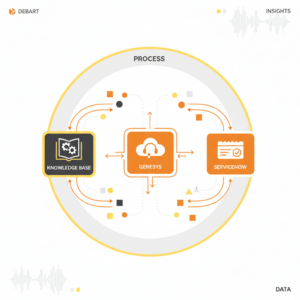
Connecting one governed knowledge base to both Genesys and ServiceNow reduces agent search time, improves answer consistency, and enables measurable self-service. The highest-performing approach uses shared taxonomy, controlled publication workflows, and secure APIs so content is created once, reused across channels, and continuously improved through feedback and analytics.
What does connecting a knowledge base to Genesys and ServiceNow mean?
Connecting a knowledge base to Genesys and ServiceNow means the same approved knowledge content can be discovered, recommended, and updated across contact centre and IT service workflows without duplicating articles. In practice, this connection is either a native connector, a federated search experience, or an integration layer that synchronises knowledge records and metadata.
The goal is operational consistency. Agents should receive the same answer whether they work a voice call in Genesys, handle a case in ServiceNow, or support a digital channel. This consistency matters because knowledge directly shapes customer outcomes, compliance outcomes, and staff confidence, especially when processes change frequently.
In modern platforms, “connection” is not only content access. It also includes feedback signals, version control, audience controls, and reporting. Genesys can surface knowledge in agent-assist experiences and portals, while ServiceNow can govern lifecycle workflows, approvals, and knowledge ownership.
Why do enterprises struggle with knowledge reuse across CX and IT?
Most organisations have multiple “truth sources” created by different teams. Contact centres optimise for fast answers and conversational phrasing. IT and operations optimise for accuracy, approvals, and traceability. When those systems drift, the customer experience becomes inconsistent, and agents lose trust in the knowledge base.
A second cause is structural mismatch. ServiceNow knowledge commonly uses ITSM-aligned categories, ownership, and permissions. Genesys knowledge experiences prioritise retrieval speed, short answer passages, and context-based recommendations. Without a shared taxonomy and a clear “system of record,” integrations become brittle and create duplicated content.
A third cause is governance. ISO guidance on knowledge management emphasises a management system approach that covers roles, lifecycle processes, and continual improvement, not only technology.¹ If governance is weak, integration accelerates the spread of outdated or non-compliant content.
How do Genesys and ServiceNow support knowledge integration?
Genesys Cloud provides built-in connectors for third-party knowledge sources, including ServiceNow, so you can surface external knowledge in agent experiences without recreating content.² In Genesys, this typically appears as configured knowledge sources within administrative settings, with controls over what is exposed and how it is searched.
ServiceNow exposes knowledge content through the Knowledge Management REST API, enabling search, retrieval, and consumption patterns that can support integration and federation.³ This matters because it creates a predictable contract for retrieving articles and relevant metadata such as language, fields, and audience attributes.
A practical implication is that the integration choice is not binary. Many enterprises start by surfacing ServiceNow knowledge inside Genesys to accelerate agent adoption, then evolve toward a model where knowledge is authored with consistent structure and measured across both ecosystems.
What integration patterns work best?
Three patterns are common, and each has a clear best-fit scenario.
Federated surfacing is the fastest path. Genesys displays ServiceNow knowledge through a connector, and ServiceNow remains the source of truth for content and workflow.² This works when governance is already strong in ServiceNow and the contact centre mainly needs consumption, not authoring.
Synchronised knowledge is a deeper approach. Articles are replicated into a dedicated CX knowledge store for performance, channel-specific formatting, or advanced search features, while ServiceNow remains the governance hub. This pattern requires careful handling of identifiers, versioning, and deletion rules.
An integration layer is the most flexible. An API gateway or middleware normalises taxonomy, enriches content, and applies consistent security controls. This is useful when you have multiple knowledge sources beyond ServiceNow, such as product documentation systems or regulated policy libraries, and you need unified retrieval across all of them.
What does good knowledge architecture look like in practice?
A reliable architecture starts with a single canonical article model. Each article should include purpose, scope, audience, last reviewed date, owner, approval state, and escalation guidance. This aligns with Knowledge-Centered Service practices where knowledge is captured in the workflow and improved through use.⁴
Next, implement a shared taxonomy and synonym map. The minimum viable standard is consistent categories, product and service tags, and a small set of intent labels that match your top contact drivers. This supports retrieval quality in Genesys and reduces misclassification in ServiceNow.
Finally, close the loop with feedback and analytics. Genesys provides knowledge performance and agent-assist dashboards that can show query patterns and content outcomes, while ServiceNow can track lifecycle adherence and usage trends.⁵ The combined view is what enables continuous improvement instead of one-off migration projects.
How do you connect knowledge workflows end-to-end?
Operationally, the strongest model is a “create once, publish many” workflow with clear gates.
Capture and draft: frontline agents and service teams propose improvements as part of case handling, consistent with KCS capture and structure principles.⁴
Validate and approve: content owners validate accuracy, compliance, and tone, then approve for specific audiences and channels.
Publish and target: publish to ServiceNow as the authoritative lifecycle record, then expose to Genesys via connector or sync.²˒³
Measure and improve: review usage, success feedback, and search-to-answer performance, then refine articles based on evidence.⁵
This workflow reduces the operational risk of “shadow knowledge” stored in chat threads, personal notes, and unmanaged documents.
Where does Knowledge Quest fit in a Genesys and ServiceNow integration?
A platform like Knowledge Quest can act as the knowledge orchestration layer across both environments by standardising structure, enforcing governance rules, and optimising content for retrieval and channel delivery. The key value is consistency: one controlled knowledge set that feeds agent assist, self-service, and ITSM workflows.
When deployed well, Knowledge Quest supports faster onboarding, more repeatable compliance controls, and improved time-to-answer because authors work within a single structured knowledge model rather than creating channel-specific duplicates. This is also where the “Products & Tools / Knowledge Quest / Integration” approach becomes practical, because the tooling choices are anchored to a workflow and measurement system, not only a connector.
For Customer Science product references relevant to this integration pathway, see: https://customerscience.com.au/csg-product/knowledge-quest/ (listed in the provided links document).
What are the main risks and how do you control them?
Security and privacy risks increase when knowledge is exposed across systems and channels. If articles include personal information, you must apply “reasonable steps” to protect it from unauthorised access or disclosure under Australian.⁶ Controls include role-based access, redaction rules, and automated retention or de-identification when information is no longer needed.⁶
API risk is another issue. Integration often expands machine-to-machine access, which makes broken authorisation and authentication controls a common failure mode in real-world API security.⁷ Controls should include least-privilege scopes, token rotation, audit logging, and gateway enforcement aligned to OWASP API Security risks.⁷
Content risk is the third category. If you optimise only for speed, knowledge becomes inconsistent, outdated, or overly specific to individual cases. KCS-style feedback loops reduce this risk by forcing content to improve through real usage rather than periodic, manual reviews.⁴
How should you measure success in a connected knowledge model?
Measurement needs to connect knowledge activity to outcomes. In contact centres, the most important outcomes are time-to-answer, average handle time, first contact resolution, and compliance adherence. ServiceNow workflows add lifecycle measures such as time-to-publish, review compliance, and ownership coverage.
Use a metric hierarchy:
Retrieval efficiency: search success rate, click-through to correct article, time-to-relief.⁴
Content health: freshness, broken link rate, duplicate rate, feedback scores.⁵
Operational impact: handle time movement, escalations reduced, rework reduced.
Experience impact: customer effort signals and agent confidence signals.
External benchmarks are often noisy, so focus on internal trend movement after standardising measurement definitions. COPC also stresses governance, adoption, quality, and impact on operational KPIs rather than upload counts.⁸
What should the next 90 days of delivery look like?
Start with a scoped driver set. Select the top 20 to 50 contact reasons that create repeatable load across both CX and IT workflows. Then build a shared taxonomy and article template before integrating. This sequence prevents “integration first” projects that simply connect two inconsistent knowledge models.
Next, choose the technical pattern that matches your governance maturity. If ServiceNow already has strong ownership and approvals, start with Genesys surfacing and measure adoption.²˒³ If lifecycle maturity is low, invest first in KCS-aligned workflows and content structure.⁴
Finally, implement a standing improvement cadence. Weekly content triage based on top failed searches and top drivers is more effective than quarterly “big clean-up” projects. Pair the cadence with a single accountable knowledge owner group and a defined escalation path for disputed content.
For professional services support in standing up governance, workflow design, and measurement, see: https://customerscience.com.au/service/cx-consulting-and-professional-services/ (listed in the provided links document).
Evidentiary layer for executives
A connected knowledge base is a management system decision, not a connector decision. ISO 30401 frames knowledge management as a repeatable system with defined roles, lifecycle processes, and continual improvement.¹ This supports operational resilience because knowledge remains stable through organisational change.
Security and compliance must be designed into the integration. ISO/IEC 27001 provides a recognised structure for management systems, supporting consistent risk treatment across integrated platforms.⁹ API controls aligned to OWASP reduce the likelihood of preventable exposure through broken access control patterns.⁷
From an operations perspective, measurable impact often appears first in reduced rework and improved consistency. SQM Group analysis links shorter call lengths with higher first call resolution in call centre environments, highlighting why time-to-answer and knowledge quality should be treated as causal drivers, not secondary metrics.¹⁰
FAQ
How is this different from just migrating articles into Genesys?
Migration copies content, but it does not guarantee lifecycle control, versioning, or shared ownership. Integration keeps a governed source of truth and allows Genesys to consume and recommend content where agents work.²˒³
Should ServiceNow or the contact centre own the “source of truth”?
ServiceNow is often the best lifecycle system of record when approvals, auditability, and role controls are critical. Contact centres should still co-own content quality through structured feedback loops so articles improve through use.⁴
What is the minimum security baseline for knowledge integration?
At minimum, use role-based access, least-privilege API scopes, audit logging, and privacy controls aligned to APP 11 for any personal information.⁶˒⁷ Also align your overall controls to an ISMS framework such as ISO/IEC 27001.⁹
How do you prevent outdated or conflicting articles?
Use a single taxonomy, enforce ownership and review dates, and operationalise weekly improvements based on failed searches and negative feedback. Genesys knowledge performance analytics helps prioritise fixes based on real query behaviour.⁵
Can AI summarise and recommend knowledge without increasing risk?
Yes, if AI outputs are constrained to approved sources, and if you measure hallucination risk through feedback, sampling, and escalation rules. Keep AI recommendations traceable back to the underlying approved article, and treat AI as a retrieval and formatting layer, not an author.
What Customer Science capability supports ongoing performance management?
A practical approach is to pair integration with ongoing measurement and communications improvement. For Customer Science product capability aligned to knowledge performance, see: https://customerscience.com.au/csg-product/commscore-ai/ (listed in the provided links document).
Sources
ISO. ISO 30401:2018 Knowledge management systems. https://www.iso.org/standard/68683.html
Genesys. Built-in connectors for knowledge articles. https://help.mypurecloud.com/articles/built-in-connectors-for-knowledge-articles/
ServiceNow. Knowledge Management REST API (Xanadu), updated 1 Aug 2024. https://www.servicenow.com/docs/r/xanadu/api-reference/rest-apis/knowledge-api.html
Consortium for Service Innovation. KCS v6 Practices Guidn 2023. https://www.serviceinnovation.org/included/docs/KCS_v6_Practices_Guide_2023_06_08.pdf
Genesys. Knowledge performance dashboard. https://help.mypurecloud.com/articles/knowledge-performance-dashboard/
Office of the Australian Information Commissioner. APP 11 Security of personal information (guidelines), updated 3 Oct 2025. https://www.oaic.gov.au/privacy/australian-privacy-principles/australian-privacy-principles-guidelines/chapter-11-app-11-security-of-personal-information
OWASP. OWASP Top 10 API Security Risks 2023. https://owasp.org/API-Security/editions/2023/en/0x11-t10/
COPC Inc. COPC Customer Experience (CX) Standard, Release 7.0 overview page. https://www.copc.com/copc-standards/cx-standard/
ISO. ISO/IEC 27001:2022 Information security management systems requirements. https://www.iso.org/standard/27001
SQM Group. Knowledge management for higher FCR (blog with benchmark observations), 11 May 2022. https://www.sqmgroup.com/resources/library/blog/knowledge-management-higher-fcr
Khazieva N. “Maximizing Synergy: The Benefits of a Joint …” Applied System Innovation (MDPI) 2024;6(4):112. https://doi.org/10.3390/asi6040112
Schmitt U. “A case based on the ISO 30401:2018-KMS standard.” Journal of Intellectual Capital, 2022. https://doi.org/10.1080/14778238.2022.2064349