





















Complex transformation programs fail most often because governance, capacity, and decision cadence break under scale. A virtual PMO fixes this by providing program controls, portfolio visibility, and delivery discipline without building a permanent overhead. When designed for outcomes, project management office outsourcing improves time-to-decision, reduces rework, and increases the likelihood that benefits are realised and sustained.
Definition
What is a virtual PMO in practical terms?
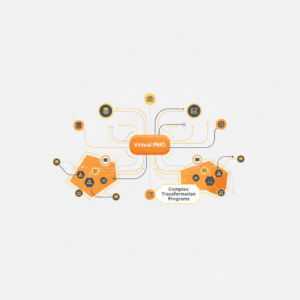
A virtual PMO is a project management office operating as a distributed service model. It delivers standard PMO capabilities through shared ways of working, digital tooling, and specialist roles that can scale up or down. Unlike a conventional PMO built as a static internal team, a virtual PMO is structured as an operating capability that can be embedded across workstreams, vendors, and internal squads while remaining lightweight.
In complex programs, “virtual” should not mean “remote admin support”. It should mean an end-to-end control function covering governance, integrated planning, dependency management, risk and issue management, reporting, and benefits tracking. In effect, virtual PMO services convert program noise into decision-quality information at the speed executives need.
How does project management office outsourcing fit?
Project management office outsourcing is the commercial and operating approach that supplies the virtual PMO capability. It can be full outsourcing of PMO delivery, a co-sourced model (internal leadership plus external specialists), or a targeted uplift (for example, planning and controls only). The core test is whether the model reduces delivery risk while improving transparency and accountability.
Context
Why do complex transformation programs struggle to land benefits?
Transformation success rates remain low across industries. One widely cited benchmark reports fewer than 30% of transformations succeed when measured as sustained performance improvement plus organisational health¹. Another executive survey-based estimate reports that 70% of digital transformation initiatives do not reach their goals². The consistent pattern is not a lack of effort. It is a lack of execution cohesion across strategy, operating model, technology, and people change.
The practical causes show up as fragmented governance, unclear decision rights, weak dependency control, and poor integration between delivery and business-as-usual. These gaps compound in multi-vendor environments, regulated settings, and programs with heavy data, security, or process redesign components. A virtual PMO is valuable because it focuses directly on these failure modes.
Why executives care about PMO design now
Major programs increasingly rely on blended workforces. Contractors and specialist partners fill capability gaps quickly, but they also increase coordination load and governance risk. Public-sector audits, including Australian examples, repeatedly emphasise the need for stronger contractor management arrangements to protect value and integrity¹². A virtual PMO provides the mechanism to apply consistent controls across internal teams, contractors, and vendors without forcing a one-size-fits-all delivery method.
Mechanism
How does a virtual PMO reduce delivery risk?
A well-designed virtual PMO reduces risk through five control loops:
Decision loop: clear forums, decision rights, and escalation paths so blockers move fast. This aligns with governance guidance that emphasises defined roles, oversight, and accountability in projects and programs⁶.
Plan loop: an integrated plan that ties milestones to dependencies and operational readiness, consistent with project management guidance on structured planning, control, and stakeholder alignment⁵.
Delivery loop: consistent RAID (risks, assumptions, issues, dependencies), change control, and schedule integrity to prevent silent drift.
Value loop: benefits mapping and measurement, including leading indicators (adoption, cycle time, quality) and lagging indicators (financial and customer outcomes).
Assurance loop: independent, periodic health checks and readiness reviews, aligned to formal assurance practices used in government and regulated environments⁷˒⁸.
The key is cadence. Complex programs fail when they cannot sustain an executive decision rhythm that matches delivery volatility. The virtual PMO stabilises that rhythm.
Which roles matter most?
The highest leverage roles are typically: program controls lead, integrated scheduler, dependency manager, benefits lead, and governance secretariat. The model can then pull in specialist project management contractors for short bursts (for example, cutover planning, procurement governance, data migration coordination). This approach supports People & Capability outcomes by strengthening internal capability transfer rather than creating a permanent external dependency.
Comparison
Virtual PMO vs traditional PMO vs “PMO as reporting”
A traditional PMO can be effective when the organisation has stable demand, consistent methods, and enough internal capacity. However, complex transformations create “peaks” in controls workload that internal teams struggle to absorb without slowing delivery.
A virtual PMO is distinct from a reporting office. Reporting-only PMOs often produce late, low-trust status packs that executives stop using. Modern PMO research highlights that PMO types and functions vary significantly and should be designed around organisational context and value contribution, not standard templates¹⁰. The practical implication is that a virtual PMO should be assessed on decision quality, dependency control, and benefits realisation, not on the volume of artefacts produced.
When outsourcing is the better option
Project management office outsourcing is usually the better option when you need speed, specialist depth, or independence. It is also valuable when internal leaders need to remain focused on operational performance while transformation peaks. The main trade-off is that outsourcing requires tighter definition of accountabilities, clear deliverables, and explicit knowledge transfer plans so the organisation retains capability after the peak period.
Applications
Where virtual PMO services deliver the highest ROI
Virtual PMO services are most valuable in three scenarios.
First, multi-stream transformations that combine operating model change, technology delivery, data migration, and customer experience redesign. These programs fail when dependencies and readiness are weak. The virtual PMO’s integrated plan and cutover governance prevent last-minute surprises.
Second, high-assurance environments such as financial services, government, and critical infrastructure, where independent reviews and evidence-based governance are expected⁷˒⁸.
Third, capability-constrained organisations where project management contractors are already in play. The virtual PMO provides the wrapper that makes contractor output coherent, traceable, and aligned to outcomes.
For organisations that need fast portfolio visibility and benefit tracking across multiple initiatives, Customer Science Insights can support executive-ready reporting and insights integration: https://customerscience.com.au/csg-product/customer-science-insights/
How to structure the operating model for scale
A scalable model typically uses a small “core” virtual PMO (governance, controls, reporting, benefits) plus a flexible “edge” of contractors and specialists that can be deployed per workstream. The core maintains standards, assurance cadence, and cross-stream integration. The edge accelerates execution without creating long-term fixed cost.
Risks
What can go wrong with a virtual PMO?
The most common failure is turning the virtual PMO into a compliance layer that slows delivery. This happens when the PMO is judged on artefact completion rather than decision outcomes. Another risk is excessive tooling complexity. Too many tools create duplicated data and erode trust.
There is also a goourced PMO staff operate without clear delegation, documented decision rights, or appropriate segregation of duties, especially where vendors are being managed. Governance standards emphasise the importance of defined responsibilities and oversight mechanisms for integrity and effectiveness⁶. A strong model uses transparent logs, auditable workflows, and clear commercial boundaries.
How to reduce outsourcing risk
Mitigate risk by specifying measurable outcomes, not just roles. Require structured knowledge transfer, run internal shadowing, and make the virtual PMO accountable for capability uplift. In contractor-heavy environments, apply consistent onboarding, performance measures, and approvals, aligning with audit expectations for contractor management in large agencies¹².
Measurement
What metrics show a virtual PMO is working?
Metrics should track both delivery health and value realisation.
Delivery health indicators include decision cycle time (issue raised to decision), schedule volatility (plan stability), dependency breach rate, and rework volume. Value indicators include benefits forecast accuracy, adoption milestones, customer or employee experience measures, and financial run-rate impact.
Cost of poor delivery is also measurable. PMI’s research has reported that an average 11.4% of investment is wasted due to poor project performance³. A virtual PMO should directly reduce the drivers of waste: unclear goals, poor sponsorship, weak risk management, and unmanaged change.
How to evidence assurance and readiness
Use structured health checks and readiness reviews at key lifecycle points, consistent with formal assurance approaches in major programs⁷˒⁸. The evidence pack should include: decision logs, risks and mitigations, dependency maps, benefits logic, operational readiness criteria, and cutover rehearsal outcomes.
Next Steps
How to implement a virtual PMO in 30–60 days
Start with a diagnostic that maps program complexity, delivery maturity, and assurance needs against the minimum viable controls set. Then implement in three waves.
Wave one establishes governance, reporting, RAID, and an integrated plan. Wave two adds dependency management, benefits tracking, and vendor coordination. Wave three optimises cadence, automation, and capability transfer.
If you need a partner-led model that blends governance, delivery controls, and capability uplift, Customer Science CX consulting and professional services can provide managed support aligned to business outcomes: https://customerscience.com.au/service/cx-consulting-and-professional-services/
What to ask for in an outsourcing statement of work
Specify outcomes such as “dependency breaches reduced by X%”, “decision cycle time reduced to Y days”, “benefits tracking established for 100% of initiatives”, and “assurance pack produced for each gate”. Also specify knowledge transfer deliverables, including playbooks, templates, and coached internal leads.
Evidentiary Layer
What evidence supports the value of a strong PMO function?
Empirical and systematic research increasingly links PMO roles to strategic execution. A 2024 study tested PMO roles in implementing organisational strategy, reinforcing the PMO’s relevance beyond administration⁹. Broader research on PMO typologies shows that fit-for-context design is central to effectiveness¹⁰.
On the transformation side, major studies and reviews consistently show high failure rates and identify recurring pitfalls, including weak governance, unclear accountability, and insufficient organisational change capability¹˒²˒¹¹. The virtual PMO directly targets these systeening decision flow, control discipline, and value realisation measurement.
FAQ
What work is suitable for virtual PMO services?
Virtual PMO services suit programs with multiple workstreams, complex dependencies, multi-vendor delivery, or constrained internal capability. They are especially useful when governance needs to be strengthened quickly without increasing permanent headcount.
Is project management office outsourcing only a cost play?
Project management office outsourcing is mainly a risk and speed play. Cost matters, but the primary benefit is faster access to specialist controls and a governance cadence that reduces rework and prevents benefit leakage.
How do we prevent a virtual PMO from becoming bureaucracy?
Define the PMO’s purpose as decision enablement and benefits delivery. Track decision cycle time and executive satisfaction with reporting quality. Remove artefacts that do not change decisions or reduce risk.
How do we integrate contractors without losing control?
Use a single integrated plan, consistent RAID and change control, and clear delegation. Require auditable logs and enforce segregation of duties in vendor management, consistent with governance and audit expectations⁶˒¹².
What tooling helps a virtual PMO scale reporting quality?
Use tools that reduce manual status chasing and improve traceability from work to outcomes. For communications performance measurement that supports program adoption and change effectiveness, Commscore AI can help quantify message reach and impact: https://customerscience.com.au/csg-product/commscore-ai/
How soon should we expect measurable impact?
Early impact should appear within weeks as decision cycle time improves and dependency risks become visible. Financial and customer outcome impact typically follows once adoption and operational readiness milestones are met.
Sources
McKinsey & Company (2018). Unlocking success in digital transformations. (Link: https://www.mckinsey.com/capabilities/people-and-organizational-performance/our-insights/unlocking-success-in-digital-transformations)
Harvard Business Review (2019). Digital Transformation Is Not About Technology. (Link: https://hbr.org/2019/03/digital-transformation-is-not-about-technology)
Project Management Institute (2020). Pulse of the Profession: Forging a Future-Focused Culture (11.4% waste statistic). (Link: https://www.pmi.org/learning/thought-leadership/pulse/pulse-of-the-profession-2020)
Project Management Institute (2023). Pulse of the Profession 2023: Power Skills, Redefining Project Success (report). (Link: https://www.pmi.org/-/media/pmi/documents/public/pdf/learning/thought-leadership/pmi-pulse-of-the-profession-2023-report.pdf)
International Organization for Standardization (2020). ISO 21502:2020 Project, programme and portfolio management: Guidance on project management. (Link: https://www.iso.org/standard/74947.html)
ISO (2017). ISO 21505:2017 Project, programme and portfolio management: Guidance on governance. (Link: https://www.iso.org/standard/63578.html)
Australian Government Department of Finance (updated 19 Dec 2025). Gateway Reviews Process. (Link: https://www.finance.gov.au/government/assurance-reviews-and-risk-assessment/gateway-reviews-process)
Digital Transformation Agency (Dec 2023). Assurance Framework for Digital & ICT Investments. (Link: https://www.dta.gov.au/sites/default/files/documents/2026-01/Assurance%20Framework%20Dec%202023.pdf)
Sandhu, M.A. et al. (2024). The role of project management office in the implementation of the strategic plan of the organization. PLOS ONE. DOI: 10.1371/journal.pone.0306702 (Link: https://journals.plos.org/plosone/article?id=10.1371/journal.pone.0306702)
Monteiro, A. et al. (2024). Project Management Office Typologies, Types, and Functions. Project Management Journal (SAGE). DOI: 10.1177/87569728241297899 (Link: https://journals.sagepub.com/doi/10.1177/87569728241297899)
Oludapo, S. et al. (2024). Why do so many digital transformations fail? A bibliometric analysis. International Journal of Research in Marketing (ScienceDirect). (Link: https://www.sciencedirect.com/science/article/pii/S0148296324000328)
Australian National Audit Office (2022). Effectiveness of the Management of Contractors in Services Australia. (Link: https://www.anao.gov.au/work/performance-audit/effectiveness-the-management-contractors-services-australia)