































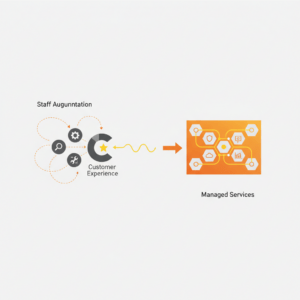
Staff augmentation and managed services solve different CX delivery problems. Staff augmentation adds capability into your operating model, but you retain delivery accountability. Managed services outsource defined outcomes under governance, SLAs, and controls. The right choice depends on whether your constraint is skills and capacity, or repeatable outcomes and risk reduction, especially under Australian contracting, privacy, and cyber expectations.
What is staff augmentation and what is a managed service?
Staff augmentation is a resourcing model where you bring external specialists into your team, processes, and tooling to accelerate delivery. You direct priorities, manage day-to-day work, and own delivery quality. In Australian terms, leaders must still manage worker classification, tax, and super obligations based on the real working arrangement, not the job title.¹˒²
Managed services is a delivery model where a provider takes responsibility for an agreed service or capability, measured against defined outcomes and service levels. It is typically governed through contractual controls, operational reporting, and continuous improvement disciplines aligned to outsourcing governance standards.³ The key difference is accountability: staff augmentation increases your capacity, while managed services shifts delivery responsibility to the provider for a defined scope.
Why does the delivery model matter for CX programs in Australia?
CX programs often fail at the operating layer, not the strategy layer. When service volumes spike, knowledge drifts, or channel mix changes, delivery throughput and control become the bottleneck. In Australia, this is compounded by a large contractor labour pool and competing expectations around capability retention. The Australian labour market includes a material share of independent contractors, which makes augmentation easy to procure, but harder to govern at scale without consistent controls.⁴
Regulatory and risk settings also shape the decision. If your CX project touches personal information that may be disclosed to overseas recipients, Australian Privacy Principle 8 requires “reasonable steps” to protect data handling, and accountability can remain with the disclosing entity.⁵ That pushes many executives toward managed service patterns with stronger contractual, process, and assurance controls. Cyber expectations create similar pressure, especially when third parties operate or access core platforms, and when Essential Eight maturity targets are part of enterprise risk.⁶
How do the two models work in practice?
Operating mechanics of staff augmentation
Staff augmentation works best when you already have clear product ownership, delivery rituals, and quality controls. You “plug in” scarce skills such as contact centre architects, CX business analysts, knowledge managers, journey analysts, or platform engineers, then use your internal governance to coordinate delivery. This model concentrates risk internally: if delivery slows, quality drops, or documentation is weak, you cannot point to an external SLA. The upside is control and adaptability when priorities change daily.
Operating mechanics of managed services
Managed services works best when you can define outputs and performance thresholds and sustain stable governance. Mature managed services align to structured outsourcing lifecycle practices and service management systems, including roles, escalation paths, change control, and continual improvement.³˒⁷ In CX contexts, this often looks like a managed “capability layer” (for example knowledge operations, QA and compliance scoring, workforce management, or analytics operations) with clear KPI reporting, cadence-based reviews, and service credits or remedies when performance drops.
Staff augmentation vs managed services: what differs?
The comparison becomes clearer when framed as control, outcomes, and risk.
Staff augmentation maximises flexibility and internal control. It is usually the fastest route to fill niche capability gaps, but it assumes your team can absorb and direct the work. It also increases the importance of classification hygiene, because contractor-like labels do not remove employee-like obligations when the practical arrangement looks like employment.¹˒²
Managed services maximises outcome accountability and repeatability. It is usually stronger for “run and improve” activities where performance can be measured, trended, and optimised under SLAs. Research on outsourcing governance consistently highlights contract design, communication, collaboration, and trust as critical success factors, which maps directly to how managed services must be run to succeed.⁸
A useful executive heuristic is: use augmentation to build and change, use managed services to operate and optimise. In reality, most enterprises run a hybrid: augment during transformation, then transition stable components into managed services once the process and metrics are proven.
Where does each model fit in common CX project types?
Transformation projects with shifting scope
For contact centre migrations, channel deflection initiatives, or new operating model design, staff augmentation can be the safer option because discovery changes the scope weekly. In this phase, you need rapid decision-making and embedded domain expertise. You also want to retain organisational knowledge as the new model stabilises.
Ongoing CX operations with measurable outputs
For steady-state functions, managed services often wins. Examples include ongoing quality assurance, knowledge maintenance, analytics operations, and compliance reporting. Service quality standards for customer contact centres define service expectations and reinforce the case for explicit KPIs and contractual clarity, particularly when service is outsourced.⁹
Practical CX example anchored in analytics
Real-time operational visibility is a recurring gap in contact centres because data is fragmented across voice, digital, bots, and CRM. When the need is to instrument and operationalise insight quickly, a product-led approach can reduce dependency on bespoke delivery. Customer Science Insights can unify contact centre data sources to support real-time decisioning for CX and operations teams.
What risks should executives manage?
Misclassification and workforce compliance risk matters most in staff augmentation. Australian regulators emphasise that classification depends on factors such as control, ability to delegate, tools and equipment, and financial risk.¹˒² A CX program that treats contractors like employees, at scale, can accumulate compliance exposure and reputational risk.
Data and security risk often drives the managed services decision. Where offshore access or processing is involved, APP 8 cross-border disclosure expectations and accountability settings should be explicitly designed into contracts, operating procedures, and assurance reviews.⁵ For cyber, Essential Eight maturity targets and control exceptions should be documented, approved, and monitored, which is harder to enforce without strong third-party governance.⁶
Service quality risk exists in both models. The difference is detection and correction speed. SLA-focused evidence shows that meeting incident resolution commitments depends on operational factors you can measure and manage, such as workload patterns, process discipline, and resolution practices.¹⁰ That reinforces the need for instrumentation and clear governance, regardless of the model you choose.
How do you measure success and control cost?
Measurement should reflect customer outcomes, operational performance, and risk controls.
Customer outcomes: First call resolution is consistently linked to satisfaction and performance in call centre contexts, so it should sit near the top of your CX measurement stack.¹¹
Operational outcomes: Track average handle time, transfer rate, repeat contact rate, and backlog age, but only alongside quality to avoid “speed over correctness” failures. ISO contact centre guidance expects monitoring of relevant KPIs and contractual clarity, which helps prevent metric gaming.⁹
Risk outcomes: For managed services, insist on evidence of service management discipline (for example ISO/IEC 20000-1 style controls for planning, transition, delivery, and improvement).⁷ For security, confirm that control ownership is explicit and mapped to your Essential Eight target maturity where applicable.⁶
What is a practical selection framework for executives?
Use a three-part decision test.
Can you clearly define outputs and service levels?
If yes, managed services can reduce delivery load and increase repeatability.³˒⁷
If no, staff augmentation is safer until the scope stabilises.
Where does accountability need to sit for risk?
If privacy, cyber, or regulatory exposure is high, shifting defined responsibilities into a governed managed service can reduce operational risk, but only if you retain oversight and assurance.⁵˒⁶
If the risk is mainly “wrong solution” risk, keep accountability internal with augmentation until you validate the design.
What capability must remain in-house?
If the capability is strategic differentiation (for example journey governance, VOC to action, or product ownership), augment and retain knowledge internally.⁸
If the capability is repeatable operations (for example QA scoring, knowledge operations, reporting), move toward managed services once stable.
For Australian enterprises that need to scale quickly without losing control, a common pattern is augment first, then transition parts of the operating layer into managed services under strong governance. If you need rapid access to CX specialists across roles such as service design, BA, change, process, and knowledge management, Customer Science provides Contracting and Workforce Augmentation services aligned to CX delivery needs.
Evidentiary layer
Staff augmentation and managed services are both valid IT contracting models Australia leaders use to deliver CX outcomes. The model choice should be treated as a governance decision, not a procurement preference. Outsourcing guidance standards emphasise lifecycle governance, mutual benefit, and sustained relationship management, which applies directly to managed service design.³ Evidence from outsourcing research reinforces that contract quality and relationship factors jointly drive outcomes.⁸ Service management standards provide an assurance baseline for managed delivery, while Australian regulatory guidance shapes workforce and privacy controls that remain the enterprise’s responsibility.¹˒⁵
The executive objective is stable delivery of customer outcomes with transparent accountability. When you align model selection to measurable outcomes, clear control ownership, and realistic internal capacity, you reduce transformation fatigue and improve CX reliability.
FAQ
When is staff augmentation the better choice?
Staff augmentation is best when scope changes quickly, when you need niche specialists embedded in your team, or when you must retain delivery control and internal capability.¹˒⁴
When is managed services the better choice?
Managed services is best when outputs can be defined, measured, and governed under SLAs, and when you want the provider accountable for a stable operating function.³˒⁷
What is the biggest hidden cost in staff augmentation?
The hidden cost is internal management load: prioritisation, quality control, documentation, and continuity planning all remain your responsibility.¹˒⁸
How do privacy and offshore delivery affect the decision?
If personal information is disclosed overseas, APP 8 requires reasonable steps to ensure protections and may leave accountability with your organisation, so governance and assurance become non-negotiable.⁵
How do you prevent quality from dropping under either model?
Use a balanced scorecard that ties operational efficiency to quality and customer outcomes, with explicit KPI definitions and auditability aligned to contact centre service expectations.⁹˒¹¹
How can teams improve customer communications quality at scale?
Automated scoring and feedback can standardise quality controls across large volumes of messages and reduce manual effort. CommScore.AI is designed to score customer communications and surface actionable improvements for consistent, brand-aligned outcomes.
Sources
Australian Taxation Office. “Employee or independent contractor.”
Fair Work Ombudsman. “Independent contractors.”
International Organization for Standardization. ISO 37500:2014, Guidance on outsourcing.
Australian Bureau of Statistics. Characteristics of Employment, Australia (August 2025): independent contractors proportion.
Office of the Australian Information Commissioner. APP Guidelines, Chapter 8: Cross-border disclosure (APP 8).
Australian Cyber Security Centre. Essential Eight Maturity Model (including November 2023 update materials).
ISO/IEC 20000-1:2018. Service management system requirements.
Hodosi, G. et al. (2024). “Influencing Factors in Information Technology Outsourcing Relationships.” Procedia Computer Science (systematic review).
ISO 18295-1:2017. Customer contact centres, service requirements for CCCs.
Swain, A.K. et al. (2022). “Key Factors in Achieving Service Level Agreements for IT incident resolution.” (Open access).
“The mediating effects of first call resolution on call centers’ performance.” (Empirical study of FCR and satisfaction).
Simões, C.A. et al. (2024). “IT Workforce Outsourcing: Benefits, Challenges and Success Factors.” ACM Digital Library. DOI: 10.1145/3658271.3658305
Yes. Below is the same Sources list, kept in the same order and wording, with a live URL added where available (plain text so it will auto-link in WordPress).
Sources
Australian Taxation Office. “Employee or independent contractor.” (ato.gov.au)
Link: https://www.ato.gov.au/businesses-and-organisations/hiring-and-paying-your-workers/employee-or-independent-contractorFair Work Ombudsman. “Independent contractors.” (fairwork.gov.au)
Link: https://www.fairwork.gov.au/find-help-for/independent-contractorsInternational Organization for Standardization. ISO 37500:2014, Guidance on outsourcing. (iso.org)
Link: https://www.iso.org/standard/56269.htmlAustralian Bureau of Statistics. Characteristics of Employment, Australia (August 2025): independent contractors proportion. (abs.gov.au)
Link: https://www.abs.gov.au/statistics/labour/earnings-and-working-conditions/characteristics-employment-australia/latest-releaseOffice of the Australian Information Commissioner. APP Guidelines, Chapter 8: Cross-border disclosure (APP 8). (oaic.gov.au)
Link: https://www.oaic.gov.au/privacy/australian-privacy-principles/australian-privacy-principles-guidelines/chapter-8-app-8-cross-border-disclosure-of-personal-informationAustralian Cyber Security Centre. Essential Eight Maturity Model (including November 2023 update materials). (cyber.gov.au)
Link: https://www.cyber.gov.au/sites/default/files/2023-11/PROTECT%20-%20Essential%20Eight%20Maturity%20Model%20%28November%202023%29.pdfISO/IEC 20000-1:2018. Service management system requirements. (iso.org)
Link: https://www.iso.org/standard/70636.htmlHodosi, G. et al. (2024). “Influencing Factors in Information Technology Outsourcing Relationships.” Procedia Computer Science (systematic review). (sciencedirect.com)
Link: https://www.sciencedirect.com/science/article/pii/S1877050924015151ISO 18295-1:2017. Customer contact centres, service requirements for CCCs. (iso.org)
Link: https://www.iso.org/standard/64739.htmlSwain, A.K. et al. (2022). “Key Factors in Achieving Service Level Agreements for IT incident resolution.” (Open access). (pmc.ncbi.nlm.nih.gov)
Link: https://pmc.ncbi.nlm.nih.gov/articles/PMC8942060/“The mediating effects of first call resolution on call centers’ performance.” (Empirical study of FCR and satisfaction). (researchgate.net)
Link: https://www.researchgate.net/publication/233611976_The_mediating_effects_of_first_call_resolution_on_call_centers%27_performanceSimões, C.A. et al. (2024). “IT Workforce Outsourcing: Benefits, Challenges and Success Factors.” ACM Digital Library. DOI: 10.1145/3658271.3658305 (dl.acm.org)
Link: https://dl.acm.org/doi/10.1145/3658271.3658305