






























Hybrid work policy design sits at the intersection of business performance, employee experience, governance, and organisational culture. The strongest policies do not focus on attendance targets alone. They define how work gets done, how teams collaborate, how decisions are made, and how outcomes are measured. Organisations that balance operational requirements with employee flexibility tend to achieve higher engagement, stronger retention, and more sustainable productivity than those relying solely on return to office mandates.¹˒²
What Is Hybrid Work Policy Design?
Hybrid work policy design is the structured process of defining where, when, and how employees work while maintaining business performance, compliance, collaboration, and employee wellbeing.
A hybrid policy is not simply a schedule. It is a governance framework that establishes expectations across workforce planning, customer service delivery, leadership accountability, technology use, workplace utilisation, and organisational culture.
Many organisations initially adopted hybrid arrangements as a temporary response to disruption. Several years later, hybrid work has become a long-term operating model across knowledge-intensive industries. Research from the OECD and Microsoft indicates that employees increasingly value flexibility as part of their employment proposition, while employers continue to seek ways to maintain collaboration, innovation, and organisational cohesion.¹˒³
Why Are Return to Office Mandates Increasing?
Return to office mandates emerged as many organisations attempted to address concerns around productivity visibility, collaboration quality, workplace investment, and culture development.
Leaders often cite several operational challenges:
- Reduced informal knowledge sharing
- Difficulties onboarding new employees
- Lower visibility of performance issues
- Fragmented team communication
- Underutilised office infrastructure
Yet evidence remains mixed. Studies from Stanford University and the UK Office for National Statistics suggest that productivity outcomes depend more on management quality, role design, and collaboration practices than physical location alone.⁴˒⁵
Because of this, blanket attendance requirements frequently generate resistance when employees perceive little connection between office presence and business outcomes.
How Does a Successful Hybrid Work Model Operate?
The most effective hybrid organisations focus on work design rather than location control.
Instead of asking, “How many days should employees attend the office?”, leading organisations ask:
- Which activities benefit from co-location?
- Which activities are best performed remotely?
- How should teams coordinate availability?
- What governance mechanisms support accountability?
- How can culture be maintained across distributed environments?
This shift changes the conversation from attendance compliance to business outcomes.
A well-designed policy defines collaboration rhythms, meeting standards, decision-making processes, communication protocols, customer service requirements, and leadership responsibilities. Employees understand expectations clearly. Managers gain consistency. Executives obtain measurable performance indicators.
What Should Be Included in a Hybrid Work Policy?
Governance and Accountability
Governance establishes who approves hybrid arrangements, monitors compliance, reviews outcomes, and manages exceptions.
Key elements include:
- Eligibility criteria
- Approval processes
- Role classifications
- Review periods
- Escalation pathways
- Compliance requirements
Without governance, policies become inconsistent and difficult to enforce.
Performance Measurement
Output-based measurement is generally more effective than attendance-based measurement.
Metrics may include:
- Customer satisfaction
- Service levels
- Project delivery performance
- Quality indicators
- Employee engagement
- Innovation outcomes
Organisations seeking evidence-based workforce insights often use platforms such as Customer Science Insights to analyse employee and customer experience data simultaneously, helping leaders understand how workplace decisions affect performance and culture. See: https://customerscience.com.au/csg-product/customer-science-insights/
Collaboration Expectations
Hybrid environments require explicit collaboration standards.
These commonly cover:
- Core collaboration hours
- Team attendance days
- Meeting etiquette
- Documentation standards
- Knowledge management requirements
- Technology usage expectations
When collaboration rules remain unclear, employees often experience communication overload and decision delays.
Hybrid Work Versus Return to Office Mandates
Hybrid Work Policies
Advantages:
- Greater employee flexibility
- Broader talent access
- Improved retention
- Reduced commuting burden
- Increased workforce resilience
Challenges:
- Coordination complexity
- Leadership adaptation requirements
- Cultural consistency risks
- Technology dependence
Return to Office Mandates
Advantages:
- Increased physical interaction
- Easier workplace visibility
- Simplified facility utilisation
Challenges:
- Higher attrition risk
- Reduced employee autonomy
- Potential recruitment constraints
- Increased employee resistance
Recent evidence suggests employee preference increasingly favours flexibility. Gallup research indicates that hybrid arrangements remain the preferred model for many professional employees where job functions permit remote work.⁶
How Can Organisations Protect Culture in Hybrid Environments?
Culture does not emerge from physical proximity alone.
Culture is the shared set of behaviours, norms, decisions, and experiences that employees encounter daily.
Organisations with strong hybrid cultures generally focus on:
Leadership Visibility
Leaders communicate frequently and consistently.
Employees need access to strategic context, decision rationale, and organisational priorities regardless of location.
Structured Connection
Informal interaction declines naturally in distributed environments.
Successful organisations deliberately create opportunities for:
- Team collaboration
- Mentoring
- Learning programs
- Cross-functional networking
- Innovation workshops
Consistent Employee Experience
Employees should receive comparable access to information, recognition, development opportunities, and leadership engagement whether working remotely or onsite.
Communication quality often becomes one of the strongest predictors of cultural health in hybrid organisations. Solutions such as CommScore AI can assist organisations in evaluating communication effectiveness and employee understanding across large workforces. See: https://customerscience.com.au/csg-product/commscore-ai/
What Risks Should Organisations Consider?
Several risks commonly emerge when hybrid work policies are poorly designed.
Proximity Bias
Employees working onsite may receive greater visibility and advancement opportunities than remote colleagues.
Manager Capability Gaps
Many managers were trained for co-located teams rather than distributed workforce leadership.
Inconsistent Policy Application
Different interpretations across business units can create perceptions of unfairness.
Security and Compliance Exposure
Remote environments can increase information governance and cybersecurity risks if controls are not clearly defined.
Regular policy reviews and workforce feedback mechanisms help identify these issues before they become systemic.
How Should Hybrid Work Success Be Measured?
Measurement should balance operational performance, employee outcomes, and cultural health.
Recommended indicators include:
Operational Metrics
- Customer satisfaction scores
- Service performance
- Project delivery rates
- Quality outcomes
Workforce Metrics
- Employee engagement
- Voluntary turnover
- Absenteeism
- Internal mobility
Culture Metrics
- Trust in leadership
- Collaboration effectiveness
- Communication clarity
- Organisational alignment
Many organisations engage specialist business consulting services to establish governance frameworks, workforce measurement systems, and operating models that connect employee experience to strategic outcomes. See: https://customerscience.com.au/solution/business-consulting/
What Are the Next Steps for Organisations Reviewing Hybrid Policies?
Organisations considering policy redesign should avoid treating hybrid work as a facilities management issue.
Instead:
- Assess workforce needs and role requirements.
- Identify activities requiring physical collaboration.
- Define measurable business outcomes.
- Establish governance and accountability structures.
- Review employee and customer experience data.
- Pilot policy changes before enterprise-wide rollout.
- Continuously monitor outcomes and adapt.
Hybrid work policies perform best when treated as operating model decisions rather than workplace attendance programs.
Evidentiary Layer
Research across multiple jurisdictions shows that flexibility, autonomy, and management quality have stronger relationships with employee engagement than physical attendance requirements alone.¹˒³˒⁶
At the same time, organisations with clear collaboration frameworks, leadership communication standards, and accountability mechanisms achieve stronger coordination outcomes than organisations relying on informal workplace interactions.²˒⁷
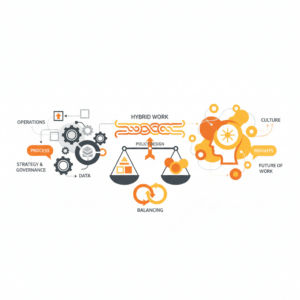
The evidence points toward a balanced approach. Hybrid work policy design succeeds when operational requirements, customer outcomes, employee expectations, and organisational culture are managed as interconnected components of the same system.
FAQ
What is hybrid work policy design?
Hybrid work policy design is the process of defining how employees split work between remote and office environments while maintaining performance, governance, culture, and compliance.
Are return to office mandates more effective than hybrid work?
Current evidence suggests effectiveness depends on role requirements, management practices, and organisational design rather than attendance requirements alone.⁴˒⁵
How many office days should a hybrid policy require?
There is no universal standard. Requirements should be based on collaboration needs, customer obligations, operational demands, and team workflows.
How can organisations measure hybrid work success?
Success should be measured through operational, workforce, and culture indicators including customer satisfaction, engagement, retention, collaboration quality, and service outcomes.
What is the biggest risk in hybrid work?
Proximity bias remains one of the most common risks because onsite employees may receive greater visibility and career opportunities than remote colleagues.
How can organisations improve hybrid work governance?
Structured research, workforce analytics, and evidence-based policy development help create consistent governance frameworks. Organisations can support this through programs such as Knowledge Quest, which helps leaders gather workforce insights and decision intelligence. See: https://customerscience.com.au/csg-product/knowledge-quest/
Sources
- OECD. The Future of Remote Work. https://www.oecd.org
- International Organization for Standardization. ISO 30414: Human Capital Reporting. https://www.iso.org
- Microsoft Work Trend Index Reports (2023-2025). https://www.microsoft.com/worklab
- Bloom, N. et al. Stanford University Working Papers on Hybrid Work. https://wfhresearch.com
- UK Office for National Statistics. Homeworking and Productivity Studies. https://www.ons.gov.uk
- Gallup. Hybrid Work Indicator Reports. https://www.gallup.com/workplace
- Australian Public Service Commission. Future of Work Research and Guidance. https://www.apsc.gov.au
- Australian Human Rights Commission. Flexible Work and Inclusion Research. https://humanrights.gov.au
- CIPD. Flexible and Hybrid Working Practices. https://www.cipd.org
- Eurofound. Living, Working and COVID-19 Research Programme. https://www.eurofound.europa.eu
- World Economic Forum. Future of Jobs Report 2025. https://www.weforum.org/reports
- Australian Government Productivity Commission. Workplace Relations and Productivity Research. https://www.pc.gov.au