
























Probity in government procurement protects fairness, transparency, accountability and value for money. A probity advisor helps agencies prevent problems before they damage a sourcing process. A probity auditor checks whether the process was followed. The advisor’s role is practical, independent and preventative, especially in complex, high-value or sensitive procurements.
Definition
What is probity in government procurement?
Probity in government procurement means procurement decisions are made with integrity, fairness, transparency, confidentiality and proper conflict management¹. It does not mean slowing every decision with extra process. Done well, probity keeps the market confident and helps procurement teams make defensible choices.
For executives, probity is a governance control. For procurement teams, it is a daily operating discipline. For suppliers, it protects equal treatment.
What does a probity advisor do?
A probity advisor gives independent advice during the procurement. The advisor reviews the process, tender documents, communications, evaluation approach, conflict declarations, records and decision points before issues harden into disputes.
The advisor does not choose the supplier. The agency remains accountable².
Context
Why does probity matter more in public procurement now?
Government procurement is under close audit, media and supplier scrutiny. The Commonwealth Procurement Rules require value for money, ethics, accountability and transparency³. Recent Australian audits have also highlighted weak conflict management, incomplete records and limited probity engagement in high-risk procurements⁴˒⁵.
Small gaps can become large problems. A missed conflict declaration. A late clarification. A poorly recorded moderation meeting. Each can weaken confidence in the result.
Mechanism
How does a probity advisor reduce procurement risk?
A probity advisor reduces risk by designing practical controls early. These usually include:
• a probity plan
• conflict of interest procedures
• confidentiality protocols
• supplier communication rules
• evaluation governance
• meeting records
• decision logs
• issue escalation pathways
Customer Science supports this type of structured governance through Business Consulting, where procurement, operating model and decision disciplines need clear ownership: https://customerscience.com.au/solution/business-consulting/
Good advice is specific. It tells the team what to do next, what to record, and when to pause.
Comparison
Probity auditor vs advisor: what is the difference?
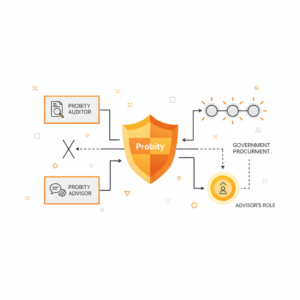
A probity advisor works during the procurement. The advisor helps the agency prevent probity breaches, improve documentation and manage live issues.
A probity auditor usually reviews the process after key stages or at completion. The auditor forms an independent view on whether the procurement complied with the agreed probity framework.
The roles should not be blurred. Victorian guidance warns that high-risk procurements may need a separate advisor and auditor to preserve independence⁶. NSW guidance also states that engaging a probity adviser or auditor does not outsource agency accountability².
Applications
When should government agencies appoint a probity advisor?
A probity advisor is most useful when the procurement is high value, complex, politically sensitive, novel, time pressured, supplier-constrained or likely to attract complaints.
Examples include digital platforms, outsourcing, citizen service redesign, panel refreshes, grants administration systems, contact centre services and major transformation programs.
In these settings, probity advice should start before the market approach. Late appointment can still help, but it often becomes repair work.
Risks
What happens when probity is treated as a checklist?
Checklist probity creates false comfort. The forms exist, but the decisions are still exposed.
The common failure patterns are predictable: conflicts are declared but not managed, evaluation criteria are interpreted differently across assessors, supplier questions are answered inconsistently, and value-for-money decisions are poorly recorded.
ISO 31000 frames risk management as identification, analysis, evaluation, treatment, monitoring and communication⁷. Probity should work the same way. Not as paperwork. As active risk control.
Measurement
How should leaders measure probity performance?
Leaders should measure probity through evidence, not sentiment. Useful indicators include:
• percentage of evaluation members with current conflict declarations
• time taken to resolve probity issues
• number of supplier clarifications and response consistency checks
• completeness of decision records
• number of late-stage process changes
• audit findings by severity
• supplier complaints and outcomes
Customer Science can support governance measurement, reporting and executive visibility through Business Intelligence: https://customerscience.com.au/solution/business-intelligence/
Next Steps
How should an agency set up the advisor role?
Start with a clear terms of reference. Define independence, reporting lines, access to documents, issue escalation, meeting attendance and expected outputs.
Then build a simple rhythm. The advisor should review the procurement plan, market documents, evaluation plan, conflict register, supplier communications, moderation approach, recommendation report and debrief material.
Keep records clean. Assume an auditor, supplier, ministerial office or integrity body may later read them.
Evidentiary Layer
What evidence supports better probity practice?
The OECD links procurement integrity to transparency, good management, misconduct prevention, accountability and control⁸. UNODC, OECD and World Bank guidance treats conflicts of interest as a core public integrity risk that needs disclosure, review and active management⁹. ISO 37001 also supports systems that prevent, detect and respond to bribery risks¹⁰.
These sources point in the same direction. Probity is strongest when it is designed into procurement governance from the start.
FAQ
What is probity in government procurement?
Probity in government procurement means fair, ethical, transparent and accountable procurement conduct. It protects equal supplier treatment, confidential information and defensible public decisions.
Is a probity advisor mandatory?
Not always. Guidance from several Australian jurisdictions treats external probity advisors as risk-based appointments, most relevant for complex, sensitive or high-value procurements²˒⁶.
Can a probity advisor make procurement decisions?
No. A probity advisor gives independent advice. The agency remains accountable for decisions and outcomes².
What is the difference between a probity auditor and advisor?
The advisor supports the live process. The auditor independently reviews whether the process complied with the agreed probity framework.
When should probity advice begin?
Probity advice should begin before the market approach, when the procurement plan, evaluation model, conflicts process and communication rules are still being shaped.
How can Customer Science help?
Customer Science can support procurement governance, decision records, service design and operational controls through CX Consulting and Professional Services: https://customerscience.com.au/service/cx-consulting-and-professional-services/
Sources
- Australian Government Department of Finance, Ethics and Probity in Procurement, https://www.finance.gov.au/government/procurement/buying-australian-government/ethics-and-probity-procurement
- NSW Government, How to engage an external probity adviser or auditor, updated 26 March 2026, https://www.info.buy.nsw.gov.au/resources/engaging-probity-advisers-and-auditors
- Australian Government Department of Finance, Commonwealth Procurement Rules, https://www.finance.gov.au/government/procurement/commonwealth-procurement-rules
- Australian National Audit Office, Australian Taxation Office’s Procurement of IT Managed Services, Auditor-General Report No. 36 2024–25, https://www.anao.gov.au
- Australian National Audit Office, Australian War Memorial Development Project audit material, https://www.anao.gov.au
- Buying for Victoria, Probity in procurement: Goods and services guide, https://www.buyingfor.vic.gov.au/probity-procurement-goods-and-services-guide
- ISO, ISO 31000:2018 Risk management Guidelines, https://www.iso.org/standard/65694.html
- OECD, Principles for Integrity in Public Procurement, https://www.oecd.org
- UNODC, OECD and World Bank, Preventing and Managing Conflicts of Interest in the Public Sector, 2020, https://www.unodc.org
- ISO, ISO 37001 Anti-bribery management systems, https://www.iso.org/standard/37001