





















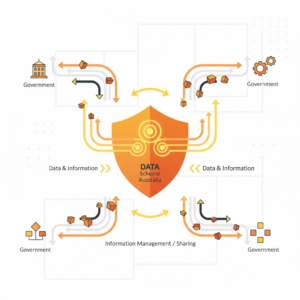
Secure data sharing protocols across government are the legal, privacy, cyber, records and operating controls that allow agencies to share data for public benefit without losing accountability. In Australia, DATA Scheme Australia¹˒² sets a structured pathway for Australian Government data, using accredited participants, registered agreements, five risk principles, privacy protections and auditable controls.
Definition
What are secure data sharing protocols across government?
Secure data sharing protocols are not only technical transfer rules. They are a controlled operating model for deciding what data can be shared, who may use it, where it may be used, how outputs are checked, and how records prove the decision was lawful. The model covers legal authority, permitted purpose, data minimisation, identity controls, security classification, encryption, access logging, output review, retention and disposal.
For Australian Government data, the DATA Scheme¹ creates a regulated route for sharing with approved participants. The Data Availability and Transparency Act 2022² provides the core legal framework, while the Data Availability and Transparency Code 2022³ adds practical detail. The Five Safes model¹² sits underneath much of this thinking: safe project, safe people, safe setting, safe data and safe output. The executive point is simple. Trust does not come from hiding data. It comes from proving why data moved, who touched it, and what safeguards applied.
Context
Why does DATA Scheme Australia matter now?
Government agencies need shared data to design services around real life events, not agency boundaries. A person applying for support, updating identity details, calling a contact centre, or moving between health and social services should not have to repeat the same facts. The Australian Government’s 2025 Data and Digital Government Strategy plan¹⁰ links data capability, connected services, cyber trust and public confidence as shared priorities.
But the risk is real. OAIC data for January to June 2025 recorded 532 notifiable data breach notifications⁶, with malicious or criminal attacks at 59 percent⁶ and human error at 37 percent⁶. Australian Government agencies accounted for 13 percent⁶ of reported breaches in that period. Secure data sharing protocols reduce this exposure by making sharing repeatable, documented and testable. Without them, agencies drift into email attachments, local spreadsheets, unclear consent, duplicated extracts and weak audit trails.
Mechanism
How do secure data sharing protocols work in practice?
A practical protocol starts with purpose. Under the DATA Scheme, Accredited Users may request Australian Government data from a Data Custodian, and Accredited Data Service Providers can support secure access, de-identification and data services¹. A data sharing agreement must be valid and registered before data is shared, collected or used¹. No shortcut should bypass that control.
The operating model should then turn the five principles⁴ into workflow:
Project: confirm public interest, approved purpose, lawful authority and ethics needs.
People: confirm accreditation, role need, training, conflicts and access limits.
Setting: use controlled environments, secure platforms, encryption, monitoring and incident response.
Data: minimise fields, classify sensitivity, protect identity, test quality and document lineage.
Output: check results before release, prevent re-identification, record decisions and manage retention.
Security controls should draw on the ASD Information Security Manual⁷, PSPF Release 2025⁸, ISO/IEC 27001¹¹ and agency records obligations⁹. That mix matters. Legal permission without cyber control is fragile. Cyber control without privacy purpose is not enough.
Comparison
How is the DATA Scheme different from ordinary file transfer?
Ordinary file transfer answers one narrow question: how does data move? DATA Scheme Australia answers a harder question: under what conditions should data be shared at all? The scheme sets roles, safeguards, registered agreements, breach responsibilities and transparency mechanisms¹˒²˒³. It also makes clear that the DATA Act does not override the Privacy Act²˒⁵.
That difference changes executive accountability. A shared folder, API, extract or secure file transfer can still be part of the solution, but it is only one control. The protocol must also define purpose, access, records, output use and review. For projects outside the DATA Scheme, agencies should still copy the control logic. Use a written agreement. Name the data owner. Classify the data. Record the decision. Limit the users. Check the output. Review access. Close the loop when the sharing ends.
Applications
Where should agencies apply secure data sharing protocols first?
Start where service risk and public value meet. Good candidates include life event services, benefits integrity, public health planning, vulnerable person support, complaints intelligence, emergency response, identity verification, and contact centre knowledge. These use cases often cross agency boundaries, mix sensitive data types, and affect real people quickly.
In contact centres, secure data sharing protocols help leaders give staff the right information without exposing more data than needed. Customer Science Insights can support operational visibility where service data, channel data and performance measures need to be brought together for better decisions. The same principle applies to policy teams. Analysts should not receive broad raw extracts when a smaller, de-identified, purpose-built dataset will answer the question.
The practical test is blunt. Can the agency explain the data share to a citizen, a minister, a regulator and an auditor using the same evidence pack? If not, the protocol is not mature enough.
Risks
What can go wrong when agencies share data without controls?
The common failure is not a single hacker. Often, it is drift. A dataset is copied for one project, reused for another, saved in a local folder, emailed to a contractor, joined with extra fields, then retained long after the purpose ends. Human error⁶ remains a major breach source, so secure data sharing protocols must control behaviour as well as systems.
The main risks are mission creep, over-collection, weak identity controls, poor contractor oversight, re-identification, unclear output ownership, missing records, and unmanaged disposal. The National Archives information standard⁹ expects Australian Government information to be reliable, findable, trusted, protected and kept only as long as needed. That is not paperwork. It is operational memory. If an agency cannot show who saw, changed or removed information, it cannot prove safe sharing.
Measurement
How should leaders measure secure data sharing?
Leaders should measure both control health and service value. Track the percentage of sharing requests with a named owner, approved purpose, privacy assessment, security classification, registered agreement, metadata record, retention rule and access review. Then track the service impact: faster decisions, fewer duplicated requests, better first contact resolution, fewer manual extracts, and fewer uncontrolled spreadsheets.
Customer Science Data & Information Management Solutions can support policy, strategy, architecture, governance, classification and AI readiness work where secure sharing needs to become an operating model, not a one-off project.
Useful executive measures include time from request to approval, percentage of datasets with complete metadata, number of privileged access exceptions, overdue access reviews, output checks completed, near misses, breach response time, and evidence packs ready for audit. Good measurement keeps the protocol alive after launch.
Next Steps
What should an agency do next?
An agency should first map its high-value datasets and name the business owner, privacy owner, security owner and records owner for each one. Then it should choose the legal pathway: DATA Scheme, another statutory authority, consent-based sharing, or a program-specific instrument. After that, build a standard data sharing agreement template, a privacy and security assessment checklist, and a register of active shares.
The next step is to test the protocol on one service journey or one analytical use case. Keep it narrow. Use real data governance, not a workshop-only version. Match controls to the ISM⁷, PSPF⁸, APPs⁵, ISO/IEC 27001¹¹ and National Archives expectations⁹. Then publish a dashboard for senior leaders. Secure data sharing protocols improve when executives can see where requests stall, where risks repeat, and where better data has improved decisions.
Evidentiary Layer
What evidence supports this approach?
The evidence points to layered control. The Five Safes framework¹² has become a widely used model for confidential data governance because it treats disclosure risk as a mix of project, people, setting, data and output controls. Australian privacy-preserving record linkage research¹³ shows that technical methods can improve data access while reducing release of personal identifiers, especially where data linkage supports research, planning and public policy.
Australian regulators and standards point in the same direction. The OAIC breach data⁶ shows that cyber attacks and human error both matter. The APPs⁵ require disciplined personal information handling. The ISM⁷ and PSPF⁸ set expectations for security control. The National Archives standard⁹ sets expectations for trustworthy information management. And the DATA Scheme¹˒²˒³ gives agencies a repeatable legal pathway. The pattern is clear: secure sharing works when law, privacy, cyber, records and operations are designed together.
FAQ
What is the minimum protocol for secure government data sharing?
The minimum protocol is a lawful purpose, named data custodian, approved user, privacy check, security classification, written agreement, controlled access setting, logging, output review, breach response plan, retention rule and disposal process.
Does DATA Scheme Australia replace the Privacy Act?
No. The DATA Scheme works with the Privacy Act²˒⁵. Sharing, collecting and using data under the scheme must still be consistent with privacy obligations.
When should an Accredited Data Service Provider be used?
An Accredited Data Service Provider should be used when the project needs specialist data services such as secure access, de-identification or complex data linking¹. The aim is to reduce risk while keeping data useful.
How do secure data sharing protocols help contact centres?
They help contact centres give staff approved information, reduce duplicated customer questions, control access and keep an audit trail. Customer Science products such as Knowledge Quest can support trusted knowledge content where approved answers need to stay current.
What should executives review each month?
Executives should review active data shares, overdue access reviews, privacy risks, security exceptions, output checks, breach near misses, metadata completion, agreement status and service outcomes.
Where do Customer Science services fit?
Customer Science Insights can support operational reporting, while Data & Information Management Solutions can help design the governance, classification and information management model that makes secure sharing repeatable.
Sources
Customer Science. Knowledge Quest.
https://customerscience.com.au/csg-product/knowledge-quest/
Office of the National Data Commissioner. The DATA Scheme. Australian Government.
https://www.datacommissioner.gov.au/data-scheme
Federal Register of Legislation. Data Availability and Transparency Act 2022. Australian Government.
https://www.legislation.gov.au/C2022A00031/latest/text
Federal Register of Legislation. Data Availability and Transparency Code 2022. Australian Government.
https://www.legislation.gov.au/F2022L01719/latest/text
Office of the National Data Commissioner. DATA Scheme Safeguards. Australian Government.
https://www.datacommissioner.gov.au/data-scheme/data-scheme-safeguards
Office of the Australian Information Commissioner. Australian Privacy Principles Guidelines.
https://www.oaic.gov.au/privacy/australian-privacy-principles-guidelines
Office of the Australian Information Commissioner. Notifiable Data Breaches Report: January to June 2025.
https://www.oaic.gov.au/privacy/notifiable-data-breaches/notifiable-data-breaches-report-january-to-june-2025
Australian Signals Directorate. Information Security Manual (ISM).
https://www.cyber.gov.au/resources-business-and-government/essential-cyber-security/ism
Australian Government. Protective Security Policy Framework (PSPF).
https://www.protectivesecurity.gov.au/
National Archives of Australia. Information Management Standard for Australian Government.
https://www.naa.gov.au/information-management/information-management-standards
Department of Finance. Data and Digital Government Strategy. Australian Government.
https://www.finance.gov.au/government/digital-government/data-and-digital-government-strategy
ISO. ISO/IEC 27001 Information Security Management.
https://www.iso.org/isoiec-27001-information-security.html
Green, E., & Ritchie, F. (2023). The Present and Future of the Five Safes Framework. Journal of Privacy and Confidentiality.
https://journalprivacyconfidentiality.org/index.php/jpc/article/view/831
Randall, S., Brown, A., Ferrante, A., Boyd, J., & Robinson, S. (2024). Implementing Privacy Preserving Record Linkage: Insights from Australian Use Cases. International Journal of Medical Informatics.
https://doi.org/10.1016/j.ijmedinf.2024.105582
Customer Science. Customer Science Insights.
https://customerscience.com.au/csg-product/customer-science-insights/
Customer Science. Information Management & Protection Solutions.
https://customerscience.com.au/solution/information-management-protection/