

















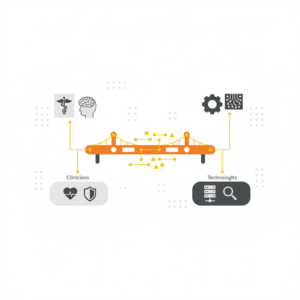
Health informatics bridges clinicians and technologists by turning clinical intent into safe, usable, interoperable digital health systems. It does this through shared clinical workflow models, data standards, human-centred design, and governance that measures outcomes, not just deployments. When done well, it reduces documentation burden, improves care continuity, and lowers change risk by aligning product delivery to clinical quality, privacy, and operational performance.
Definition
What is health informatics in practical terms?
Health informatics is the discipline that improves health and care by shaping how information and technology support clinical decisions, workflows, and patient outcomes. It sits between clinical practice, software engineering, data management, and service operations. Clinical informatics emphasises that technology should make clinicians “safer, faster, and better” in care delivery rather than replacing clinical judgement.¹¹ The practical unit of work is not a feature. It is a clinical task, such as medication reconciliation, discharge planning, or escalation to rapid response, mapped to data, interfaces, and process controls.
Health informatics also defines how digital health care systems should exchange and interpret data. Interoperability standards such as HL7 FHIR provide a shared structure for health information exchange across systems and organisations.³ In Australia, the Australian Digital Health Agency publishes FHIR implementation guides to support exchange with national infrastructure such as My Health Record.⁵ This combination of workflow clarity and standards discipline is what turns clinician intent into dependable technology.
Context
Why do clinicians and technologists keep missing each other?
The gap usually forms because clinicians think in time-critical workflows and risk, while technologists think in requirements, abstractions, and delivery increments. Without a shared model, each side optimises locally. The cost shows up as poor usability, brittle integrations, and change fatigue. Documentation burden is a visible symptom. A national US study estimated physicians spend an average of 1.77 hours per day documenting outside normal hours, and most respondents reported documentation time is not appropriate.¹ This is not only a productivity issue. It is a patient safety and workforce sustainability issue.
At system level, digital health care is now expected to be person-centred, scalable, and secure. The World Health Organization’s Global Strategy on Digital Health calls for coordinated investment in governance, workforce, and interoperability to make digital solutions accessible and sustainable.² This raises the bar for executive leaders. Success requires clinical adoption and measurable outcomes, not just technology go-live.
Mechanism
How does health informatics translate clinical work into technology?
Health informatics uses a repeatable translation layer across four artefacts: clinical workflow, information model, user interaction, and governance controls.
First, it defines the clinical workflow as the primary “truth” for what must happen, including exceptions and escalation paths. Second, it expresses information as structured concepts, terminologies, and exchange formats. HL7 FHIR supports this by defining resources and APIs designed for electronic exchange.³ Third, it applies human-centred design so that interfaces match real clinical contexts, cognitive load, and time pressure. ISO 9241-210 formalises human-centred design principles and activities across the system life cycle.⁴ Fourth, it puts controls around change, privacy, and clinical safety so that improvements do not introduce new failure modes.
This mechanism is also how advanced capabilities fit safely. For example, ambient documentation and AI scribing can reduce clinician burden when implemented with strong review workflows, accountability, and measurement. Recent research and evaluations link documentation burden with burnout risk and describe technology options such as scribes and workflow redesign.⁶˒⁷
Comparison
Health informatics vs digital transformation: what is the difference?
Digital transformation is a broad organisational program. Health informatics is the specialist capability that makes transformation clinically real and safe. Transformation can deliver platforms and funding. Informatics ensures the platform delivers the right clinical tasks, with the right data quality, at the right moment in care.
Health informatics vs health IT: what is the difference?
Health IT focuses on systems and infrastructure. Health informatics focuses on clinical meaning, usability, and outcomes. A health IT team may deliver an EHR upgrade. A health informatics team ensures the upgrade reduces clicks in medication ordering, improves handover quality, and keeps data exchange reliable across services.
Health informatics vs data analytics: what is the difference?
Analytics produces insight from data. Health informatics ensures the data is fit for purpose in the first place and that insights can be operationalised safely. For executives, this matters because analytics value collapses when upstream documentation burden rises or when interoperability gaps fragment the patient record.
Applications
What does “bridging the gap” look like in delivery?
Bridging is achieved through shared operating rhythms and shared artefacts, not more meetings. A practical model is a joint clinical-technology “product triangle” with three owners: clinical safety and workflow, technical architecture and delivery, and operational adoption. Health informatics supplies the translation between these owners so decisions stay coherent.
A high-leverage starting point is to standardise the “clinical job to be done” for priority journeys such as discharge, outpatient referrals, and deteriorating patient response. Then align data exchange to FHIR profiles where appropriate, including national requirements in Australia for My Health Record connections.⁵ This reduces duplicate integration work and increases reuse.
For organisations that need a structured way to quantify friction across journeys, Customer Science Insights can support experience measurement and prioritisation across digital health care pathways (https://customerscience.com.au/csg-product/customer-science-insights/). This is most valuable when informatics has already defined the workflow and data signals that matter, so measurement reflects clinical reality.
Risks
What can go wrong if the clinician-technologist bridge is weak?
The biggest risk is silent failure. Systems may technically “work” while degrading care quality through workflow workarounds, poor data quality, and delayed decisions. Documentation burden can rise without leaders noticing until burnout, turnover, and safety incidents escalate. Evidence reviews highlight documentation burden as a contributor to burnout and a target for intervention, including workflow redesign and automation, but also note that tools must be evaluated for real downstream effects.⁷
Interoperability can also fail in subtle ways. Even when interfaces are delivered, mismatched terminology, incomplete context, and inconsistent identifiers can create clinical risk. Health informatics reduces this by enforcing conformance testing, terminology governance, and clear source-of-truth rules.
Security and privacy are non-negotiable risks in health and care. Standards such as ISO 27799 provide health-specific guidance for applying information security controls to protect personal health information.¹⁰ This matters because “fast integration” without controls increases breach and trust risk, and it can halt digital programs when incidents occur.
Measurement
How do you measure whether health informatics is working?
Measure outcomes across clinician experience, care performance, and technology reliability, using both leading and lagging indicators.
Clinician experience indicators should include documentation time outside scheduled hours, inbox burden, and task switching load. A national study quantified after-hours documentation time and showed that most physicians report documentation time is inappropriate.¹ Burnout-linked signals can also be predicted from EHR use measures in some settings, supporting targeted intervention at unit level.⁹
Care performance should track process reliability for priority workflows, such as medication reconciliation completion, discharge summary timeliness, and follow-up adherence. Technology reliability should track interoperability conformance, API error rates, and data quality completeness. In Australia, using published implementation guides and connection pathways for My Health Record supports consistent exchange across a growing ecosystem.⁵
For teams that want help setting up measurement frameworks, baseline studies, and governance dashboards, Customer Science CX consulting and professional services can support program measurement and operationalisation (https://customerscience.com.au/service/cx-consulting-and-professional-services/).
Next Steps
What should executives do in the next 90 days?
Start with a focused bridge-building program that produces shared artefacts and measurable change.
Select two clinical workflows that are high volume and high risk, such as discharge and medication management.
Map the real workflow, including exceptions, and agree on “done” definitions that include clinical quality and usability.
Align information exchange to standards, prioritising FHIR where it reduces integration friction and supports reuse.³˒⁵
Apply human-centred design activities explicitly, using ISO 9241-210 as a lifecycle reference, and require usability evidence before scale-out.⁴
Establish a governance cadence that reviews clinician burden, safety signals, and interoperability reliability monthly, and funds fixes as product work, not as one-off projects.
This approach aligns to global direction on coordinated digital health capability building, including workforce, governance, and sustainable adoption.²
Evidentiary Layer
What evidence supports the need for this bridge?
Documentation burden and burnout risk are consistently linked in the literature and evidence syntheses, making clinician experience a board-level operational risk.⁶˒⁷ In one national study, physicians spent an average of 1.77 hours per day documenting outside office hours, and 84.7% reported billing-related documentation increases total documentation time.¹ These burdens are measurable and actionable.
There is also emerging evidence that ambient documentation technologies can reduce burnout in real-world settings when implemented with safe workflows and oversight, including clinician review of outputs before record finalisation.⁸ However, informatics leadership remains essential because these tools can increase risk if they introduce errors, privacy exposure, or new workflow complexity.⁶
Interoperability standards and national implementation guides provide a practical foundation for scaling digital health care safely. HL7 FHIR defines the exchange approach,³ and Australian national resources describe connection methods and adoption across more than 110 software products integrated with My Health Record.⁵ Human-centred design standards provide the guardrails for usability and adoption,⁴ and health-specific security guidance reduces privacy and trust risk.¹⁰
FAQ
What problem does health informatics solve for executives?
Health informatics reduces the gap between clinical intent and technology delivery so digital health care improves outcomes, reduces clinician burden, and lowers change risk through measurable governance.¹˒²
Is health informatics only about EHRs?
No. It spans EHRs, interoperability, patient apps, remote monitoring, clinical decision support, and data platforms, as long as the focus is clinical workflow, meaning, and outcomes.³˒⁵
How does interoperability relate to clinician workload?
Poor interoperability forces re-documentation and manual reconciliation. Standards-based exchange, including FHIR profiles and conformance testing, reduces duplicate work and improves continuity of care.³˒⁵
Does AI documentation remove the clinician-technologist gap?
No. AI can reduce burden, but it still needs workflow design, safety controls, privacy protections, and measurement to prevent new risks.⁶˒⁸
What capability should we build first: standards, UX, or analytics?
Build workflow definition and human-centred design first, then standards-based exchange, then analytics. This sequence protects usability and data quality, which analytics depends on.⁴˒⁷
What tools can help make the bridge measurable?
Use journey and experience measurement that is anchored to clinical workflows and outcomes, and connect it to governance and delivery prioritisation. Customer Science Commscore AI can support communication and experience measurement across complex service journeys (https://customerscience.com.au/csg-product/commscore-ai/).
Sources
JAMA Internal Medicine. “Medical Documentation Burden Among US Office-Based Physicians in 2019: A National Study.” 2022. Stable permalink: https://jamanetwork.com/journals/jamainternalmedicine/fullarticle/2790396
World Health Organization. “Global strategy on digital health 2020–2025.” 2021. Stable permalink: https://www.who.int/publications/i/item/9789240020924
HL7. “FHIR Overview (FHIR v5.0.0).” Stable permalink: https://fhir.hl7.org/fhir/overview.html
ISO. “ISO 9241-210:2019 Ergonomics of human-system interaction, Human-centred design.” Stable permalink: https://www.iso.org/standard/77520.html
Australian Digital Health Agency. “My Health Record | Digital Health Developer Portal.” Stable permalink: https://developer.digitalhealth.gov.au/resources/resource-services/my-health-record
National Academy of Medicine. “Electronic Health Record Optimization and Clinician Well-Being: A Potential Roadmap Toward Action.” 2020. Stable permalink: https://nam.edu/perspectives/electronic-health-record-optimization-and-clinician-well-being-a-potential-roadmap-toward-action/
Agency for Healthcare Research and Quality (AHRQ). “Measuring Documentation Burden in Healthcare. Technical Brief No. 47.” Stable permalink: https://effectivehealthcare.ahrq.gov/products/medical-documentation-burden/technical-brief
Mass General Brigham. “Ambient documentation technologies reduce physician burnout” (press release). 2025. Stable permalink: https://www.massgeneralbrigham.org/en/about/newsroom/press-releases/ambient-documentation-technologies-reduce-physician-burnout
Mayo Clinic Proceedings. “Predicting Primary Care Physician Burnout From Electronic Health Record…” 2024. Stable permalink: https://www.mayoclinicproceedings.org/article/S0025-6196(24)00037-5/fulltext
ISO. “ISO 27799: Information security management in health using ISO/IEC 27002 (new version available: ISO 27799:2025).” Stable permalink: https://www.iso.org/standard/62777.html
AMIA Clinical Informatics Fellows. “What is Clinical Informatics?” Stable permalink: https://www.acifellows.org/faq
US Office of the National Coordinator for Health IT (healthit.gov). “Health Level 7 (HL7) Fast Healthcare Interoperability Resources (FHIR).” Updated 2026. Stable permalink: https://www.healthit.gov/interoperability/investments/fhir/