


















Data Classification Policy: Securing the Crown Jewels
Definition
A data classification policy sets the rules for how information gets labelled, handled, and protected across an organisation. Simple idea. Hard execution.
At its core, it separates data into sensitivity tiers. Public. Internal. Confidential. Restricted. Sometimes more granular depending on sector pressure or regulatory load.
Data sensitivity labels sit inside this system. They attach meaning to files, records, messages, and datasets. Not just metadata. They decide who can see what, and under what conditions.
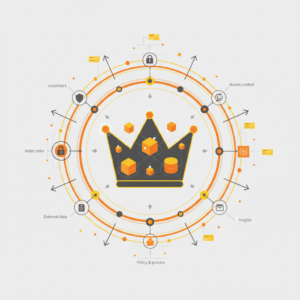
So when people say “crown jewels,” they are talking about the small slice of data that would hurt the business most if exposed. Customer records. Pricing models. Identity systems. Strategic plans. Not everything matters equally. That’s the point.
A policy makes this distinction repeatable instead of emotional.
Context
Modern organisations don’t struggle with data volume alone. They struggle with uncontrolled spread.
Files move through email threads. Cloud drives multiply copies. APIs replicate datasets across services. One dataset becomes ten versions before anyone notices.
This is where a data classification policy steps in. It draws lines in a system that otherwise spreads without friction.
And yes, regulators notice. Privacy laws in Australia and beyond expect organisations to know where sensitive data sits and how it is protected. Guesswork doesn’t hold up in audits.
There is also internal pressure. Teams need speed. Security needs control. Classification sits in between those two forces.
Not perfectly. But close enough to keep things stable.
Mechanism
How does classification actually work in practice?
It usually starts with rules. Then tagging. Then enforcement.
Rules define categories. For example:
- Personal data
- Financial data
- Operational data
- Strategic data
Tagging applies those categories at file, record, or system level. Sometimes manual. Sometimes automated. Most mature setups mix both.
Enforcement is where things tighten. Access controls. Encryption requirements. Sharing restrictions. Retention rules.
And this is where systems like Customer Science Insights come into play. They help teams see where data sits, how it flows, and where classification gaps quietly appear.
Small gaps matter. One mislabeled dataset can bypass controls entirely.
That’s the uncomfortable truth most teams run into late.
Comparison
Without a classification policy, everything gets treated the same. Same storage rules. Same access rules. Same handling.
That sounds fair. It isn’t.
Because equal treatment of unequal data creates exposure.
With classification in place, structure appears. Not perfect structure, but usable structure. Sensitive datasets get tighter controls. Low-risk data moves faster.
There is still friction. People forget labels. Systems drift. Migrations break tagging chains.
But the difference shows up during incidents.
One approach slows everything down all the time. The other slows only what matters when it matters.
Applications
Where does this actually get used?
In customer systems first. CRM platforms. Support logs. Identity stores. These carry personal data at scale.
Then financial systems. Transactions, invoices, audit logs. High sensitivity, high scrutiny.
Then operational environments. Internal reports, forecasts, performance dashboards. Less regulated, still important.
Classification policies often sit alongside broader governance programs. They don’t work alone. They plug into identity systems, retention frameworks, and monitoring tools.
And when organisations mature, classification expands into automation workflows, sometimes supported by services like Information Management Protection where controls are embedded into daily operations instead of bolted on after the fact.
It becomes part of how data moves, not just how it is stored.
Quiet shift. Big impact.
Risks
Misclassification is the main problem. Not cyberattacks. Not system failure.
A file labelled incorrectly can slip through weaker controls. That alone can expose sensitive information without anyone noticing in real time.
Over-classification is another issue. Everything marked “restricted” slows teams down. People start ignoring labels altogether. That defeats the purpose.
Then there’s inconsistency across systems. One platform tags data correctly. Another ignores labels entirely. Gaps appear between tools.
And shadow data. Always shadow data. Copies created outside formal systems that never inherit classification rules.
These issues don’t show up all at once. They accumulate quietly.
Until something breaks.
Measurement
How do you know if a data classification policy is working?
Start with coverage. What percentage of data assets are actually classified. Low coverage usually signals weak adoption.
Then accuracy. Are labels correct when checked against real content. This often requires sampling and audit.
Then enforcement strength. Are policies actually applied or just documented.
Tracking improves when systems connect classification with governance tools and monitoring frameworks. Not spreadsheets. Those fall behind quickly.
A structured approach is often supported through advisory services like CX Consulting and Professional Services which focus on aligning classification rules with operational behaviour, not just policy documents.
Measurement only works when it reflects reality, not intention.
Next Steps
Start small. Don’t try to classify everything at once.
Pick high-risk datasets first. Customer data. Financial records. Identity stores. Build rules around those.
Then expand outward.
Keep labels simple in early stages. Too many categories slows adoption. People stop using them.
Train teams in context, not theory. Show real examples of misclassification and what it leads to.
And connect classification to tooling early. Manual systems don’t scale past a certain point.
There is a point where automation support becomes necessary. That’s usually when data volume crosses into constant movement across platforms.
Evidentiary Layer
Research across security frameworks consistently points to classification as a foundational control for data protection maturity. NIST guidance on information sensitivity mapping highlights classification as a prerequisite for access control design. ISO standards reinforce similar structures around information handling rules. Australian government security frameworks echo the same requirement for structured data handling.
The pattern is stable. When classification exists and is enforced, breach impact reduces. When it is absent, containment becomes harder.
Not theoretical. Observed repeatedly in incident response records.
FAQ
What is a data classification policy used for?
It defines how data is labelled and handled so sensitive information receives appropriate protection.
What are data sensitivity labels?
They are tags applied to data that indicate how it should be accessed, shared, and stored.
How does classification reduce risk?
It limits exposure by controlling access to higher-risk data categories.
What happens if data is misclassified?
Sensitive data may be exposed or low-value data may be over-restricted, slowing operations.
Can classification be automated?
Yes. Many systems combine automated tagging with manual validation for accuracy.
Where does it fit in security strategy?
It sits at the foundation of data governance and supports access control, monitoring, and compliance systems.
What tools support classification programs?
Platforms like Knowledge Quest help teams structure, track, and operationalise classification rules across systems.
Sources
- ISO/IEC 27001:2022 Information Security Management Systems
https://www.iso.org/standard/27001 - NIST SP 800-60 Volume I Revision 1
https://csrc.nist.gov/publications/detail/sp/800-60/rev-1/final - NIST SP 800-53 Security and Privacy Controls
https://csrc.nist.gov/publications/detail/sp/800-53/rev-5/final - Australian Cyber Security Centre (ACSC) Information Security Manual
https://www.cyber.gov.au/resources-business-and-government/essential-cyber-security/ism - GDPR Official Text (EU Regulation 2016/679)
https://eur-lex.europa.eu/eli/reg/2016/679/oj - Cloud Security Alliance Data Classification Guidance
https://cloudsecurityalliance.org/artifacts/data-classification-recommendations/ - UK National Cyber Security Centre Data Classification Principles
https://www.ncsc.gov.uk/collection/data-protection - OECD Security and Privacy Guidelines
https://www.oecd.org/sti/ieconomy/security-privacy.htm