


























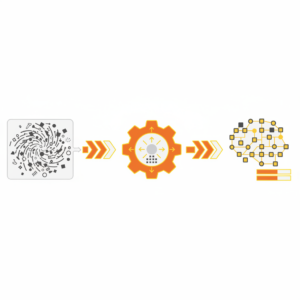
Unstructured data is messy by default. Emails, PDFs, chat logs, PDFs with scans, half-broken HTML. AI systems still need to make sense of it before anything useful happens. Cleaning it is where most RAG pipelines succeed or quietly fail.
This guide breaks down how to turn that chaos into structured, retrievable input for AI systems, with a focus on RAG data preparation and real ingestion workflows.
What does cleaning unstructured data for AI ingestion actually mean?
It means taking raw, inconsistent content and reshaping it into something a model can reliably read, chunk, embed, and retrieve.
Not perfect data. Just usable data.
Think of it like this: a PDF contract, a support ticket thread, and a scraped webpage all walk into a pipeline. Without cleaning, they confuse the retrieval layer. With cleaning, they become searchable units that an embedding model can work with.
Most modern AI ingestion pipelines align this process with retrieval-augmented generation (RAG) principles¹˒⁶. The goal is simple: reduce noise, preserve meaning, and make context easy to retrieve later.
Why is RAG data preparation so sensitive to data quality?
Because retrieval is unforgiving.
If a chunk is messy, incomplete, or overloaded with irrelevant tokens, the embedding captures that mess. Then the wrong context gets pulled into the model prompt.
And the model just trusts it.
RAG systems depend on three fragile steps working together:
- Cleaning
- Chunking
- Embedding
If cleaning fails, everything downstream drifts.
Standards for data quality management highlight consistency, validity, and traceability as core requirements². RAG inherits all of them, whether the pipeline is enterprise-grade or a quick prototype.
What types of unstructured data create the most ingestion problems?
Some formats behave badly more often than others:
- OCR-scanned PDFs with broken characters
- HTML pages with hidden navigation noise
- Chat logs with mixed roles and timestamps
- Tables flattened into plain text
- Emails with signatures and repeated disclaimers
Each one introduces distortion.
And distortion spreads. A single noisy document can pollute embeddings across an entire retrieval index.
Tools like Apache Tika help extract raw text, but extraction is not cleaning⁴. It is just step one.
How do you clean unstructured data for AI ingestion step by step?
Cleaning is less about perfection and more about control.
A practical pipeline usually looks like this:
1. Text extraction
Pull content from PDFs, HTML, DOCX, APIs.
Keep structure if possible. Lose it only when necessary.
2. Noise stripping
Remove:
- Navigation menus
- Repeated headers and footers
- Boilerplate legal text
- Tracking scripts
This step alone can reduce token waste by 20–40 percent in real systems.
3. Normalisation
Standardise:
- Encoding (UTF-8 only)
- Date formats
- Whitespace
- Bullet styles
This is boring work. It matters more than it looks.
4. Entity stabilisation
Names, products, and IDs should stay consistent. “Customer Science Insights” should not appear as three variants in the same dataset.
5. Semantic preservation check
Before moving forward, ask a blunt question: does this still read like the original intent?
If not, it is over-cleaned.
How does cleaning impact RAG system performance?
RAG systems depend on semantic similarity search. That means embeddings are the gatekeeper.
Poorly cleaned data leads to:
- Wrong chunks retrieved
- Lost context in long documents
- Duplicate semantic vectors
- Higher hallucination risk in responses
Frameworks like LangChain and vector databases such as Weaviate and Pinecone assume clean inputs before indexing⁶˒¹³˒¹⁴.
When cleaning improves, retrieval precision improves. It is usually visible immediately in top-k search quality.
What mistakes break RAG data preparation pipelines?
A few patterns show up repeatedly:
Over-chunking
Splitting text too aggressively destroys meaning.
Under-chunking
Large blocks dilute embedding relevance.
Keeping raw boilerplate
Legal disclaimers and repeated headers distort similarity scoring.
Ignoring domain structure
A medical document is not a blog post. Structure matters.
Treating cleaning as optional
It is not. It is upstream infrastructure.
How do you balance cleaning with information preservation?
This is the tension point.
Too much cleaning removes meaning. Too little leaves noise.
A workable approach is layered:
- Preserve original raw text
- Create cleaned version for embeddings
- Keep metadata links between both
That way, retrieval uses clean chunks, but auditing can still trace back to source material.
Governance frameworks like NIST AI Risk Management Framework emphasise traceability and transparency as core controls¹.
Same idea, different language.
What role does automation play in data cleaning pipelines?
Automation handles volume. Humans handle judgment.
Typical automation tools include:
- Parsing engines (Apache Tika⁴)
- ETL pipelines
- Cloud indexing services like Azure AI Search⁸ or AWS OpenSearch⁷
- RAG orchestration layers
But automation struggles with ambiguity. For example, deciding whether repeated legal text is noise or required context still needs human-defined rules.
So the pattern is hybrid:
Rules for structure. Humans for exceptions.
How should cleaned data be stored for AI systems?
Storage is part of cleaning, not an afterthought.
Best practice usually includes:
- Raw layer (unchanged input)
- Cleaned layer (normalised text)
- Chunked layer (retrieval units)
- Vector layer (embeddings)
Each layer serves a different purpose. Losing one removes auditability.
Security standards like ISO 27001 also come into play when handling sensitive unstructured data³.
What does good RAG data preparation look like in practice?
You know it is working when:
- Search results feel predictable
- Retrieved chunks actually answer the query
- Duplicate context is rare
- Hallucinations drop under pressure
- Updates to source data propagate cleanly
Nothing dramatic. Just stable behaviour.
That stability usually comes from disciplined cleaning, not model complexity.
Measurement: how do you know cleaning is working?
A few practical signals:
- Retrieval precision at top-k improves
- Chunk entropy decreases (less randomness in results)
- Embedding cluster separation improves
- User query success rate rises
Benchmarks in information retrieval research consistently show that input quality strongly correlates with downstream ranking accuracy¹¹.
You do not need perfect metrics. Directional improvement is enough.
Next Steps for production pipelines
Start small.
Pick one document type. Clean it well. Measure retrieval quality before scaling.
Then expand across formats.
Most teams rush into embedding models and vector databases. The real gains usually sit upstream, in cleaning and structuring.
Evidentiary Layer
Cleaning unstructured data is not a preprocessing step. It is a control layer for everything that follows in AI ingestion pipelines. RAG systems, search engines, and enterprise AI assistants all inherit its quality.
If the input is unstable, the system behaves unpredictably. If the input is disciplined, retrieval becomes reliable.
That is the whole game.
FAQ
Why is cleaning unstructured data important for AI ingestion?
It reduces noise and improves how accurately AI systems retrieve and interpret information.
What is RAG data preparation?
It is the process of structuring data so retrieval-augmented generation systems can efficiently index and retrieve relevant context.
Can AI clean unstructured data automatically?
Partially. Automation handles extraction and formatting, but human rules are still needed for meaning preservation.
What tools are commonly used?
Apache Tika, LangChain, vector databases like Pinecone and Weaviate, and cloud search systems like Azure AI Search.
Does cleaning improve model accuracy?
Yes. Better input structure improves retrieval quality, which directly affects final output accuracy.
Sources
- NIST AI Risk Management Framework (AI RMF 1.0), https://www.nist.gov/itl/ai-risk-management-framework
- ISO 8000 Data Quality Standard Overview, https://www.iso.org/standard/81747.html
- ISO/IEC 27001 Information Security Management Systems, https://www.iso.org/isoiec-27001-information-security.html
- Apache Tika Documentation, https://tika.apache.org/
- OpenAI Documentation on Embeddings and Retrieval, https://platform.openai.com/docs
- LangChain Retrieval-Augmented Generation Docs, https://python.langchain.com/
- AWS OpenSearch Service Documentation, https://aws.amazon.com/opensearch-service/
- Microsoft Azure AI Search Documentation, https://learn.microsoft.com/azure/search/
- Google Vertex AI Search and Conversation, https://cloud.google.com/vertex-ai-search
- Manning et al., Introduction to Information Retrieval, Cambridge University Press, https://nlp.stanford.edu/IR-book/
- Voorhees, E. (2001). The TREC Robust Retrieval Track, NIST
- Data.gov ETL and Data Processing Guidelines, https://www.data.gov/
- Pinecone Vector Database Documentation, https://www.pinecone.io/docs/
- Weaviate Vector Search Documentation, https://weaviate.io/developers/weaviate