

























What is customer identity?
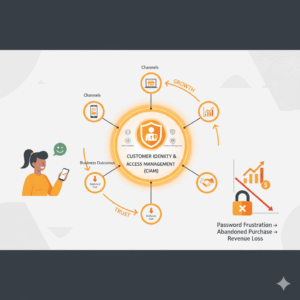
Customer identity describes how a business verifies, recognizes, and authorizes a customer across channels, sessions, and products. It combines identity proofing, authentication, authorization, and profile management into one discipline often implemented through Customer Identity and Access Management, or CIAM. CIAM differs from workforce IAM by focusing on consumer scale, low-friction experiences, consent, and marketing data interoperability. CIAM connects logins, profiles, consents, and security posture so customers can access services safely and consistently. NIST frames identity in terms of assurance levels for proofing and authentication, which helps leaders calibrate risk and friction.¹²
Why does customer identity matter to growth and trust?
Strong customer identity drives conversion, lifetime value, and reputation. Password frustration still causes real revenue leakage. In 2024, the FIDO Alliance found that 42 percent of consumers abandoned at least one purchase in the prior month because they could not remember a password, with higher rates among younger cohorts.⁶ Secure and seamless sign-in protects reputation and reduces operational drag from account recovery. Security events also impose significant cost. The 2024 IBM Cost of a Data Breach analysis reported a global average breach cost of 4.88 million US dollars, reflecting higher disruption and recovery expenses.⁴ Human factors remain central. Verizon reported the human element in 68 percent of breaches in its 2024 dataset, which underscores the importance of phishing-resistant authentication and clear customer communications.³
What is a working definition executives can use?
Executives can define customer identity as the capability that proves a customer is who they claim to be, binds that proof to a durable profile, and enforces the right access at the right time across every touchpoint. This unit includes four mechanisms. Identity proofing establishes confidence at account creation. Authentication verifies control of authenticators at sign-in and step-up. Authorization makes fine-grained access decisions using policy. Profile and consent management record attributes, preferences, and legal permissions. Leaders use assurance levels to align effort with risk and to embed privacy by design.¹²
How does customer identity actually work in practice?
Teams implement customer identity with standards and layered controls. OAuth 2.0 delegates authorization securely, while OpenID Connect adds an identity layer so services can verify end-user identity and rely on signed ID tokens.⁸⁷ Assurance levels guide the choice of authenticators from passwords to passkeys, device-bound cryptographic credentials, or multi-factor combinations.² Enrollment flows gather verified attributes and consents. During authentication, the system evaluates risk signals such as device reputation, geolocation, and behavior. Policy then gates access or prompts step-up. Event logs feed fraud models, while profiles sync to marketing and service platforms under clear consent controls. This structure keeps the experience simple while the mechanism stays robust behind the scenes.¹²⁷⁸
What problems does weak customer identity create?
Weak identity introduces friction, fraud, and fragmented data. Customers face lockouts, duplicate accounts, and repetitive KYC checks. Contact centres absorb repetitive resets and recovery calls that extend handle time. Security exposure rises through credential stuffing and phishing. Australia’s OAIC reported 595 notifications in the July to December 2024 period, with malicious or criminal attacks accounting for 69 percent of incidents and phishing identified as a leading cyber-incident driver of compromised credentials.⁵ These patterns show how weak identity harms experience, increases cost, and erodes trust simultaneously.³⁴⁵
What is the difference between CIAM and IAM for employees?
CIAM prioritizes scale, user experience, and consent. It must support millions of users, social logins, passkeys, progressive profiling, and granular marketing consents. Workforce IAM focuses on employee roles, joiner-mover-leaver processes, privileged access, and device management. Both domains share standards, policy engines, and assurance concepts, yet customer identity optimizes for conversion and privacy controls at consumer scale. Leaders should avoid reusing workforce IAM platforms for consumer scenarios without assessing rate limits, UX, consent capture, and analytics needs.¹²⁷⁸
Where should leaders start their identity and data foundations?
Leaders start by grounding strategy in assurance and interoperability. Set target Identity Assurance Level for onboarding and target Authenticator Assurance Level for sign-in based on risk, regulatory context, and product sensitivity.¹² Choose standards-based protocols such as OAuth 2.0 and OpenID Connect to make identity portable across channels and partners.⁷⁸ Establish a single customer profile that stores stable identifiers, verified attributes, and consent states. Prioritize phishing-resistant authenticators such as passkeys and platform biometrics to cut friction and fraud at the same time.²⁶ Instrument every step with event telemetry that links to fraud, CX, and analytics. This data foundation keeps identity actionable across marketing, service, and risk functions.
What are practical applications that pay back quickly?
Executives can fund the journey with focused applications. Password-less sign-in reduces drop-off and support volume while improving success rates.⁶ Step-up authentication based on risk signals protects payments and personal data without punishing low-risk sessions. Just-in-time account linking merges guest and known identities at checkout to raise conversion. First-party data capture with explicit consent powers personalization with lower privacy risk. Secure federation with partners accelerates ecosystem growth. These applications turn identity into a performance lever by tying UX directly to risk-based controls.¹²⁷⁸
How should teams measure value, risk, and progress?
Teams should track both experience and security signals. Track login success rate, average time-to-authenticate, and the share of authentications using phishing-resistant methods. Track account recovery volume and cost per recovery. Measure registration completion rate and profile completeness. On the security side, track credential stuffing attempts blocked, step-up rates, and verified fraud losses. Tie these to financial outcomes such as cart conversion and churn. Use breach cost benchmarks for scenario planning and capital allocation. The IBM benchmark provides a directional anchor for avoided loss.⁴ Align metrics with OAIC reporting expectations in Australia and maintain evidence for rapid incident response.⁵
What is the risk if we delay identity modernization?
Delay keeps costs and exposures high. Human-driven attack paths persist and adapt. Verizon’s analysis shows the human element present in most breaches, which means password reuse and phishing remain profitable for attackers.³ Customers increasingly expect fast sign-in and password less options. FIDO’s research shows growing familiarity with passkeys and clear preference for biometrics across markets, which means lagging experiences look dated and increase abandonment.⁶ Regulators monitor breach reporting, and notification volumes in Australia continue to rise.⁵ Identity modernization cuts risk and pays for itself in conversion, support deflection, and avoided remediation.
Which architecture principles create a durable advantage?
Strong identity architecture uses five principles. Standards first ensures OAuth 2.0, OpenID Connect, and FIDO-based authenticators remain interoperable across channels.⁷⁸ Assurance by design sets explicit IAL and AAL targets and tests them in production.¹² Progressive disclosure collects only the data required at each step and links it to clear consent. Observable identity turns every event into telemetry for CX and fraud teams. Customer-centric controls prioritize passkeys and phishing-resistant MFA with accessible fallback paths to keep success high. This structure scales, audits cleanly, and adapts to new threats without disrupting customers.¹²⁶⁷⁸
How do you sequence delivery for impact?
Leaders should run a three-wave plan. Wave one stabilizes sign-in by adding passkeys alongside existing flows, improving rate limits and bot defenses, and cleaning profile and consent data. Wave two implements risk-based step-up, social and government federation where appropriate, and a unified customer profile in the data platform. Wave three expands into partner federation, delegated authorization for data sharing, and privacy-enhancing analytics. Each wave ships measurable improvements in login success, conversion, and fraud deflection. Use OAIC guidance and incident data to refine controls and reporting.⁵
What is the call to action for executives?
Executives should treat customer identity as a growth and trust system, not just a security control. Set a target experience for sign-in, recovery, and consent. Fund passkey rollout and risk-based authentication to reduce both drop-off and fraud. Require standards and assurance alignment in every RFP. Link identity telemetry to CX and fraud analytics so teams can act quickly on signal. This approach aligns product, marketing, security, and service around the customer and turns identity into a durable competitive advantage.¹²⁴⁵⁶⁷⁸
FAQ
What is customer identity in simple terms?
Customer identity is the capability that verifies a customer, binds that verification to a profile, and enforces access consistently across channels using standards such as OAuth 2.0 and OpenID Connect, calibrated by assurance levels from NIST.¹²⁷⁸
Why does customer identity matter for revenue and CX?
Customer identity matters because sign-in friction and recovery pain drive abandonment, while modern authentication improves conversion and trust. In 2024, 42 percent of consumers abandoned a purchase in the prior month due to password issues.⁶
Which standards should Australian enterprises use for CIAM?
Enterprises should adopt OAuth 2.0 for delegated authorization and OpenID Connect for the identity layer, and they should align enrollment and authentication to NIST’s assurance levels to match risk.¹²⁷⁸
How big is the risk if we get identity wrong?
The average global cost of a data breach reached 4.88 million US dollars in 2024, and the human element featured in 68 percent of breaches, which highlights the combined financial and human-risk exposure.³⁴
Which authentication methods reduce phishing and friction?
Passkeys and biometric authenticators provide phishing-resistant, user-friendly sign-in and are gaining consumer familiarity and preference across multiple markets.⁶
What Australian signals should leaders monitor?
Leaders should monitor OAIC Notifiable Data Breaches statistics. In July to December 2024 there were 595 notifications, with malicious or criminal attacks at 69 percent and phishing a leading driver of compromised credentials in cyber incidents.⁵
Which metrics prove CIAM value to executives?
Track login success rate, proportion of phishing-resistant authentications, registration completion, account recovery volume and cost, blocked credential stuffing attempts, and conversion lift relative to identity changes. Use breach-cost benchmarks for scenario planning.⁴
Sources
NIST SP 800-63-3 Digital Identity Guidelines — Grassi, Garcia, Fenton — 2017, updated resources — NIST. https://pages.nist.gov/800-63-3/sp800-63-3.html
NIST SP 800-63B Implementation Resources: Authenticator Assurance Levels — NIST — 2020. https://pages.nist.gov/800-63-3-Implementation-Resources/63B/AAL/
2024 Data Breach Investigations Report — Verizon — 2024. https://www.verizon.com/business/resources/reports/2024-dbir-data-breach-investigations-report.pdf
Cost of a Data Breach Report 2024 — IBM Security — 2024. https://cdn.table.media/assets/wp-content/uploads/2024/07/30132828/Cost-of-a-Data-Breach-Report-2024.pdf
Notifiable Data Breaches Report: July to December 2024 — Office of the Australian Information Commissioner — 2025. https://www.oaic.gov.au/privacy/notifiable-data-breaches/notifiable-data-breaches-publications/notifiable-data-breaches-report-july-to-december-2024
2024 Online Authentication Barometer — FIDO Alliance — 2024. https://fidoalliance.org/wp-content/uploads/2024/10/Barometer-Report-2024-Oct-29.pdf
OpenID Connect Core 1.0 — OpenID Foundation — 2014, errata set 2. https://openid.net/specs/openid-connect-core-1_0.html
RFC 6749: The OAuth 2.0 Authorization Framework — Hardt — 2012 — IETF. https://www.rfc-editor.org/rfc/rfc6749