































Trusted digital identity is a foundational enabler of seamless citizen services. When implemented well, it reduces friction, improves security, and allows governments to design services around real needs rather than proof processes. This article explains how the digital identity framework Australia is adopting supports service transformation, and what agencies must consider to drive safe, trusted adoption.
What is trusted digital identity in government?
Trusted digital identity in government refers to a secure, reusable way for individuals to prove who they are when accessing public services online. Rather than repeatedly presenting documents, citizens use a verified digital credential recognised across agencies.
The core problem addressed is duplication. Traditional identity checks are inconsistent, manual, and error prone. They increase effort for citizens and cost for government. A trusted digital identity replaces fragmented verification processes with a common, assured approach¹.
In Australia, digital identity is positioned as a whole of government capability, not a single system. It underpins service access while preserving privacy, choice, and security.
Why is digital identity critical for seamless citizen services?
Seamless services depend on trust. Citizens must be confident that government can verify identity accurately while protecting personal information. Without trusted identity, services default to conservative, high friction processes.
Digital identity reduces this friction. Once verified, citizens can move across services without re establishing identity at each interaction. This supports faster transactions, fewer errors, and lower assisted channel demand².
For agencies, trusted identity also reduces fraud risk and compliance burden. Strong identity assurance enables more confident automation and data sharing, which are essential to modern service models.
How does the digital identity framework Australia uses work?
Federated and user controlled design
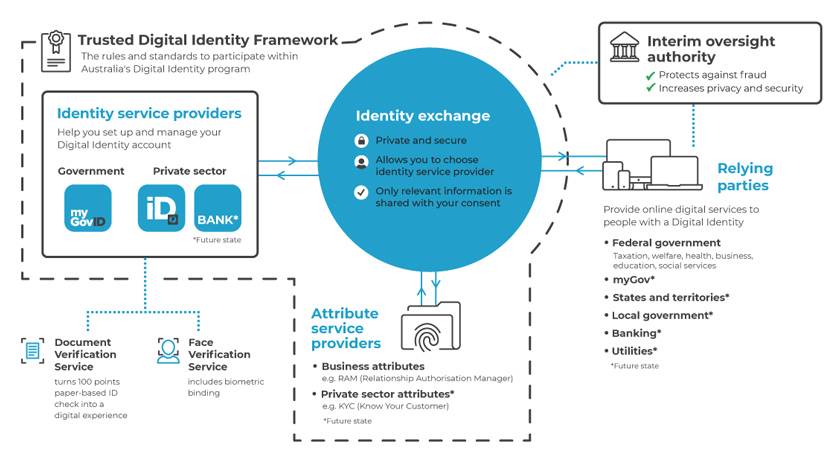
Australia’s digital identity framework uses a federated model. Multiple accredited providers can verify identity, while agencies rely on a common trust framework rather than building their own solutions.
This model avoids single points of failure and gives citizens choice. Importantly, it limits data sharing to what is required for each transaction, supporting privacy by design³.
The framework is overseen by the Australian Government and aligned with broader data and digital strategies.
Assurance levels matched to service risk
Not all services require the same level of identity assurance. The framework defines different assurance levels, allowing agencies to balance risk and usability.
Low risk services can be accessed with lighter verification, while high risk transactions require stronger proof. This proportional approach improves usability without compromising security⁴.
How does digital identity differ from traditional authentication?
Traditional authentication focuses on credentials such as usernames and passwords. Digital identity focuses on verified identity attributes.
The difference is material. Authentication confirms access to an account. Digital identity confirms a real person, with defined confidence, across multiple services. This enables cross agency journeys and proactive service delivery.
From a CX perspective, this shift removes repetitive proof points that frustrate users and increase failure demand.
Where does digital identity deliver the most value?

Life event and cross agency services
Digital identity is critical for services that span multiple agencies. Life events such as birth, business start up, or retirement require consistent identity verification across systems.
A trusted identity allows services to be designed end to end, rather than forcing citizens to re identify at each step. This supports true citizen centric government services.
CX and digital service transformation
Digital identity enables more personalised and proactive services. When identity is assured, agencies can safely tailor content, pre fill data, and automate decisions.
Customer Science Insights supports this by linking identity enabled service journeys with CX and operational performance data, allowing agencies to measure real impact.
What are the risks of digital identity adoption?
Trust is the primary risk. If citizens fear misuse of data, adoption will stall. Transparency, consent, and strong governance are essential.
There is also an inclusion risk. Not all citizens can easily access digital channels. Digital identity must be complemented by assisted and alternative access pathways⁵.
Finally, agencies risk over reliance on identity as a solution. Identity enables services, but does not fix poor service design or policy complexity.
How should agencies measure digital ID adoption and success?
Measurement should focus on outcomes, not just registrations. Key indicators include reduced time to complete transactions, lower repeat contact, and increased digital completion rates.
Qualitative feedback is equally important. Understanding where users hesitate or drop out reveals trust and usability issues.
CommScore AI can analyse unstructured interaction data to identify identity related friction, while Knowledge Quest ensures consistent guidance across digital and assisted channels.
What are the next steps for agencies?
Agencies should assess where identity friction currently exists in priority services. This identifies high value opportunities for digital identity integration.
CX Research and Design services can support this assessment, ensuring identity is embedded into journeys in a way that improves outcomes rather than adding complexity.
CX Consulting and Professional Services then help align governance, assurance, and delivery models to support scalable adoption.
Evidentiary Layer
International evidence shows that trusted digital identity is a key enabler of digital government maturity. OECD analysis links strong identity frameworks with improved service uptake and reduced fraud⁶. Australian policy reviews similarly emphasise proportional assurance and privacy by design as critical success factors⁷.
FAQ
What is trusted digital identity?
It is a secure, reusable way for citizens to prove who they are across government services.
How does the digital identity framework Australia uses protect privacy?
It limits data sharing to what is required and gives users control and transparency.
Is digital identity mandatory for citizens?
No. Adoption is voluntary, with alternative access pathways remaining available.
Which services benefit most from digital identity?
Cross agency and high volume services where repeated identity checks create friction.
What tools support digital identity enabled services?
Customer Science Insights, Knowledge Quest, and CommScore AI support measurement, guidance, and insight.
How can agencies build trust in digital ID?
Through transparency, strong governance, and clear communication supported by CX Communications services.
Sources
-
Australian Government, Trusted Digital Identity Framework, 2023.
-
Australian National Audit Office, Identity and Access Management in Government, 2021.
-
OECD, Digital Identity Policy Frameworks, 2020. https://doi.org/10.1787/d7f2f0a9-en
-
ISO IEC 29115, Entity Authentication Assurance Framework, 2018.
-
Australian Human Rights Commission, Digital Inclusion and Accessibility, 2022.
-
OECD, Government at a Glance, 2021. https://doi.org/10.1787/1c258f55-en
-
Department of Finance, Digital Government Strategy Review, 2022.