

















Why leaders must decide between orchestration and campaigns
Executives chase revenue lift, cost control, and trust. Teams often reach for the tool they know, typically campaign management, even when the problem calls for responsive, stateful coordination. The wrong choice creates noise, duplicate contacts, and missed moments. The right choice aligns timing, consent, and content to the customer context and to the business objective. Journey orchestration engines listen for events, evaluate rules, update states, and execute the next best action across channels. Campaign managers schedule and distribute planned messages to defined audiences. Both create value. Each solves a different class of problem. Selecting well increases conversion, reduces customer effort, and protects brand reputation. Research on personalization impact reinforces the upside when coordination matches customer intent at the moment of truth.¹
What is touchpoint orchestration and how does it work?
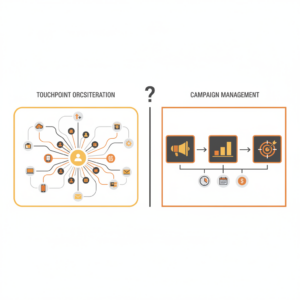
Touchpoint orchestration coordinates interactions in real time based on customer signals. An orchestration engine ingests events, such as “trial started,” “payment failed,” or “case created.” The engine updates the customer’s state, evaluates guarded rules, and selects an action like “send in-app nudge,” “open proactive case,” or “pause until verification.” Adobe Journey Orchestration formalizes reusable events defined in XDM schemas so multiple journeys can act on a single source of truth.² Salesforce Journey Builder and similar tools support event triggers that start or advance a person the moment relevant data arrives through an API or data change.³ Twilio Segment Journeys exposes steps such as Hold Until, Delay, Data Split, and Randomized Split to keep flows responsive and testable without custom code.⁴ Orchestration feels like a state machine applied to customer experience, which brings clarity and resilience to complex journeys.⁵
What is campaign management and where does it shine?
Campaign management plans and executes outbound communications to a target audience on a schedule. Teams segment recipients, select channels, build creative, and schedule delivery windows. The model excels for launches, offers, seasonal programs, and compliance notifications that must reach many recipients consistently. Platforms like Braze, Iterable, and Salesforce Marketing Cloud provide audience building, message templates, send-time optimization, and frequency controls that fit planned program cycles.⁶ ⁷ ⁸ The strengths include scale, creative workflow, and calendar discipline. The unit of work is the campaign, not the individual customer state. Campaigns can react to data, yet their core pattern remains batch planning and controlled distribution to segments.
How do the mechanisms differ under the hood?
Orchestration treats each person as a stateful entity moving through a defined journey. The engine listens for triggers, applies rules as guards, and advances or pauses the state, often across channels and systems in a single flow.² ⁴ Campaign management treats each send as part of a planned sequence to an audience. The engine builds a list from segmentation rules and executes delivery at the scheduled time, sometimes with send-time optimization or throttles.⁶ Orchestration optimizes for time to relevance. Campaign management optimizes for reach and creative control. Orchestration requires event governance, consent checks at entry and send, and clear re-eligibility policies so people do not re-enter inappropriately.² ⁹ Campaigns require audience deduplication, frequency caps, and calendar governance so programs do not collide.⁶ ⁸
When should you use touchpoint orchestration instead of a campaign?
Use orchestration when timeliness and context determine success. Service recovery needs triggers like “negative CSAT” to start immediate outreach. Renewal journeys need rule-based branches for different tenure or product states. Onboarding benefits from “hold until first action” logic to nudge only when a person stalls. Twilio’s Hold Until and Randomized Split steps allow safe pauses and controlled experiments for these patterns.⁴ Adobe’s event and state model supports cross-journey reuse so one signal can serve multiple flows without duplication.² These mechanisms align contact to behavior, not to calendar. They also connect to non-messaging actions such as case creation or entitlement updates, which often drive the actual outcome faster than another email.⁵
When is campaign management the right tool for the job?
Choose campaign management when the goal is broad distribution on a defined timeline. Product launches, holiday promotions, policy updates, and program enrollments benefit from audience planning, creative orchestration, and calendar control. Campaign platforms excel at managing internal review, approvals, and localization at scale.⁶ ⁷ They provide frequency caps and contact policies that prevent over-messaging across many programs. For regulated notifications or time-boxed offers, a calendar anchor is a feature, not a flaw. Campaigns can still ingest data for personalisation, but their primary success metric is coverage and controlled cadence, not stepwise state progression.
How do consent, re-eligibility, and deduplication influence the choice?
Consent frameworks apply in both approaches, but they surface differently in operations. Orchestration checks consent and purpose at journey entry and again at action time because interactions are event-driven and often multi-step.² ⁵ Campaigns check consent during audience build and enforce channel-level policies during send.⁶ Re-eligibility matters most for orchestration. Teams must define when a person can re-enter after completion or failure to prevent loops and fatigue. Platforms expose explicit re-entry controls for journeys and Canvases, which governance should standardize.⁹ Deduplication applies everywhere. Vendors document duplicate email handling and shared address edge cases that builders must respect.¹⁰ Clear policies reduce noise and regulatory risk.
How can teams run both models in one operating system?
High-performing organizations run both as a portfolio. Product and CX leaders own journeys that require state and service handoffs. Marketing and growth teams own planned programs with audience goals and creative cycles. Shared governance covers event schemas, consent policies, deduplication, frequency caps, and release management.² ⁶ ⁹ A weekly design authority reviews new journeys and campaigns, resolves conflicts, and validates experiments. Orchestration tools send to campaign tools when scale and templating are needed, and campaign tools call orchestration when behavior suggests a pivot, such as pausing a promotion during a service incident. The integration respects each model’s strength.
Which metrics help you decide and then prove impact?
Leaders select metrics that match the mechanism. For orchestration, measure time to activation, time in state, branch flow distribution, first contact resolution, and re-entry rate, then tie these to revenue or cost-to-serve.⁵ For campaigns, measure reach, deliverability, incremental conversion, and fatigue indicators relative to calendar cadence.⁶ Both should track complaint rates and opt-out reasons. Personalization research shows that timely and relevant contacts correlate with better commercial outcomes, which supports investment in orchestration where context and timing drive value.¹ Report results in one dashboard so leaders can reallocate spend and effort across models with evidence, not assumptions.
What risks should executives anticipate and mitigate?
Orchestration risks include schema drift, rule sprawl, and silent failure when dependencies time out. Event governance, state-first design, and failure handling reduce these risks.² ⁵ Campaign risks include audience overlap, calendar collisions, and frequency creep. A global calendar, caps, and deduplication standards mitigate these.⁶ ¹⁰ Both approaches must honor consent and purpose limitations to comply with privacy obligations and maintain trust. Explicit re-entry windows and audit trails protect customers and operators.⁹ Healthy programs write these controls into the design checklist, not into a playbook that no one reads.
What practical decision rule should teams use day to day?
Teams can use a simple test. If the desired outcome depends on individual behavior within a short window, choose orchestration. If the desired outcome depends on reaching a defined audience within a defined window, choose a campaign. If both apply, connect them. Start the campaign to create awareness. Route responders into a journey that adapts to their actions. Use experiments to prove which handoffs create lift.⁴ Close the loop by retiring programs that over-message and by hardening journeys that reliably reduce effort or increase revenue. The portfolio will feel coherent to customers and manageable to operators.
FAQ
What is the core difference between touchpoint orchestration and campaign management?
Touchpoint orchestration reacts to events, updates customer state, and selects the next best action in real time. Campaign management plans and delivers scheduled messages to defined audiences with calendar control.² ⁶
When should a service leader choose orchestration over a campaign?
Choose orchestration when outcomes depend on individual behavior, such as onboarding progression, failed payments, negative CSAT, or renewal steps that need immediate and contextual responses.² ⁴ ⁵
Which features signal that a platform supports true orchestration?
Look for reusable event schemas, guarded branching, waits that respond to real signals, and explicit re-entry controls for journeys and Canvases.² ⁴ ⁹
How do we prevent duplicate or repeated sends across programs?
Enable deduplication at the platform level, apply frequency caps, and standardize re-entry windows. Review vendor guidance on duplicate email handling and shared addresses.⁶ ¹⁰
Can campaigns and orchestration work together without conflicts?
Yes. Run campaigns for awareness and promotion, then hand responders to orchestrated journeys that adapt to behavior. Use a weekly design authority and shared policies to prevent collisions.² ⁶
Which metrics prove that orchestration is worth the effort?
Track time to activation, time in state, branch distribution, and re-entry rate, then tie to conversion or cost metrics. Evidence from personalization research links timely relevance to stronger commercial outcomes.¹
Sources
The value of getting personalization right—or wrong—is multiplying — N. Arora et al., 2021, McKinsey Insights. https://www.mckinsey.com/capabilities/growth-marketing-and-sales/our-insights/the-value-of-getting-personalization-right-or-wrong-is-multiplying
About events | Adobe Journey Orchestration — Adobe, 2025, Adobe Experience League. https://experienceleague.adobe.com/en/docs/journeys/using/events-journeys/about-events/about-events
Things to Know About Journey Builder Triggered Send — Salesforce, 2023, Salesforce Help. https://help.salesforce.com/s/articleView?id=mktg.mc_jb_triggered_send_properties.htm
Journeys Step Types: Randomized splits and Hold Until — Twilio Segment, 2024, Twilio Docs. https://www.twilio.com/docs/segment/engage/journeys/v1/step-types
Learn about state machines in Step Functions — AWS, 2024, AWS Documentation. https://docs.aws.amazon.com/step-functions/latest/dg/concepts-statemachines.html
Create a Canvas — Braze, 2024, Braze Docs. https://www.braze.com/docs/user_guide/engagement_tools/canvas/create_a_canvas/create_a_canvas/
Journeys Overview — Iterable, 2024, Iterable Support. https://support.iterable.com/hc/en-us/articles/4405798856212-Journeys-Overview
Marketing Cloud Overview — Salesforce, 2024, Salesforce Documentation. https://help.salesforce.com/s/articleView?id=mc_overview.htm
Re-eligibility for Campaigns and Canvas — Braze, 2024, Braze Docs. https://www.braze.com/docs/user_guide/engagement_tools/messaging_fundamentals/reeligibility/
Duplicate Emails — Braze, 2023, Braze Docs. https://www.braze.com/docs/user_guide/message_building_by_channel/email/best_practices/duplicate_emails/