





























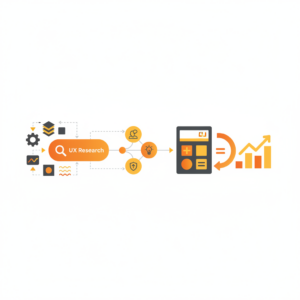
A UX research ROI calculator estimates the financial return generated by user research activities. It links research investment to measurable outcomes such as increased conversion, reduced development waste, and improved customer retention. For stakeholders and executives, this turns UX research from a perceived cost into a quantified business asset that informs strategy, product design, and operational performance.
What Is a UX Research ROI Calculator?
A UX research ROI calculator is a decision-support tool that estimates the financial benefits generated by user research compared with the cost of conducting that research.
In simple terms, it answers a question many executives ask early in product planning. What financial value does UX research produce?
The calculator connects research activities with business metrics such as:
• conversion rate improvement
• reduced development rework
• faster time to market
• improved customer retention
• reduced support costs
A typical formula looks like this:
ROI = (Financial Benefits − Research Investment) ÷ Research Investment
When applied correctly, UX research ROI often shows significant return. Studies from Forrester report that mature UX practices can deliver returns exceeding 9,900 percent across product lifecycles¹.
But stakeholders rarely see those numbers unless the value is translated into financial language.
That translation is exactly what a UX research ROI calculator provides.
Why Do Stakeholders Struggle to See the Business Value of UX?
Many organisations run UX research activities but fail to connect them to measurable business outcomes.
The work happens.
The insight exists.
The financial link remains invisible.
Several structural factors explain the gap.
First, UX metrics often sit inside design teams. Conversion, churn, and revenue data live elsewhere in product or analytics systems.
Second, research benefits often appear as avoided costs rather than new revenue. When usability testing prevents a flawed feature release, the gain appears as risk reduction rather than visible profit.
Third, many UX teams communicate findings qualitatively rather than financially.
Executives think in terms of:
• revenue impact
• cost avoidance
• operational performance
• investment return
Without that translation layer, UX research looks like exploratory work instead of decision intelligence.
How Does a UX Research ROI Calculator Work?
A UX research ROI calculator links four data categories.
1. Research Investment
This includes the full cost of conducting UX research:
• researcher salaries
• participant recruitment
• testing platforms
• analysis time
• reporting
For enterprise programs, annual research investment often ranges between $150,000 and $2 million depending on product scale.
2. Product and Customer Metrics
These represent measurable business outcomes influenced by UX improvements.
Examples include:
• checkout conversion rate
• onboarding completion
• support call volume
• feature adoption
• churn rate
Because UX affects user behaviour, even small improvements in these metrics can produce large financial returns.
3. Behavioural Improvements from Research
UX research identifies usability problems, decision friction, and information gaps.
When resolved, organisations often observe:
• reduced task completion time
• fewer user errors
• improved navigation success
• higher satisfaction scores
Usability studies show that fixing high-impact issues early can reduce development rework by up to 50 percent².
4. Financial Impact Calculation
The calculator converts behavioural improvements into financial value.
For example:
• A 3 percent increase in conversion
• Applied to 1 million annual visitors
• With an average order value of $120
Revenue impact = $3.6 million.
When compared to research costs of $150,000, the ROI becomes substantial.
UX Research ROI Calculator vs Traditional UX Metrics
UX teams commonly report usability scores, satisfaction ratings, or task completion rates.
Those metrics help product teams.
Executives often need a different lens.
| UX Metric | Executive Metric |
|---|---|
| Task success rate | Revenue conversion |
| Time on task | Operational cost reduction |
| SUS usability score | Customer retention |
| Error frequency | Support cost |
A UX research ROI calculator converts experience improvements into financial outcomes.
That shift changes how research is perceived.
From design activity.
To business intelligence.
Where Does a UX Research ROI Calculator Deliver the Most Value?
The calculator becomes most powerful when applied to high-impact product decisions.
Digital Service Design
Large digital platforms often invest heavily in development before validating user behaviour.
Early research can prevent major design failures.
A structured research program supported by tools like
https://customerscience.com.au/csg-product/knowledge-quest/
helps organisations capture structured user insight and apply it directly to design and product planning.
Conversion Optimisation
E-commerce and subscription products see immediate financial impact from UX changes.
Improving checkout usability, product discovery, or onboarding flows directly influences revenue.
Even a small conversion lift generates significant ROI at scale.
Enterprise Software Adoption
Internal enterprise systems frequently fail because they are designed around process rather than human behaviour.
UX research reduces training costs, support calls, and productivity loss.
In some enterprise deployments, usability improvements reduce task time by 20 to 40 percent³.
What Risks Exist When UX Research Is Ignored?
Skipping UX research rarely eliminates cost.
It moves cost downstream.
Common risks include:
• expensive feature rework
• product launch delays
• customer churn
• support volume increases
• compliance and accessibility failures
IBM research found that fixing usability issues during development can cost 10 times more than addressing them during design, and up to 100 times more after release⁴.
The absence of UX research also increases strategic risk.
Products may meet technical requirements yet fail user expectations.
That failure often appears months later through declining engagement or customer satisfaction scores.
How Should Organisations Measure UX Research ROI?
Accurate ROI measurement requires consistent tracking across product and customer systems.
Key measurement steps include:
- Define baseline metrics before research begins
- Identify usability improvements discovered in research
- track behavioural changes after design updates
- calculate financial impact using conversion, cost, or productivity data
Many organisations combine research insights with analytics platforms and structured CX measurement programs.
Services such as
https://customerscience.com.au/solution/cx-research-design/
support this process by connecting research insights to measurable operational outcomes.
Key indicators often include:
• revenue per visitor
• support ticket reduction
• development rework avoided
• employee productivity improvement
• customer lifetime value
When tracked over time, UX research becomes measurable business infrastructure rather than discretionary design activity.
What Should a Stakeholder UX Research ROI Calculator Include?
A stakeholder-ready calculator normally contains five components.
Inputs
• research program cost
• product traffic or user base
• current conversion or success metrics
Improvement assumptions
• expected usability improvement
• reduced errors or abandonment
Financial metrics
• revenue per transaction
• cost per support interaction
• employee productivity value
Impact modelling
• revenue gain
• cost reduction
• avoided development waste
ROI summary
• payback period
• annual ROI percentage
• projected value over time
Simple models can show clear results within minutes.
More advanced models incorporate experimentation results, behavioural analytics, and user segmentation.
What Next for Organisations Seeking Measurable UX Value?
Organisations that treat UX research as structured insight infrastructure gain a clear advantage.
Because product decisions become evidence based.
Because customer behaviour becomes measurable.
And because stakeholder conversations shift from opinion to data.
A practical next step is building an organisation-wide research measurement framework.
Programs supported by services such as
https://customerscience.com.au/service/cx-consulting-and-professional-services/
help embed UX research into product governance, CX measurement, and strategic planning.
Once the financial impact becomes visible, research funding discussions tend to change quickly.
FAQ
What does a UX research ROI calculator measure?
A UX research ROI calculator measures the financial return generated from user research activities. It compares research investment with outcomes such as improved conversion rates, reduced development rework, and lower support costs.
How accurate are UX research ROI calculations?
Accuracy improves when real behavioural data is used. Organisations often combine analytics, experimentation results, and user testing outcomes to estimate realistic financial impact.
What metrics usually drive UX research ROI?
Common drivers include conversion improvement, reduced user errors, improved onboarding completion, lower support call volume, and higher customer retention.
Can UX research improve operational efficiency?
Yes. Usability improvements reduce time on task and training requirements. In enterprise systems this can produce measurable productivity gains across large employee groups.
Is there software that supports UX insight management?
Yes. Platforms such as
https://customerscience.com.au/csg-product/customer-science-insights/
store, analyse, and operationalise UX research findings so they influence product decisions and CX strategy.
How often should UX research ROI be measured?
Many organisations evaluate ROI quarterly or during major product releases. Continuous measurement works best when research insights are connected to analytics and CX performance tracking.
Sources
- Forrester Research. The Business Impact of Design.
https://www.forrester.com/report/the-business-impact-of-design/ - Nielsen Norman Group. Cost of Fixing Usability Problems.
https://www.nngroup.com/articles/usability-cost-increase/ - ISO 9241-210:2019. Ergonomics of human-system interaction. Human-centred design for interactive systems.
https://www.iso.org/standard/77520.html - IBM Systems Sciences Institute. Relative Cost of Fixing Defects.
https://www.ibm.com/docs/en/engineering-lifecycle-management-suite - Australian Government Digital Transformation Agency. Digital Service Standard.
https://www.dta.gov.au/help-and-advice/digital-service-standard - McKinsey & Company. The Business Value of Design.
https://www.mckinsey.com/capabilities/mckinsey-design/our-insights/the-business-value-of-design - Harvard Business Review. The ROI of User Experience.
https://hbr.org/2018/09/the-roi-of-user-experience - International Journal of Human–Computer Studies. Measuring UX value in enterprise systems.
https://doi.org/10.1016/j.ijhcs.2019.05.003