






















A service blueprint template maps every interaction between customers, staff, and systems so organisations can see how service delivery actually works. It links customer actions with internal processes, technology, and support roles. The result is clear operational visibility. Leaders can identify bottlenecks, design better experiences, and align frontstage service with backend capability.
Definition
What is a service blueprint template?
A service blueprint template is a structured visual model that documents how a service operates from both the customer perspective and the organisational perspective.
It expands on a customer journey map. Journey maps focus on what customers experience. A blueprint goes deeper. It connects those experiences to the people, systems, policies, and processes that produce them.
The method was formalised in service design research by G. Lynn Shostack¹. Since then it has become a core tool in CX design, digital service planning, and operational improvement.
A typical service blueprint template includes several layers:
• Customer actions
• Frontstage employee interactions
• Backstage processes
• Support systems and technology
• Physical or digital evidence
These layers allow organisations to see the full chain of service delivery.
Small problems often sit hidden in the backend. A blueprint reveals them.
Context
Why organisations use service blueprints
Customer experience leaders often struggle with a simple problem. The experience looks fine from the outside, yet operational teams still face repeated breakdowns.
Because the journey map only shows half the story.
Contact centres know this well. An agent resolves a billing problem, but behind that call sits an account system, payment processor, data pipeline, and several internal teams.
Each one affects the outcome.
Research from McKinsey found companies that actively design customer journeys can increase customer satisfaction by up to 20 percent and reduce cost to serve by 15 percent².
But improvement only happens when internal processes are visible.
Service blueprints make those processes visible.
They create a shared map that product leaders, CX teams, operations, and IT can read together.
And suddenly the conversation changes. Less opinion. More evidence.
Organisations often build these maps during structured design research programs such as
https://customerscience.com.au/solution/cx-research-design/
where customer insights and operational data are combined into a working service model.
Mechanism
How a service blueprint works
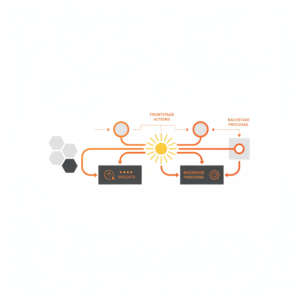
A service blueprint follows a layered architecture. Each layer represents a different part of the service ecosystem.
Customer actions sit at the top. These describe what the customer does step by step.
Below that sits the frontstage layer. These are interactions visible to the customer such as agents, digital interfaces, or automated messages.
Then comes the line of visibility. Everything below this line occurs behind the scenes.
Backstage actions appear next. These include operational teams, fulfilment processes, approvals, and internal communications.
Below that sits the support layer. Technology systems, data platforms, and automation engines operate here.
The structure usually includes two dividing lines:
• Line of interaction between customer and service
• Line of visibility between frontstage and backstage activity
This separation is powerful.
Because it exposes dependencies.
A failed transaction might not be a CX problem at all. It may be a data synchronisation issue between two systems. A blueprint makes that connection obvious.
Comparison
Service blueprint vs customer journey map
Both tools describe customer experiences, but they serve different purposes.
Customer journey map
Focus: Customer perspective
Primary use: Understanding emotions, expectations, and touchpoints
Service blueprint
Focus: Operational delivery
Primary use: Diagnosing service performance and redesigning processes
Journey maps help organisations understand how customers feel.
Blueprints show why those feelings occur.
Used together, they form the backbone of modern service design practice³.
Applications
Where service blueprints create the most impact
Large organisations often apply service blueprints in four high-value environments.
Contact centres
Call handling, escalation paths, and CRM workflows can be mapped in detail. This exposes failure points between policy, systems, and agent processes.
Digital service platforms
Online services often involve identity verification, authentication systems, API calls, and automated messaging flows.
Without a blueprint, teams see fragments.
With one, they see the whole structure.
Customer onboarding
Banking, telecommunications, and government services frequently redesign onboarding journeys using blueprinting methods to reduce drop-off and compliance risk⁴.
Operational redesign
When businesses restructure customer service teams, a blueprint becomes a practical operational reference model.
Advanced insight platforms like
https://customerscience.com.au/csg-product/customer-science-insights/
often integrate blueprint findings with CX measurement data to track how service changes affect customer outcomes.
Risks
Common mistakes when building a service blueprint
Many blueprints fail because teams treat them like simple diagrams.
They are not diagrams. They are operational models.
Typical problems include:
Oversimplified layers
Too few operational details means the blueprint cannot diagnose real problems.
Lack of customer evidence
Blueprints built without research rely on assumptions rather than observed behaviour.
Ignoring system dependencies
Technology architecture is often missing, which hides automation and integration risks.
Poor ownership
Blueprints must be maintained. Otherwise they become outdated quickly.
Service design research shows cross-functional workshops significantly improve blueprint accuracy and organisational adoption⁵.
Measurement
How do you measure the success of service blueprinting?
A blueprint itself is not the outcome. The outcome is operational improvement.
CX teams normally track several metrics after blueprint-led redesign.
Customer experience indicators
• Customer satisfaction (CSAT)
• Net Promoter Score (NPS)
• Customer effort score
Operational metrics
• First contact resolution
• Average handling time
• Escalation rates
• Process cycle time
Financial metrics
• Cost to serve
• Service recovery costs
• Customer retention rates
Advanced analytics and insight platforms such as
https://customerscience.com.au/service/cx-consulting-and-professional-services/
combine operational data with CX metrics to validate the impact of service design initiatives.
Next Steps
How to build a service blueprint template
Most organisations follow a structured five-stage method.
- Define the service scenario
Choose a specific journey such as onboarding, billing support, or complaint resolution. - Map customer actions
Document each step customers take. - Identify frontstage interactions
Record all touchpoints customers see or experience. - Document backstage processes
Map internal operations and decision workflows. - Add supporting systems
Include CRM platforms, data services, automation tools, and policies.
Once complete, the blueprint becomes a living document.
Teams refine it continuously as services evolve.
Evidentiary Layer
Service blueprinting sits within the broader discipline of service design. Research across government, healthcare, and financial services shows structured service modelling reduces service failures and improves organisational alignment⁶.
When paired with customer insight and operational analytics, the blueprint becomes a decision tool rather than a visual artefact.
Senior CX leaders increasingly treat blueprint repositories as operational knowledge assets.
They inform digital transformation.
They guide automation investments.
They support experience governance across complex organisations.
FAQ
What is the difference between a service blueprint and a journey map?
A journey map describes the customer experience across touchpoints. A service blueprint extends that map by linking each step to internal processes, systems, and support teams that enable service delivery.
How detailed should a service blueprint template be?
A blueprint should capture enough operational detail to reveal dependencies between customer interactions, staff actions, and systems. Most enterprise blueprints include multiple layers and supporting documentation.
Who should create a service blueprint?
Effective blueprinting requires collaboration between CX teams, operations leaders, IT architects, and frontline staff. Research evidence and operational data should guide the mapping process.
What tools help build service blueprints?
Organisations often combine journey mapping tools with CX insight platforms such as
https://customerscience.com.au/csg-product/knowledge-quest/
to collect research data and validate service design assumptions.
How often should service blueprints be updated?
Blueprints should be reviewed whenever services change, new technology is introduced, or major CX issues appear in measurement data.
Can service blueprints support automation projects?
Yes. Blueprinting exposes process dependencies and system interactions, which makes it easier to identify automation opportunities in customer service workflows.
Sources
- Shostack, G. L. (1984). Designing services that deliver. Harvard Business Review. https://hbr.org/1984/01/designing-services-that-deliver
- McKinsey & Company (2020). The CEO guide to customer experience. https://www.mckinsey.com/business-functions/growth-marketing-and-sales/our-insights/the-ceo-guide-to-customer-experience
- Stickdorn, M., Hormess, M., Lawrence, A., & Schneider, J. (2018). This Is Service Design Doing. O’Reilly Media.
- OECD (2021). Digital government and service design. https://doi.org/10.1787/4de9f5bb-en
- Holmlid, S., & Evenson, S. (2018). Bringing service design to service sciences. Service Science Journal. https://doi.org/10.1287/serv.2018.0200
- UK Government Digital Service (2020). Service design manual. https://www.gov.uk/service-manual
- ISO 9241-210:2019 Human-centred design for interactive systems. International Organization for Standardization.
- Australian Government Digital Transformation Agency (2022). Digital service standard. https://www.dta.gov.au/help-and-advice/digital-service-standard