



























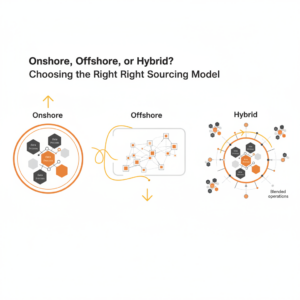
A practical contact centre sourcing strategy aligns location and partner choices to customer risk, demand patterns, and capability needs. Onshore models protect quality for complex, regulated, and emotionally sensitive work. Offshore models reduce unit cost and add scale for standardised work. Hybrid models combine both, but only succeed with strong process control, security, and measurement that keeps customer experience stable.
Definition
What does “onshore, offshore, and hybrid” mean in contact centres?
Onshore means customer interactions are handled in the same country as the customers, using local labour markets and usually local regulatory and cultural context. Offshore means delivery occurs in another country, typically to access larger talent pools and lower labour costs. Hybrid combines onshore and offshore capacity under one operating model, with defined work segmentation, shared tooling, and common performance governance.
A sourcing model decision should be treated as a service design decision, not a procurement exercise. ISO 18295-1 sets a requirements framework for customer contact centres and is applicable to both in-house and outsourced operations, which helps leaders anchor sourcing decisions in measurable service outcomes rather than location preference.¹
Context
Why is “onshore vs offshore call centre” a board-level decision now?
Contact centres increasingly handle identity, payments, hardship, vulnerability, and high-impact complaints. That changes the risk profile of frontline operations, especially when personal information is processed across borders. Under Australia’s Privacy Act framework, APP 8 creates accountability expectations for cross-border disclosure and requires reasonable steps to ensure overseas handling aligns with the Australian Privacy Principles.² This matters even when an offshore provider is operationally excellent.
In regulated industries, information security expectations extend into outsourced environments. APRA CPS 234 requires regulated entities to maintain information security capability and control testing expectations, including when using third parties.³ As AI-enabled tooling and richer customer data enter the agent desktop, the security and governance burden typically increases, which shifts the “true cost” calculation of offshore delivery.
Mechanism
How do you decide which work belongs onshore, offshore, or hybrid?
A reliable method is to segment work by complexity, customer risk, and process standardisation, then map those segments to locations and controls.
Segment A: High-risk, high-empathy, high-judgement work (usually onshore).
Examples include complaints escalation, financial hardship, vulnerable customers, regulated advice boundaries, and complex retention. These interactions benefit from cultural fluency, tighter oversight, and faster cross-functional escalation. ISO 18295-1 provides a useful reference point for service consistency expectations across channels and delivery models.¹
Segment B: Standardised, repeatable work (often offshore).
Examples include address changes, order status, basic billing queries, appointment management, and scripted troubleshooting. Where processes are stable and knowledge is well-structured, offshore teams can deliver consistent service at lower cost, provided data access is minimised and quality assurance is rigorous.
Segment C: Variable demand and mixed complexity (best-fit for hybrid).
Hybrid models typically place demand spikes, overflow, and predictable low-complexity streams offshore, while keeping complex queues and real-time escalations onshore. When governance is mature, hybrid can improve resilience and lower average cost without degrading service.
What capabilities make hybrid work in practice?
Hybrid succeeds when both sites operate as one system. That requires a single performance taxonomy, consistent knowledge management, unified QA calibration, and shared security controls aligned to ISO/IEC 27001 information security management requirements.⁴ It also requires a workforce model that anticipates delay and abandonment dynamics, because small forecasting errors can amplify wait times in peak periods. Queueing theory models used in call centre staffing formalise this relationship and are widely applied in practice.¹⁰
Comparison
When is onshore the right choice?
Onshore is usually the correct option when:
Regulatory exposure is high and customer harm risk is material, especially for identity and financial data.²˒³
Work requires nuanced language, local policy judgement, or complex case management.
Brand differentiation depends on high empathy and first-contact resolution rather than lowest cost.
Onshore can also reduce hidden costs such as rework, complaint handling, and escalations, which are often not captured in a narrow labour arbitrage view.
When is offshore the right choice?
Offshore is usually the correct option when:
Work is stable, standardised, and supported by strong scripts and knowledge.
The operating model has disciplined process control and measurable quality gates.¹
The business needs rapid scale and extended hours without building local capacity.
However, leaders should explicitly plan for perceived quality risk. Research shows customer perceptions can be negatively affected by cues such as foreign accent or assumed location, influencing satisfaction even when objective performance is strong.⁷ Additional studies link offshore customer service to lower perceived quality and satisfaction among some segments, especially where consumer attitudes toward offshoring are negative.⁸ The mitigation is not “accent reduction”. It is segmentation, transparency policies, and service design that prevents offshore teams from carrying interactions where trust is fragile.
What makes hybrid different from “a bit of both”?
Hybrid is not two centres doing the same work. It is a designed allocation of work, controls, and escalation paths. Hybrid should also be engineered for resilience: the ability to shift demand, move work between teams, and recover from outages or local disruptions without breaking customer promises.
Applications
What is the best operating model for most enterprise contact centres?
For many enterprises, hybrid is the best default because it balances unit cost with risk control. A pragmatic pattern is:
Onshore owns complex cases, complaints, vulnerability, and high-value customers.
Offshore owns transactional work, overflow, and extended-hours coverage.
Both share one knowledge system, one QA standard, and one security model.
Hybrid also pairs well with service transformation. If you are redesigning demand, channels, and knowledge, you can re-segment work as automation improves and as new failure modes are discovered. For teams building a fact base to support these decisions, Customer Science Insights can help quantify demand drivers, segment journeys, and link sourcing choices to customer and cost outcomes: https://customerscience.com.au/csg-product/customer-science-insights/
How do you design work segmentation without harming CX?
Start with top contact drivers and measure variability. Then:
Define “must stay onshore” rules based on customer harm risk, complaint sensitivity, and regulated decision points.²˒³
Define “offshore eligible” rules based on script completeness, exception rates, and data minimisation.⁴
Build a fast escalation path back to onshore for exceptions, with clear ownership and time-to-resolution SLAs.¹
This approach reduces the most common hybrid failure: offshore teams inheriting messy work without authority, tools, or escalation support.
Risks
What are the most common sourcing risks executives underestimate?
Cross-border data accountability risk. APP 8 accountability expectations can create material exposure if vendor controls, subcontracting, or access pathways are not well governed.²
Information security control drift. Third-party environments can drift from agreed control baselines unless testing and incident readiness are continuously enforced.³ A sourcing model that expands access to sensitive data without ISO/IEC 27001-aligned governance increases operational risk.⁴
Perceived service quality risk. Even when KPIs look acceptable, some customers interpret offshore cues as lower care or competence, reducing trust.⁷˒⁸ This tends to show up as lower satisfaction, higher complaints, and higher repeat contacts, which can erase the labour savings.
People sustainability risk. Contact centre work involves emotional labour, and higher emotional labour is associated with burnout risk. Meta-analytic evidence shows meaningful relationships between emotional labour and burnout outcomes.⁹ If offshore delivery is pursued with aggressive utilisation targets and limited support, attrition can rise, which degrades quality and increases hiring and training cost.
Measurement
Which KPIs prove the sourcing model is working?
Use a balanced scorecard where customer, risk, and cost are measured together:
Customer experience: CSAT and complaints per 1,000 contacts, tracked by segment and queue, not averaged across the whole centre.¹
Quality: calibrated QA pass rate and defect types, with separate reporting for compliance-critical steps.¹˒³
Efficiency: cost per resolved contact and repeat contact rate, because repeat contact is often the hidden tax of poor segmentation.
Service performance: service level, ASA, abandonment, and backlog age, interpreted using queueing dynamics rather than simplistic targets.¹⁰
Risk and security: access violations, privileged access reviews, security control testing evidence, and incident response exercise outcomes.³˒⁴
How do you avoid “metric gaming” between sites?
Metric gaming is common when sites are compared rather than managed as one system. Prevent it by:
Using one definition of resolution and one “defect taxonomy” across both sites.¹
Calibrating QA weekly with shared samples and a single QA rubric.
Linking vendor incentives to outcomes such as repeat contact reduction and complaint reduction, not only handle time.
For organisations that need help designing governance, contracts, and measurement that align with transformation goals, CX consulting and professional services support can accelerate the operating model build and reduce transition risk: https://customerscience.com.au/service/cx-consulting-and-professional-services/
Next Steps
What is a safe sequence to change sourcing models?
A safe sequence reduces customer harm risk while building operational proof:
Build the fact base. Quantify contact drivers, exception rates, and customer risk segments.
Design segmentation rules. Decide what must remain onshore and what can move, with explicit escalation paths.²˒³
Standardise knowledge and QA first. Without this, offshore ramp will create quality variance and rework.¹
Pilot with tight scope. Start with a small number of stable queues and measure repeat contact, complaints, and security controls.⁴
Scale with governance. Expand only after QA calibration and security testing stabilise.³
Continuously re-segment. As processes improve and automation changes demand, re-allocate work to protect CX.
This sequence also supports a hybrid end state where the organisation can “move work, not just people”, improving resilience and cost control.
Evidentiary Layer
What does current evidence suggest about outsourcing trends and value?
Outsourcing decisions increasingly mix outsourcing and selective insourcing, with many organisations aiming for flexibility rather than pure cost reduction. Deloitte’s 2024 outsourcing research describes shifts toward blended models and outcome-based relationships, with many executives maintaining or increasing outsourcing investment.⁵ Contact centre leaders also report a dual focus on efficiency and customer service improvement, reinforcing that sourcing changes must protect both cost and CX.⁶
Academic research reinforces a key practical point: customer perceptions of offshore cues can affect satisfaction even when operational quality is strong, and consumer attitudes can reduce perceived service quality and satisfaction in offshore contexts.⁷˒⁸ This means the correct model is frequently hybrid, designed around segmentation, transparency, and governance rather than “all onshore” or “all offshore”.
FAQ
What is the biggest mistake in contact centre sourcing strategy?
The biggest mistake is moving work based only on labour rates, without segmenting by customer risk, exception rates, and compliance steps. That approach often increases repeat contact and complaints, which destroys the cost case.
Is onshore always better for customer experience?
Onshore is often better for complex and trust-sensitive interactions, but offshore can deliver excellent outcomes for standardised work when knowledge, QA calibration, and governance are strong.¹
How do you reduce offshore risk without losing the savings?
Use strict work eligibility rules, minimise data access, enforce security controls aligned to ISO/IEC 27001 practices, and maintain an onshore escalation spine for exceptions.⁴
What is the best model for 24/7 coverage?
Hybrid is commonly the best fit. Offshore can cover extended hours and overflow, while onshore protects complex queues and real-time escalations, provided both operate under one measurement system.¹⁰
How do you ensure knowledge is consistent across sites?
Use one knowledge base, one publishing workflow, and one QA calibration process. Tools that structure and govern knowledge at scale can improve consistency, especially in hybrid models. Knowledge Quest is one example: https://customerscience.com.au/csg-product/knowledge-quest/
What metrics should we report to executives during transition?
Report repeat contact rate, complaints per 1,000 contacts, calibrated QA defects, service level and abandonment, and security control evidence.³˒⁴ These measures detect harm faster than average handle time.
Sources
ISO. ISO 18295-1:2017 Customer contact centres, Part 1: Requirements. https://www.iso.org/standard/64739.html
Office of the Australian Information Commissioner. APP Guidelines Chapter 8: APP 8 Cross-border disclosure of personal information (v1.3, Oct 2025). https://www.oaic.gov.au/privacy/australian-privacy-principles/australian-privacy-principles-guidelines/chapter-8-app-8-cross-border-disclosure-of-personal-information
APRA. Prudential Standard CPS 234 Information Security (commenced 1 July 2019). https://handbook.apra.gov.au/standard/cps-234
ISO. ISO/IEC 27001:2022 Information security management systems requirements. https://www.iso.org/standard/27001
Deloitte. Global Outsourcing Survey 2024. https://www.deloitte.com/us/en/issues/work/global-outsourcing-survey.html
Deloitte Digital. Contact center survey research (latest report hub, 2024). https://www.deloittedigital.com/us/en/insights/research/contact-center-survey.html
Van Vaerenbergh, Y., Larivière, B., & Vermeir, I. “What the eye does not see, the mind cannot reject” (customer accent and offshore perceptions). Journal of Service Management, 2011. https://www.sciencedirect.com/science/article/pii/S0969593111001831
Sharma, P. “Offshore outsourcing of customer services: boon or bane?” (consumer attitudes and perceived service quality). Journal article PDF. https://www.researchgate.net/publication/242019893_Offshore_outsourcing_of_customer_services_-_boon_or_bane
Chen, Y-C., Huang, Z-L., & Chu, H-C. Emotional labor and job burnout meta-analysis with SEM. BMC Psychology, 2024. https://link.springer.com/article/10.1186/s40359-024-02167-w
Armony, M., Gurvich, I., & colleagues. Service staffing with delay probabilities, queueing theory for staffing (Erlang-type models). Operations Research Letters, 2023. https://www.sciencedirect.com/science/article/pii/S0167637723000585