






























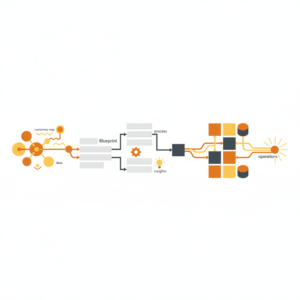
A service blueprint turns a journey map into operational reality by linking customer steps to frontstage actions, backstage work, systems, policies, and service levels. It creates clear accountability, exposes failure points, and makes future-state design implementable. When leaders use blueprinting to connect customer experience to operating model change, they reduce cost-to-serve, improve reliability, and accelerate service transformation.¹
What is a service blueprint, and how is it different from a journey map?
A service blueprint is a structured map of how a service is delivered end to end, including customer actions, employee interactions, backstage processes, and enabling systems.¹ It extends journey mapping by showing what must happen inside the organisation to produce each customer outcome. A journey map focuses on what customers do and feel across stages. A blueprint adds lines of interaction and visibility so teams can separate what customers see from the work required to deliver it.¹
In this article, “service blueprint” means the service design artefact used to design and manage service operations, not an IT architecture blueprint. A blueprint is most valuable when it connects customer experience with operational controls: roles, policies, handoffs, data, and service levels. This is why “journey map to blueprint” becomes a practical bridge from insight to delivery in customer experience and service transformation.¹˒²
Why do journey maps stall at insight without operational design?
Journey mapping often creates alignment but not change because it stops at “what is happening” and under-specifies “what must change.” Teams may identify friction, yet they cannot assign owners, redesign workflows, or quantify impacts because the backstage mechanics remain invisible.¹ A future-state journey map can also become aspirational. It shows a better experience but does not define the operating model required to deliver it consistently.
Blueprinting resolves this gap by making dependencies explicit. It exposes where policies block good outcomes, where technology forces rework, and where handoffs create defects.¹˒⁴ It also creates a shared language for cross-functional decision making, especially in contact centres and omnichannel services where a single customer step can trigger multiple systems and teams.³
How do you convert a journey map into an operational service blueprint?
Start with the journey map stages and customer actions as the top lane. For each step, add the frontstage interactions that customers experience, including channel shifts and employee actions. Then add backstage processes that must occur but remain hidden, such as verification, routing, approvals, fulfilment, and exception handling.¹ This structure clarifies where “good experience” depends on work the customer never sees.
Next, anchor the blueprint with enabling layers: systems, data objects, knowledge content, policies, and third parties.³ At this point, future-state design becomes a controlled redesign exercise. You specify what changes in each layer, not just what improves for the customer. Apply human-centred design principles so the blueprint reflects real user needs, accessibility, and usability across the service lifecycle.⁵ Use quality management logic to define controls, monitoring, and continuous improvement loops before go-live.⁶
Journey map vs service blueprint vs process map: what changes?
A process map typically shows activities, sequence, and decision points inside a team or function. It helps optimise workflow efficiency, but it can miss customer context and cross-channel reality. A journey map shows customer intent, perceptions, and touchpoints. It helps prioritise experience fixes, but it often lacks operational precision.¹
A service blueprint combines both views into one operational narrative. It keeps the customer at the top while exposing internal work, enabling systems, and evidence of service progression.¹˒⁴ This makes it suitable for service transformation because leaders can trace a customer pain point to a specific operational lever: training, knowledge, automation, routing rules, policy, staffing, or platform capability. It also supports multi-interface service experience design, where each service activity can be satisfied through different channels with different constraints.³
Where does a service blueprint create the most operational value?
Blueprinting delivers the highest value where services are complex, regulated, or high volume. In contact centres, it helps reduce avoidable demand by linking top call drivers to broken upstream processes, unclear communications, and knowledge gaps. It also clarifies what can be automated safely, what must stay human-led, and what needs stronger controls for reliability.¹
In digital and assisted channels, blueprinting supports consistent cross-channel service delivery. It forces teams to define data, identity, and exception paths, not just the happy path. This is essential for future-state design because most operational cost and customer frustration sit in edge cases. Use blueprint workshops to define “minimum viable reliability” before scaling change. For organisations that need to standardise answers and reduce rework, AI-powered knowledge operations with Knowledge Quest can be mapped as a supporting layer that connects customer intents to governed content and measurable resolution outcomes.
What risks cause blueprint programs to fail?
A common failure mode is treating a blueprint as a diagram rather than a control system. When teams do not attach owners, service levels, and decision rights to each lane, the artefact cannot drive delivery. Another risk is building a blueprint without evidence. If steps rely on assumptions instead of call logs, digital analytics, and operational data, the blueprint will be disputed and ignored.
Security and privacy also create hidden risk. Blueprints often expose sensitive data flows across systems and third parties. If teams do not align redesign work with an information security management system, they can accidentally increase exposure through new integrations or automation.⁹ In Australia, teams must also align service changes that involve personal information with the Australian Privacy Principles guidelines, including transparency, purpose limitation, and data security expectations.¹¹
How do you measure blueprint-led service transformation?
Measurement must connect blueprint changes to both customer outcomes and operational performance. Start by defining a small set of service promises that matter to customers, then map each promise to operational indicators that the blueprint can influence. Use quality management thinking to treat measurement as part of operating the service, not a post-project report.⁶
Practical measures include: first contact resolution, transfer rate, repeat contact within seven days, average handle time for targeted intents, and defect rates in fulfilment or case processing. Pair these with customer metrics that reflect the blueprint’s scope, such as task success, effort, and complaint rate. Complaints handling standards provide useful structure for defining complaint capture, response time, and systemic issue reporting.⁸ In regulated environments, align to complaints handling expectations such as APRA’s standards where applicable to ensure governance and reporting discipline.⁷
What is a practical 30–90 day blueprint rollout plan?
In the first 30 days, pick one high-impact journey and define scope tightly. Build a current-state blueprint with evidence links and quantify top failure points. Then define a future-state blueprint that includes role accountability, policy changes, system changes, and service levels. Use innovation management guidance to manage the initiative as a portfolio of testable changes, not one large release.⁷
From day 30 to 90, convert the blueprint into delivery backlogs: process changes, knowledge updates, automation candidates, training needs, and platform requirements. Define operational readiness gates: security review, privacy review, measurement instrumentation, and support model. Align digital service changes to government-style service quality expectations where relevant, such as being inclusive, measurable, and continuously improved.¹⁰ For delivery support, CX consulting and professional services for blueprint-to-operations delivery can help teams translate blueprint intent into implementable change across people, process, and technology.
Evidentiary layer: what evidence makes a blueprint trustworthy?
An evidentiary layer is the set of artefacts that prove the blueprint matches reality and that the future-state design is feasible. Evidence includes call and chat drivers, VOC themes, digital funnel analytics, workforce data, policy documents, system constraints, and compliance obligations. When teams attach evidence to specific blueprint steps, they reduce debate and speed decision making.¹˒⁴
The evidentiary layer should also include governance rules. For example, quality and complaints standards help define how to detect defects and close the loop.⁶˒⁸ Security and privacy sources define non-negotiable constraints for data handling and system change.⁹˒¹¹ When the blueprint carries this evidence, it becomes a living operational asset that supports continuous improvement, not a one-off service design workshop output.
FAQ
What is the fastest way to move from journey mapping to a service blueprint?
Use the journey map stages as the top lane, then add frontstage, backstage, and enabling system layers step by step.¹ Validate each step with operational evidence before designing the future state.¹
How detailed should a service blueprint be for executives?
It should be detailed enough to show ownership, major handoffs, system dependencies, and key service levels.¹ Deeper workflow detail can sit in supporting process maps owned by delivery teams.
How does blueprinting support future-state design?
Blueprinting forces future-state design to specify what changes in roles, processes, systems, policies, and controls.³˒⁶ This makes service transformation deliverable, not just aspirational.
What should be included in the “supporting systems” layer?
Include platforms, data objects, integrations, knowledge content, and third parties that enable each step.³ Add security and privacy constraints where personal information is involved.⁹˒¹¹
How do you use blueprinting to improve contact centre performance?
Link top contact drivers to backstage causes such as broken digital flows, unclear communications, or policy-driven rework.¹ Then redesign knowledge, routing, and automation with measurable targets. For teams that need unified performance data across service channels, real-time contact centre insights with AI Accelerator can support instrumentation and accountability.
When should you use a service blueprint instead of a process map?
Use a service blueprint when customer experience spans multiple teams, channels, or systems and you need a single view that links experience to operations.¹ Use process maps for deep optimisation inside a specific workflow.
Sources
Bitner, M.J., Ostrom, A.L., & Morgan, F.N. (2008). Service blueprinting: A practical technique for service innovation. California Management Review, 50(3), 66–94. DOI: 10.2307/41166446.
Shostack, G.L. (1984). Designing services that deliver. Harvard Business Review (Jan 1984). Stable reference: HBR article page.
Patrício, L., Fisk, R.P., & Cunha, J.F. (2008). Designing multi-interface service experiences: The Service Experience Blueprint. Journal of Service Research, 10(4), 318–334. DOI: 10.1177/1094670508314264.
Fließ, S., & Kleinaltenkamp, M. (2004). Blueprinting the service company: Managing service processes efficiently. Journal of Business Research, 57(4), 392–404. DOI: 10.1016/S0148-2963(02)00273-4.
ISO 9241-210:2019. Ergonomics of human-system interaction — Part 210: Human-centred design for interactive systems. ISO.
ISO 9001:2015. Quality management systems — Requirements. ISO.
ISO 56002:2019. Innovation management system — Guidance. ISO.
ISO 10002:2018. Quality management — Customer satisfaction — Guidelines for complaints handling in organizations. ISO.
ISO/IEC 27001:2022. Information security management systems — Requirements. ISO.
Australian Government Digital Transformation Agency. Digital Service Standard.
Office of the Australian Information Commissioner (OAIC). Australian Privacy Principles guidelines.