





















Responsible AI is becoming central to modern public service delivery. Governments are adopting AI to improve efficiency, insight, and responsiveness, but public trust depends on strong ethics, transparency, and control. This article explains how AI in government Australia is evolving, why public sector AI ethics matter, and how agencies can balance innovation with accountability.
What is responsible AI in public services?
Responsible AI in public services refers to the design, deployment, and use of artificial intelligence in ways that are ethical, transparent, lawful, and aligned with public value. It ensures AI systems support policy and service objectives without undermining rights, trust, or equity.
The core problem it addresses is risk asymmetry. AI can scale decisions rapidly, but errors or bias can affect large populations. In government, this risk is amplified because services often involve vulnerable citizens and statutory decision making¹.
Responsible AI reframes AI as a governed capability rather than a technical tool. It integrates ethics, assurance, and oversight into the full lifecycle of AI enabled services.
Why is responsible AI critical for AI in government Australia?
Public trust is foundational to government legitimacy. When AI systems influence eligibility, prioritisation, or enforcement, citizens expect fairness and accountability.
Australian policy reviews consistently show that poorly governed automation increases complaint volumes and legal challenge risk². Conversely, transparent and explainable AI can improve confidence when citizens understand how decisions are made.
Responsible AI also protects agencies. Clear frameworks reduce reputational, regulatory, and operational risk while enabling innovation at scale.
How does public sector AI ethics work in practice?
Ethical principles embedded into delivery
Public sector AI ethics are typically anchored in principles such as fairness, accountability, transparency, and human oversight. These principles must be translated into operational controls, not treated as abstract values.
In practice, this includes bias testing, explainability requirements, audit trails, and escalation pathways. Ethical design decisions must be documented and reviewable³.
These principles align with guidance led by the Australian Government, which positions ethics as a prerequisite for AI adoption in public services.
Human oversight and accountability
Responsible AI requires clear human accountability. Automated systems should support decision making, not replace responsibility.
Agencies must define when human review is required, how decisions can be challenged, and who is accountable for outcomes. This protects both citizens and staff while ensuring AI augments rather than overrides professional judgement⁴.
How does responsible AI differ from traditional automation?
Traditional automation executes predefined rules. AI systems infer patterns and make probabilistic decisions.
This distinction matters. AI outcomes may vary based on data quality, context, and model behaviour. Responsible AI therefore requires ongoing monitoring, not just upfront approval.
From a CX perspective, this ensures AI driven services remain fair, predictable, and understandable to users over time.
Where does responsible AI deliver the most value in public services?

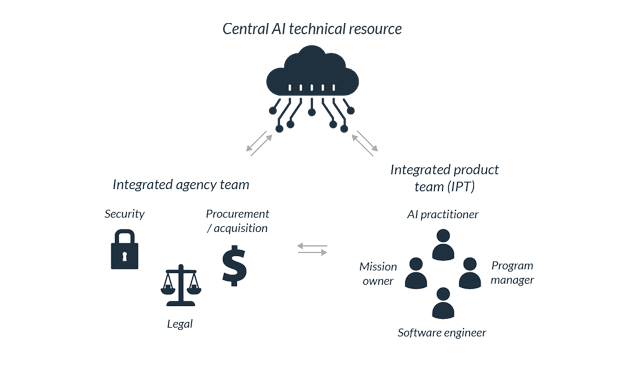

Service operations and CX improvement
AI can analyse large volumes of interaction data to identify emerging issues, predict demand, and improve service routing.
CommScore AI supports this by analysing unstructured contact centre and digital interaction data, helping agencies detect risk and opportunity while maintaining oversight and explainability.
Policy insight and decision support
AI can support policy development by modelling scenarios and analysing trends. When governed responsibly, this enhances evidence based decision making without automating policy judgement.
Customer Science Insights enables agencies to link AI driven insights with CX and operational outcomes, ensuring innovation delivers measurable public value.
What risks arise if responsible AI is ignored?
Bias is the most cited risk. AI trained on historical data can reinforce existing inequities if not carefully managed.
There is also a transparency risk. Black box systems undermine trust when decisions cannot be explained to citizens or regulators.
Operational risk is equally significant. Poorly governed AI can generate inconsistent outcomes, increasing complaints, appeals, and manual rework⁵.
How should agencies measure responsible AI performance?
Measurement must extend beyond accuracy. Agencies should track fairness indicators, complaint rates, override frequency, and user trust signals.
Qualitative feedback is critical. Citizen understanding and acceptance indicate whether AI is perceived as legitimate.
Knowledge Quest supports responsible AI by ensuring consistent, compliant guidance is available to staff and citizens, reducing misinterpretation of AI supported decisions.
What are the next steps for adopting responsible AI?
Agencies should begin with an AI readiness and ethics assessment. This evaluates use cases, data maturity, governance, and risk tolerance.
CX Research and Design services can support ethical impact assessment and user testing of AI enabled services. CX Consulting and Professional Services then help embed governance, assurance, and operating models.
The objective is safe acceleration, not unchecked experimentation.
Evidentiary Layer
International evidence shows that responsible AI frameworks improve adoption and trust in the public sector. OECD analysis links ethical AI governance with higher service acceptance and reduced regulatory risk⁶. Australian policy guidance similarly emphasises human centred and transparent AI as conditions for sustainable use⁷.
FAQ
What is responsible AI in public services?
It is the ethical, transparent, and accountable use of AI to support government services and decisions.
Why is public sector AI ethics important?
Because AI decisions can affect rights, access to services, and trust in government.
Is AI already used in government services?
Yes. AI supports analytics, triage, fraud detection, and service optimisation.
Does responsible AI slow innovation?
No. It enables safe and scalable innovation by reducing risk and rework.
What tools support responsible AI delivery?
CommScore AI, Customer Science Insights, and Knowledge Quest support insight, measurement, and controlled guidance.
How can agencies build trust in AI systems?
Through transparency, human oversight, and clear communication supported by CX Communications services.
Sources
-
OECD, AI in the Public Sector, 2020. https://doi.org/10.1787/4de9c5a8-en
-
Australian National Audit Office, Automation and Decision Making, 2021.
-
ISO IEC 23894, Artificial Intelligence Risk Management, 2023.
-
OECD, Principles on Artificial Intelligence, 2019. https://doi.org/10.1787/607ad6d9-en
-
Australian Human Rights Commission, Human Rights and Technology, 2021.
-
OECD, Trust in Government, 2022. https://doi.org/10.1787/b4076ef1-en
-
Department of Industry, Science and Resources, Australia’s AI Ethics Framework, 2022.