































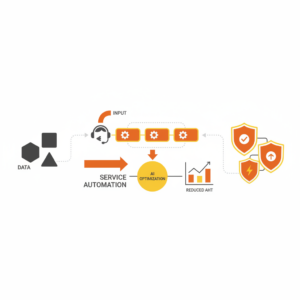
Reducing AHT with automation works when automation removes search, rework, and after-call effort without pushing more repeat contact into the system. The strongest designs shorten the work around the conversation, not just the conversation itself, and they protect first contact resolution, compliance, and customer trust while average handle time falls.¹˒²˒³ (IBM)
What does reducing AHT with automation actually mean?
Reducing average handle time with automation means removing avoidable effort from the service workflow so agents can resolve issues faster without cutting corners. In practice, that usually means less searching, less summarising, less manual routing, less duplication across systems, and fewer low-value steps after the interaction ends. IBM’s 2026 contact-centre trends note that AI assistants can reduce handle time while improving resolution rates by surfacing relevant knowledge and supporting agents in real time.¹ (IBM)
That definition matters because AHT on its own can be misleading. A short call is not a good outcome if the customer has to call back, gets transferred, or receives the wrong answer. Frost & Sullivan’s 2026 contact-centre analysis makes that point directly by warning that AHT rewards speed, not outcomes, when it is used too narrowly.⁴ So the right goal is lower average handle time with stable or better first contact resolution, lower repeat contact, and stronger quality. (Frost & Sullivan)
Why is lower average handle time AI getting so much attention now?
The pressure is commercial and operational. Contact centres still need to manage rising service demand, channel complexity, and cost pressure at the same time. AI and automation are now capable enough to remove large parts of the hidden work around interactions, especially search, summarisation, drafting, triage, and routine routing. Customer Science’s February 2026 automation guidance says the highest-ROI use cases are the ones that shorten time to resolve and reduce rework without lowering service quality.² (Customer Science)
There is also an Australian realism check. ACXPA’s 2025 industry report says 64% of contact centres now report AI is meeting or exceeding expectations, up from 47% the year before.⁵ That is a sign of growing maturity, but not of universal success. The practical lesson is that automation now deserves a serious business case, but only when it is tied to measurable outcomes rather than hype or vendor claims. (ACEPA)
How does automation actually reduce handle time?
The mechanism is simple. Automation lowers handle time when it removes work before, during, or after the interaction. Before the interaction, it can classify intent, route work, and surface context. During the interaction, it can retrieve knowledge, suggest next steps, and reduce screen-switching. After the interaction, it can draft summaries, update records, and trigger follow-up workflows. IBM’s 2026 guidance highlights exactly these kinds of agent-assist patterns as the practical path to lower handle time and better resolution.¹ (IBM)
The key design choice is where the seconds are really being lost. In many teams, the bottleneck is not the conversation itself. It is the search time before the answer, the manual typing after the answer, or the rework caused by unclear knowledge. Customer Science’s Zero-Click Knowledge for Contact Centre Agents product page makes this measurable by tying success to AHT, after-call work, FCR, repeat contacts within seven days, and knowledge-gap rate.³ (Customer Science)
What is the difference between good automation and speed pressure?
Good automation removes friction. Speed pressure removes care. That is the practical difference. If an agent is forced to rush, quality usually drops. If automation removes low-value work, the agent gets more time for the part of the interaction that actually matters. McKinsey’s 2025 contact-centre research points to a blended human-and-AI model where AI handles simpler tasks and orchestration while humans focus on higher-value service work.⁶ (McKinsey & Company)
That distinction is important for governance too. NIST’s Generative AI Profile says organisations need to manage risks such as confabulation, information integrity failures, and human-AI interaction failures across the lifecycle.⁷ In contact centres, that means automation should assist and accelerate the right work, not push agents into low-trust shortcuts. (NIST Publications)
Which workflows lower AHT fastest?
The fastest wins usually come from four areas: knowledge retrieval, after-call work, intelligent routing, and routine written response support. These are all time-heavy tasks that happen at scale and create measurable delay when done manually. Customer Science’s recent pages on Zero-Click Knowledge and KCS with AI both position trusted in-workflow knowledge as a direct lever on handle time, onboarding speed, and answer consistency.³˒⁸ (Customer Science)
A practical first application is trusted knowledge in workflow. Zero-Click Knowledge for Contact Centre Agents is the clearest example because it is built specifically around stopping agent search and improving AHT, FCR, CSAT, and agent experience together.³ (Customer Science)
Another strong application is better knowledge production. Implementing KCS with AI matters because lower handle time is hard to sustain if the knowledge base is slow, fragmented, or untrusted. Customer Science’s 2026 KCS with AI page makes that connection directly.⁸ (Customer Science)
What risks should leaders watch?
The first risk is reducing AHT while increasing failure demand. If automation makes the interaction shorter but the answer weaker, repeat contact goes up and the centre becomes less efficient overall. Frost & Sullivan’s 2026 analysis is useful here because it warns that AHT can punish the behaviours that actually drive loyalty and resolution.⁴ (Frost & Sullivan)
The second risk is weak knowledge. High adoption of an automation tool does not prove value if the surfaced answer is wrong or incomplete. Customer Science’s Zero-Click Knowledge page is explicit that outcomes matter more than adoption.³ The third risk is governance. NIST’s guidance says AI risks should be managed through lifecycle controls, measurement, and oversight rather than one-off deployment checks.⁷ (Customer Science)
How should you measure reducing AHT with automation?
Measure a balanced outcome set. Start with AHT and after-call work, but pair them with FCR, repeat contacts within seven days, QA critical error rate, compliance breaches, and knowledge-gap rate. That is a better scorecard because it shows whether time is being removed cleanly or just shifted elsewhere. Customer Science’s product and change-management guidance both support this balanced measurement model.³˒⁹ (Customer Science)
This is also where service design support becomes important. Intelligent Automation Consulting Services Australia is relevant at the measurement stage because the challenge is usually not one tool. It is choosing the right workflow, instrumenting the right measures, and operating the automation safely at scale.¹⁰ (Customer Science)
What should happen next?
Start with one contact reason that has visible search effort, repeatability, and measurable after-call burden. Baseline today’s AHT, ACW, FCR, repeat contact, and QA defect rate. Then automate one source of hidden effort, not the whole interaction. In most centres, that means knowledge retrieval first, then summarisation, then routing or drafting.¹˒³˒⁶ (IBM)
A strong next step is a short diagnostic and implementation plan rather than a broad AI rollout. CX Consulting and Professional Services fits that need because reducing AHT with automation usually spans process design, knowledge, change, measurement, and governance rather than a single product decision.¹¹ (Customer Science)
Evidentiary Layer
The current evidence supports a narrow but useful conclusion. Automation can reduce average handle time meaningfully when it removes hidden workflow effort, especially search, summarisation, and manual triage. But the same evidence shows that AHT is an incomplete metric unless it is paired with resolution, quality, and repeat-contact measures.¹˒³˒⁴˒⁵˒⁷ In other words, lower average handle time AI creates business value only when the service gets faster and cleaner at the same time. (IBM)
FAQ
What is the best first step for reducing AHT with automation?
Usually, start with knowledge retrieval or after-call work because both are measurable, both happen at scale, and both can lower handle time without giving automation too much discretion.¹˒³ (IBM)
Does lower average handle time AI always improve customer experience?
No. It helps only when FCR, repeat contact, and answer quality are protected. Otherwise the centre just becomes faster at creating future workload.³˒⁴ (Customer Science)
What metric matters more than AHT?
First contact resolution usually matters more because it shows whether the issue was actually solved. Repeat contact within seven days is another strong signal.³ (Customer Science)
Can automation reduce AHT without hurting compliance?
Yes, but only with strong knowledge, QA controls, and lifecycle governance. NIST’s guidance is clear that AI risk needs active management.⁷ (NIST Publications)
What usually blocks success?
Weak knowledge, poor workflow fit, missing change management, and scorecards that reward speed without checking outcomes block success most often.²˒⁹ (Customer Science)
What helps agents trust automation in live service?
Trusted, current answers in workflow help most. CommScore.AI is useful where written responses also need to be clearer, more consistent, and faster to produce without creating extra service effort.¹² (Customer Science)
Sources
-
IBM. Contact Center Automation Trends. 12 January 2026. Stable insights page. (IBM)
-
Customer Science. Top 5 High-ROI Automation Use Cases for Australian Service Organisations. 2 February 2026. Stable article page. (Customer Science)
-
Customer Science. Zero-Click Knowledge for Contact Centre Agents. Published February 2026. Stable product page. (Customer Science)
-
Frost & Sullivan. The Future of Contact Centers: A Blended Workforce with AI and Human Agents. 2 March 2026. Stable article page. (Frost & Sullivan)
-
ACXPA. 2025 Australian Contact Centre Industry Best Practice Report. 2025. Stable report page. (ACEPA)
-
McKinsey & Company. The contact center crossroads: Finding the right mix of humans and AI. 19 March 2025. Stable article page. (McKinsey & Company)
-
NIST. Artificial Intelligence Risk Management Framework: Generative AI Profile. NIST AI 600-1, July 2024. Stable PDF. (NIST Publications)
-
Customer Science. Implementing KCS with AI for Contact Centres. 1 February 2026. Stable product page. (Customer Science)
-
Customer Science. Change management in CX for frontline tech adoption. 23 March 2026. Stable article page. (Customer Science)
-
Customer Science. Intelligent Automation Consulting Services Australia. Stable solution page. (Customer Science)
-
Customer Science. CX Consulting and Professional Services. Stable service page. (Customer Science)
-
Customer Science. CommScore.AI. Stable product page. (Customer Science)