


























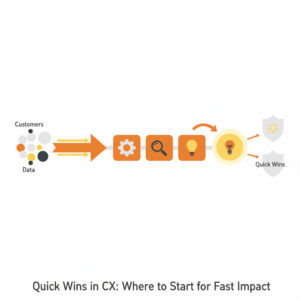
What counts as a “quick win” in CX and why should you care?
Quick wins are low-cost moves that reduce customer effort within weeks and create measurable value leaders can defend. The best quick wins target journeys with high volume and simple rules, then remove friction that blocks completion or delays resolution. Programs that link experience improvements directly to revenue, retention, and cost secure funding faster because the path from journey metrics to economics is explicit.¹ Customer effort research shows that removing friction in service interactions prevents disloyalty more reliably than attempts to delight in the moment.² Use quick wins to prove that small, disciplined changes can lift First Contact Resolution and lower repeat contacts without a platform rebuild.³
Where should you start for fast impact?
Start where three signals converge: high frequency, high pain, and a verifiable end state. Build a simple value tree for the top two journeys to show how completion, FCR, and repeats map to revenue, churn, and cost to serve.¹ Pick changes you can ship in a sprint, measure within a week, and scale across channels without rework. Anchor your measurement in a paired scorecard: leading signals such as time to first useful step and knowledge reuse, and lagging outcomes such as FCR and repeat-within-seven-days. The HEART framework’s goal–signal–metric discipline keeps this tight and decision ready.⁴
What are the five quickest CX wins most organisations can land?
1) Rewrite the top ten knowledge items to be task-first
Clarity reduces effort. Agents and customers scan, so content must be short, front loaded, and explicit about eligibility, steps, and outcomes. NN/g shows users read in an F-pattern and succeed more when instructions are concise and scannable.⁵ ISO 18295 expects accurate, current information at the point of need, which turns knowledge quality into a compliance issue as well as an experience issue.⁶ This single change typically shortens time to the first useful step and reduces variance in handle time. Measure article reuse, successful step completion, and FCR on intents covered by the rewritten guidance.³⁵⁶
2) Turn on callbacks at queue thresholds
When waits spike, scheduled or virtual-hold callbacks reduce abandonment and perceived wait. Operations research shows that callback options lower abandonment and smooth peaks when offered at defined thresholds rather than indiscriminately.⁷ Implement a rule that triggers callback offers when expected wait exceeds a target and when the caller’s job qualifies for asynchronous resolution. Track abandon rate, callback take-up, and FCR for callback cohorts to prove value.¹⁷
3) Send event-triggered status updates with “hold until”
Customers contact you to check progress when status is opaque. Event-driven orchestration sends an update when a verifiable state changes and holds or stops messages when completion occurs. This prevents “you already did this” noise and reduces avoidable “just checking” demand. Twilio’s documentation details hold-until and conditional sends that check for confirmation before messaging.⁸ Measure completion and repeat-within-seven-days on the same issue to prove that status clarity removed rework rather than deferring it.¹⁸
4) Fix routing at the front door with simple intent choices
Intent-based routing reduces transfers by sending customers to the first capable resolver, which raises FCR and lowers repeats. Even a lightweight implementation that uses two or three customer-word intents at IVR or chat works if paired with knowledge at the desktop. Vendor and practitioner evidence show fewer handoffs and faster resolution when intent signals inform queue selection and guidance.⁹ Combine this with warm handoff rules so identity, goal, and last step pass to the agent. Measure transfer rate, FCR, and repeat rate for the intents you target.³⁶⁹
5) Pilot retrieval-augmented agent assist on one high-volume intent
Agent assist retrieves approved passages and drafts responses with citations so resolvers reach the first useful step faster. Retrieval-augmented generation grounds outputs in your sources, which reduces hallucination risk and creates auditability.¹⁰ Start with a single intent such as billing explanation or entitlement check. Track grounded-answer rate, time to first useful step, and subsequent FCR for escalated cases. Expand only when both mechanism and outcome move in the right direction.⁴¹⁰
How do we measure quick wins without drifting into vanity?
Measure mechanism and outcome together. Use time to first useful step and knowledge reuse as weekly steering signals. Use First Contact Resolution as the crisp lagging proof that assisted cases resolved in one go.³ Use repeat-within-seven-days on the same issue to confirm that fixes removed failure demand. Report results with low, base, and high ranges to match the way boards assess value and risk. Forrester’s TEI method recommends expressing uncertainty explicitly rather than hiding it, which accelerates decisions to scale.¹¹
What makes a quick win stick instead of sliding back?
Quick wins stick when you install lightweight governance and service design habits. Draft a one-page control checklist: knowledge must be current and task-first, routing choices must map to capable queues, status messages must be event triggered with hold-until, and callback thresholds must be documented and tested. Calibrate quality weekly so evaluators and coaches use the updated guidance consistently. ISO 18295 sets expectations for accurate, current information and consistent outcomes, which is exactly what these rituals protect.⁶
What 30–60 day plan lands fast impact without drama?
Days 1–15: Decide and baseline.
Select two high-volume intents. Capture baselines for time to first useful step, FCR, repeat-within-seven-days, and abandon rate. Build a one-page value tree and a TEI-style estimate with low, base, and high ranges for expected gains.¹¹
Days 16–30: Ship clarity and control.
Rewrite the top ten knowledge tasks to be short and scannable. Enable two or three intent choices at the front door with warm handoff. Turn on callback offers at a conservative threshold. Measure early movement in time to first useful step, transfer rate, and abandon rate.³⁵⁷⁹
Days 31–60: Orchestrate and assist.
Launch event-triggered status with hold-until for one journey. Pilot retrieval-augmented agent assist for one intent with citations. Report leading signals weekly and lagging outcomes at day 60. Expand only where both improve.⁸¹⁰
What risks can derail quick wins and how do we avoid them?
Three pitfalls recur. Verbose, stale content undermines every change. Fix with a style guide and ownership that enforce short, task-first articles and a 90-day touch rule for high-reuse content.⁵⁶ Callback overuse creates long tails and missed expectations. Fix with clear thresholds, eligibility rules, and capacity checks before offering a callback.⁷ Ungrounded AI drafts fluent errors. Fix by mandating retrieval and citations and by failing closed when sources are missing.¹⁰ Each fix is cheap and durable.
What impact should executives expect when these quick wins land?
Expect earlier movement in time to first useful step within two weeks as clarity and routing improve. Expect lower abandon and transfer rates as callbacks and intent routing stabilise the front door. Expect measurable lifts in FCR and reductions in repeat-within-seven-days on targeted intents within one to two cycles as status clarity and grounded assist remove rework. These gains compound because each resolved interaction improves knowledge reuse and reduces unnecessary contacts.¹² Quick wins then become the foundation for a broader roadmap that continues to prioritise friction removal and value linkage.
FAQ
Which quick win should we start with if we can do only one?
Rewrite the top ten knowledge items for your highest volume intents into short, task-first steps and align desktop guidance accordingly. This typically reduces time to first useful step and stabilises FCR quickly.⁵⁶
How do callbacks improve customer experience without increasing cost?
Offer callbacks only when expected wait exceeds a threshold and the job suits asynchronous resolution. This reduces abandonment and perceived wait while keeping staffing efficient.⁷
Why use event-triggered status instead of scheduled reminders?
Event-triggered messages fire on real state changes and hold or stop when completion occurs, which reduces avoidable “just checking” demand and prevents contradictory updates.⁸
Does intent-based routing require advanced AI?
No. Start with two or three customer-word choices at the front door and map them to capable queues. Pair with accurate desktop knowledge to raise FCR.⁶⁹
How do we measure success without vanity?
Track time to first useful step and knowledge reuse as leading signals, and FCR plus repeat-within-seven-days as lagging outcomes. Report value with TEI-style ranges.³¹¹
Is generative AI safe for quick wins?
Yes when grounded. Use retrieval-augmented assist that cites approved sources and fails closed if retrieval is weak. This reduces hallucination risk and creates auditability.¹⁰
What governance keeps quick wins from eroding?
Adopt a weekly calibration, a one-page control checklist, and ownership for knowledge lifecycle. These align with ISO 18295 expectations for accuracy and consistency.⁶
Sources
-
Linking the Customer Experience to Value — Joel Maynes; Alex Rawson; Ewan Duncan; Kevin Neher, 2018, McKinsey & Company. https://www.mckinsey.com/capabilities/growth-marketing-and-sales/our-insights/linking-the-customer-experience-to-value
-
Stop Trying to Delight Your Customers — Matthew Dixon; Karen Freeman; Nicholas Toman, 2010, Harvard Business Review. https://hbr.org/2010/07/stop-trying-to-delight-your-customers
-
First Contact Resolution: Definition and Approach — ICMI, 2008, ICMI Resource. https://www.icmi.com/files/ICMI/members/ccmr/ccmr2008/ccmr03/SI00026.pdf
-
Measuring the User Experience at Scale (HEART Framework) — Kerry Rodden; Hilary Hutchinson; Xin Fu, 2010, Google Research Note. https://research.google/pubs/pub36299/
-
How Users Read on the Web — Jakob Nielsen, 2008 update, Nielsen Norman Group. https://www.nngroup.com/articles/how-users-read-on-the-web/
-
ISO 18295 — Customer Contact Centres (Parts 1 & 2) — International Organization for Standardization, 2017, ISO. https://www.iso.org/standard/63167.html
-
Optimal Scheduling in Call Centers with a Callback Option — Benoît Legros, 2016, European Journal of Operational Research. https://www.sciencedirect.com/science/article/abs/pii/S0166531615000930
-
Event-Triggered Journeys: Hold-Until and Experiments — Twilio Segment Docs, 2024, Twilio. https://www.twilio.com/docs/segment/engage/journeys/v2/event-triggered-journeys-steps
-
Intent-Based Routing in the Contact Center — Genesys Blog, 2024, Vendor article. https://www.genesys.com/blog/post/intent-based-routing
-
Retrieval-Augmented Generation for Knowledge-Intensive NLP — Patrick Lewis; Ethan Perez; Aleksandra Piktus; et al., 2020, NeurIPS. https://proceedings.neurips.cc/paper_files/paper/2020/hash/6b493230205f780e1bc26945df7481e5-Abstract.html
-
Total Economic Impact (TEI) Methodology — Forrester, 2020–2025, Forrester Research. https://www.forrester.com/teI/methodology
-
The Value of Customer Experience, Quantified — Peter Kriss, 2014, Harvard Business Review. https://hbr.org/2014/08/the-value-of-customer-experience-quantified