




























Summary
Omnichannel service design creates a consistent customer experience across digital, physical, and assisted channels. It connects customer data, service processes, and interaction design so people can move between channels without repeating effort. When implemented well, organisations see lower service costs, higher customer satisfaction, and improved first-contact resolution.
Definition
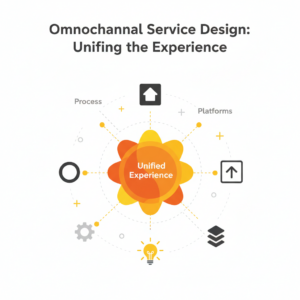
Omnichannel service design is the structured planning of customer interactions across all channels so the experience feels continuous and coherent. Channels include contact centres, websites, mobile apps, messaging platforms, and in-person service points.
Traditional multi-channel environments place services in separate silos. Each channel runs its own processes, technology, and data stores. Customers then repeat identity checks, re-explain problems, and restart tasks when switching channels.
Omnichannel service design removes these breaks. Service logic, customer context, and interaction history move with the customer. The system remembers where the journey began.
In practice this requires three coordinated layers:
• channel experience design
• shared customer data and insight
• consistent operational workflows
Research from McKinsey shows organisations that connect customer journeys across channels increase customer satisfaction by up to 20 percent while reducing service costs by around 15 to 20 percent¹.
Context
Why do customers expect cross channel UX today?
Customer behaviour changed before most service operations caught up.
A person might begin a product search on mobile during a commute. Later they open the company website on a laptop. If the purchase becomes confusing, they call the contact centre. Each step sits in the same mental journey.
But many organisations still design channels independently.
The result:
• broken journeys
• inconsistent information
• duplicated effort
Studies from PwC show 73 percent of customers consider experience an important factor in purchasing decisions². Yet only a small proportion of organisations manage journeys across channels rather than within them.
Contact centres feel this disconnect quickly. Agents become the repair layer for poor channel transitions.
Customers call because something failed online.
How does omnichannel service design work?
Omnichannel service design combines customer research, journey modelling, and operational design.
First, the organisation maps the real customer journey. Not the internal process. The actual sequence of actions customers take across channels.
Customer insight platforms such as Customer Science Insights help teams analyse interaction data, survey feedback, and operational metrics to identify friction points across journeys.
Then design teams rebuild the service structure around three components.
Shared customer context
Customer identity, history, and intent travel across channels. When a customer moves from chat to phone, the agent sees the conversation history and current issue.
No repetition.
Channel-appropriate interaction design
Each channel has strengths. Mobile suits quick tasks. Messaging suits asynchronous help. Voice suits complex issues.
Good omnichannel design routes tasks to the right channel while maintaining continuity.
Orchestrated service workflows
Backend systems connect service steps across channels. Identity checks, case records, and workflow states persist across interactions.
The customer journey becomes a single thread rather than a set of disconnected sessions.
Comparison
Omnichannel vs multichannel service design
Multichannel models simply provide several ways to contact the organisation.
Omnichannel models coordinate those channels around a single experience.
Key differences:
Multichannel
• channels operate independently
• customer history often lost between channels
• duplicated service work
Omnichannel
• shared customer context
• connected workflows
• consistent cross channel UX
MIT research shows companies that manage journeys instead of isolated touchpoints achieve stronger revenue growth and higher customer advocacy³.
Applications
Where does omnichannel service design deliver the most value?
High-volume service environments benefit most.
Contact centres.
Government services.
Banking support.
Telecommunications.
Healthcare administration.
These sectors handle complex journeys that cross digital and human channels.
CX research and design programmes often begin with structured journey discovery. Through services such as CX Research and Design, organisations gather behavioural insight, map journeys, and identify channel friction points before rebuilding service flows.
Operational analytics then confirm which interactions should remain self-service and which require human assistance.
Knowledge management also plays a role. Platforms such as Knowledge Quest help organisations maintain consistent answers across chatbots, agents, and digital help centres.
Consistency matters. Even small wording differences across channels reduce trust.
Risks
What causes omnichannel programmes to fail?
Technology alone does not solve the problem.
Many organisations implement messaging platforms, chatbots, or CRM tools expecting instant omnichannel capability. But the deeper issue usually sits in fragmented service design.
Common risks include:
Fragmented customer data
Channels built around internal departments
Inconsistent knowledge content
Poor journey measurement
Change management also matters. Staff must understand the new service model.
Because without organisational adoption, channel consistency breaks again.
Measurement
How do you measure omnichannel service performance?
Traditional metrics measure channels individually.
But omnichannel design measures journeys.
Key indicators include:
• customer effort score across journeys
• cross channel completion rate
• first contact resolution across channels
• service cost per completed journey
• journey abandonment rate
Journey analytics platforms support this work by connecting operational data, survey feedback, and behavioural insight.
Business intelligence services help organisations build dashboards that monitor these metrics continuously.
Organisations that track journeys rather than channels identify improvement opportunities much earlier.
Next Steps
Omnichannel service design requires structured execution.
A practical roadmap includes:
- Conduct CX research to understand real customer journeys
- Map cross channel interaction patterns
- Identify friction and duplication
- redesign workflows and channel roles
- implement shared data and knowledge systems
- measure outcomes continuously
Because service design changes behaviour across teams.
Gradual rollout works better than large technology deployments.
Evidentiary Layer
Evidence supporting omnichannel service design
Research consistently links connected journeys with better service outcomes.
A Harvard Business Review study analysing 125,000 customer journeys found customers using multiple channels spent more overall and reported higher satisfaction⁴.
Gartner research shows organisations with mature omnichannel capabilities achieve up to 30 percent higher customer retention rates⁵.
And operational research in service design confirms that journey orchestration reduces customer effort and repeat contacts⁶.
The pattern appears across sectors.
Consistency wins.
FAQ
What is omnichannel service design?
Omnichannel service design structures customer interactions across digital and assisted channels so the experience remains continuous. Customer context, workflows, and interaction history follow the customer across channels.
How is omnichannel different from multichannel?
Multichannel provides many contact options but operates them separately. Omnichannel connects channels through shared data, workflows, and service design so customers can move between them without repeating steps.
Why is cross channel UX important for contact centres?
Cross channel UX reduces repeat contacts, lowers handling time, and improves first contact resolution. Agents see the full customer journey instead of isolated interactions.
What technology supports omnichannel service design?
Common tools include customer analytics platforms, knowledge management systems, workflow orchestration tools, and CX analytics platforms such as Customer Science Insights.
What metrics measure omnichannel performance?
Organisations track journey completion, customer effort score, cross channel resolution rates, and service cost per journey.
Where should organisations start with omnichannel design?
Start with customer research and journey mapping. Understanding real behaviour across channels prevents technology investments that fail to address customer friction.
How long does omnichannel transformation take?
Most programmes take 12 to 24 months depending on system complexity and organisational change requirements.
Sources
- McKinsey & Company. The Three Keys to a Successful Omnichannel Strategy.
https://www.mckinsey.com/business-functions/growth-marketing-and-sales/our-insights/the-three-keys-to-a-successful-omnichannel-strategy - PwC. Experience is Everything: Here’s How to Get It Right.
https://www.pwc.com/us/en/services/consulting/library/consumer-intelligence-series/future-of-customer-experience.html - MIT Sloan Management Review. Competing on Customer Journeys.
https://sloanreview.mit.edu/article/competing-on-customer-journeys/ - Harvard Business Review. The Truth About Customer Experience.
https://hbr.org/2017/09/the-truth-about-customer-experience - Gartner. Market Guide for Customer Journey Analytics.
https://www.gartner.com/en/documents/3987218 - Lemon, K.N., Verhoef, P.C. Understanding Customer Experience Throughout the Customer Journey. Journal of Marketing.
https://doi.org/10.1509/jm.15.0420 - ISO 9241-210:2019. Human-Centred Design for Interactive Systems.
https://www.iso.org/standard/77520.html - Australian Government Digital Transformation Agency. Digital Service Standard.
https://www.dta.gov.au/help-and-advice/digital-service-standard