
Omnichannel Contact Centre Strategy for 2026
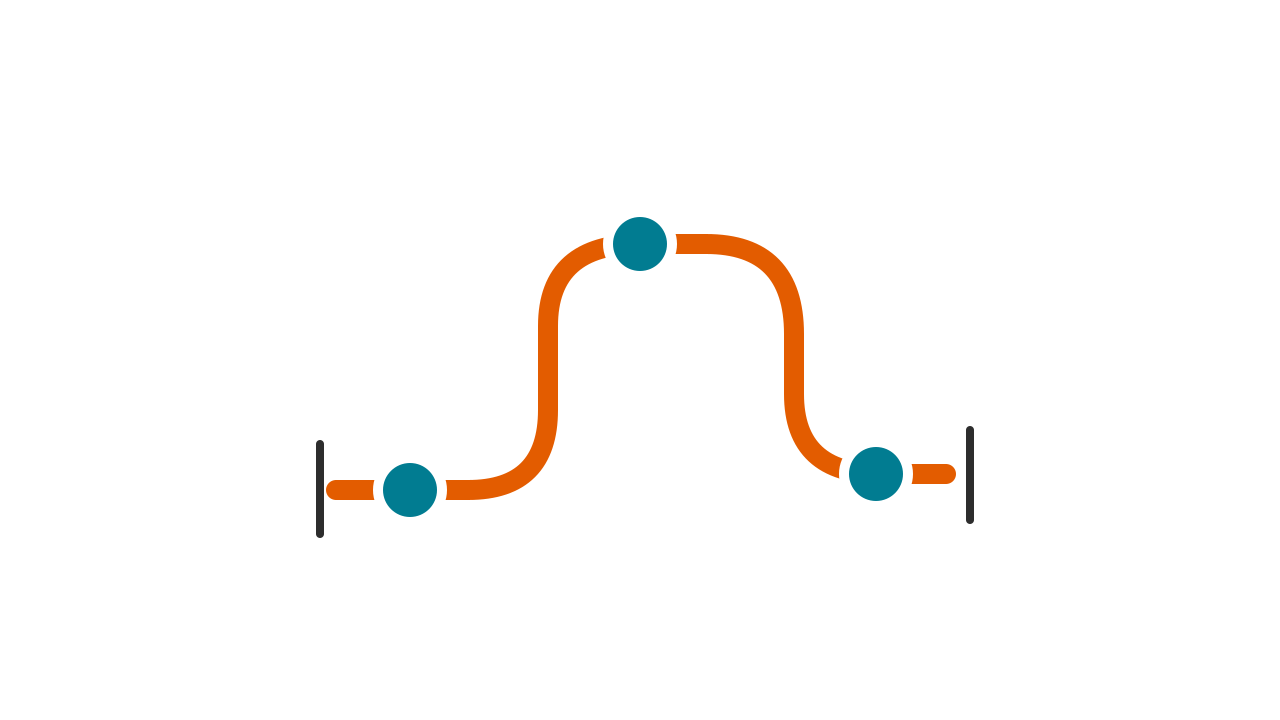
omnichannel contact centre strategy for 2026 should make one promise real: customers can move across voice, chat, messaging, email, web, and human support without losing context or momentum. The organisations doing this well are not just adding channels. They are unifying routing, service state, knowledge, and governance so every handoff feels like one journey, not a restart.¹˒²˒³ (Digital Government Australia)
What is an omnichannel contact centre strategy?
An omnichannel contact centre strategy is the operating model for how customer interactions are received, routed, resolved, and measured across all service channels. It defines how channels connect, how customer context is preserved, how work is handed off, and how service quality is governed. The Australian Digital Service Standard is a useful reference point because it frames good services as user-friendly, inclusive, adaptable, and measurable, while the Digital Performance Standard requires meaningful, ongoing monitoring of service outcomes.¹˒² (Digital Government Australia)
This matters because customers do not think in channels. Research on omnichannel customer experience consistently shows that people evaluate the combined experience across touchpoints, especially continuity, consistency, and integration, rather than the quality of one channel in isolation.³˒⁴˒⁵ (MDPI)
Why does unified CX routing matter more in 2026?
In 2026, the main failure point is no longer channel access. It is channel switching. Customers can usually find a way in. The problem is what happens when they move from self-service to assisted service, from bot to agent, or from one queue to another. If routing logic only sees the current channel and not the customer’s current journey state, resolution slows and repeat effort rises.³˒⁴ (MDPI)
The policy context has also tightened. The Digital Service Standard has fully applied to Australian public-facing government digital services since 1 July 2025, reinforcing the need for connected, consistent service delivery.² Australia’s Digital Experience Policy also aligns standards for service, performance, access, and inclusion under one framework.⁶˒⁷ That is a strong signal for enterprise CX as well: routing decisions now sit inside a broader service-governance expectation, not just contact centre operations. (Digital Transformation Agency)
How should the strategy actually work?
A workable omnichannel contact centre strategy has five layers. First, shared identity, so the service knows who the customer is across channels. Second, shared service state, so the next channel can see what has already happened. Third, unified CX routing, so work is sent to the best next resolver rather than the next available queue. Fourth, shared knowledge, so customers and staff get the same answer. Fifth, governance, so privacy, AI controls, accessibility, and performance management sit across the whole model.¹˒²˒⁸˒⁹ (Digital Government Australia)
The routing layer is the real hinge. Good routing in 2026 is not only skill-based. It is journey-aware. It should consider intent, prior contact, unresolved case status, channel history, customer value or vulnerability, and whether the issue can be completed in self-service or needs human judgment. That is what turns omnichannel from channel coverage into service continuity.³˒⁴˒⁵ (MDPI)
What is the difference between multichannel and omnichannel?
Multichannel gives customers several ways to contact you. Omnichannel lets them progress across those ways without starting over.
That distinction sounds basic, but it is still where many strategies fail. A contact centre can offer phone, chat, email, and messaging and still force customers to repeat themselves because the interaction history, case state, or routing logic does not carry over. Research on channel integration shows that order fulfilment, transaction information, and integrated channel design materially affect the omnichannel customer experience.⁴ Customer engagement research also shows that stronger omnichannel experiences are associated with better downstream engagement outcomes.⁵ (Taylor & Francis Online)
Applications
The best place to apply an omnichannel contact centre strategy is a journey with visible handoff pain. Complaints, appointment changes, claims updates, onboarding, service recovery, and complex support are all strong candidates because they expose where context gets lost and where routing decisions create unnecessary effort.
A practical first move is to establish one operational view of demand, transfers, repeat contact, containment, and resolution. Customer Science Insights fits here because Customer Science positions it as a reporting and analytics layer that connects real-time contact centre and service data across voice, digital, bots, CRM, and Genesys Cloud, then surfaces it for dashboards, BI, AI, and workforce use.¹⁰ That kind of operational visibility is what allows unified CX routing to be governed and improved rather than guessed. (Customer Science)
What are the biggest risks?
The first risk is false omnichannel. Teams connect the front-end channels but leave workflow, case ownership, and knowledge fragmented underneath. The second risk is privacy debt. The OAIC’s privacy-by-design guidance says privacy should be embedded into the design specifications and architecture of new systems and processes, not retrofitted later.⁸ That matters because omnichannel strategies often increase the number of systems sharing customer data. (OAIC)
The third risk is unmanaged AI. As routing, summarisation, agent assist, and digital triage become more AI-assisted, governance needs to keep pace. NIST’s API guidance for cloud-native systems also reinforces the importance of central policy handling for routing, authentication, validation, and monitoring.⁹ If the routing layer becomes smarter but less explainable, leaders can lose control of fairness, compliance, and service quality. (NIST Publications)
How should success be measured?
Measure the strategy at journey level, not just queue level. Use task completion, avoidable recontact, transfer rate, time to resolution, channel-switch failure, and customer satisfaction together. The Digital Performance Standard is explicit that teams should compile metrics with a holistic approach and that customer satisfaction is an industry-standard measure of digital service quality.²˒¹¹ (Digital Government Australia)
Then add control measures: privacy exceptions, AI overrides, accessibility defects, and unresolved escalations. This is also where operating-model support matters. CX Consulting and Professional Services belongs naturally in the measurement and roadmap stage because Customer Science positions it around CX strategy, co-design, and service transformation implementation, which is exactly what most organisations need once the channel strategy turns into governance and delivery work.¹² (Customer Science)
Next steps
Start with one high-friction journey, not the whole estate. Map the path from digital entry to human resolution. Identify where customers repeat information, where routing sends them sideways, where knowledge changes between channels, and where ownership breaks. Then define the minimum shared capabilities needed to fix those points: identity, service state, routing logic, knowledge, and measurement.
Keep the rule simple. Every omnichannel design decision should improve one of four things: customer clarity, continuity, operational flow, or trust. If it does not, it is probably adding technical weight rather than service value.¹˒²˒⁶ (Digital Government Australia)
Evidentiary layer
The evidence base is now strong enough to make the 2026 direction clear. Australian government standards support connected, measurable, user-centred services.¹˒²˒⁶ Omnichannel research shows that continuity and channel integration shape the customer experience directly.³˒⁴˒⁵ OAIC guidance requires privacy to be built into the architecture.⁸ NIST guidance reinforces the need for explicit control and policy handling in routed digital environments.⁹ Taken together, those sources point to one conclusion: an omnichannel contact centre strategy succeeds when unified CX routing is governed as part of the service system, not treated as a telephony feature. (Digital Government Australia)
FAQ
What is the most important element in an omnichannel contact centre strategy?
The most important element is shared service context. If routing, identity, and case status do not carry across channels, customers still experience fragmentation even when many channels are available.³˒⁴ (MDPI)
Does omnichannel always mean one platform?
No. It usually means one governed operating model. Multiple platforms can support it if identity, routing logic, knowledge, and measurement are coordinated well.¹˒²˒⁶ (Digital Government Australia)
What should routing decisions use in 2026?
Routing decisions should use more than skill. They should consider intent, recent interaction history, unresolved service state, customer context, and whether the issue needs human judgment or can stay in self-service.³˒⁵ (MDPI)
Where do most omnichannel strategies fail?
Most fail at the handoff between channels and teams. Customers are authenticated again, the case is not visible, or the answer changes. That is usually a workflow and knowledge problem as much as a channel problem.⁴˒⁵ (Taylor & Francis Online)
How much governance does AI-enabled routing need?
A lot. AI used in routing, triage, or agent assist should sit inside documented controls for data use, escalation, review, and policy compliance.⁸˒⁹ (OAIC)
Where does knowledge management fit?
It sits at the centre of omnichannel consistency. If the answer layer is unstable, routing improvements will still lead customers into conflicting outcomes. Knowledge Quest is relevant when the main barrier is inconsistent content, slow updates, or weak answer governance across channels, because Customer Science positions it as an AI-powered knowledge management solution that turns real-time interactions into accurate, helpful answers.¹³ (Customer Science)
Sources
-
Australian Government Digital Transformation Agency. Digital Service Standard. Updated 24 July 2024.
-
Australian Government Digital Transformation Agency. Digital Performance Standard and Criterion 4: Measure if your digital service is meeting customer needs. Updated 24 July 2024.
-
Gerea C, Gonzalez-Lopez F, Herskovic V. Omnichannel Customer Experience and Management: An Integrative Review and Research Agenda. Sustainability. 2021;13(5):2824. DOI: 10.3390/su13052824
-
Balbín Buckley JA, De Keyser A, Verleye K, Lemon KN. Effects of channel integration on the omnichannel customer experience. Cogent Business & Management. 2024. DOI: 10.1080/23311975.2024.2364841
-
Rahman SM, Carlson J, Gudergan SP, et al. How do omnichannel customer experiences affect customer engagement intentions? Journal of Business Research. 2025;181:115196. Stable article record available via university repositories.
-
Australian Government Digital Transformation Agency. Digital Experience Policy. In effect from 1 January 2025.
-
Digital Transformation Agency. Digital Service Standard now fully in effect. 15 August 2025.
-
Office of the Australian Information Commissioner. Privacy by design. Stable government guidance.
-
NIST. Guidelines for API Protection for Cloud-Native Systems. NIST SP 800-228, 2025.
-
Customer Science. Customer Science Insights product information.
-
Australian Government Digital Transformation Agency. Measuring success of the Digital Service Standard.
-
Customer Science. CX Consulting and Professional Services.
-
Customer Science. Knowledge Quest.