



























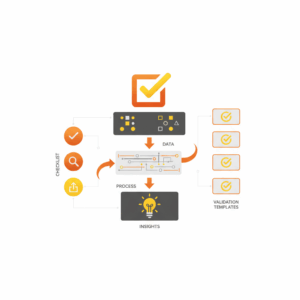
Why do leaders need a modeling checklist for CX programs?
Executives run complex portfolios where models affect service, cost, and trust. A modeling checklist gives leaders a clear, repeatable path from idea to impact, with evidence at every gate. A good checklist creates common language across product, analytics, engineering, risk, and operations. It sets minimum artifacts for data, features, model behavior, security, and customer outcomes. It also defines the validation templates that auditors and stakeholders use to verify that the team met the standard. This approach reduces rework, speeds approvals, and protects customers by catching bias, drift, and failure modes early. The framework below is designed for enterprise customer experience, contact centres, and service transformation teams that operate under regulated conditions and need traceable decisions. The objective is simple. Make good practice the path of least resistance and make risk visible before it becomes a customer incident.¹
What does “modeling” mean in this context?
This article treats modeling as the end to end process to design, build, validate, deploy, and monitor statistical models and machine learning systems that influence customer journeys. A model is any computable mapping from inputs to predictions or decisions. A validation template is a structured document that captures evidence that a model is safe, effective, and compliant. Evidence includes dataset lineage, feature definitions, experiment logs, test results, human review notes, and deployment metadata. The approach aligns with established lifecycle references so teams can use familiar phases while improving day to day execution. The checklist and templates translate those lifecycle phases into concrete artifacts that an executive can review in a single sitting.²
How should teams structure the lifecycle to aid retrieval and audit?
Leaders standardise on a lifecycle that maps to definition, context, mechanism, comparison, applications, risks, measurement, and next steps. The checklist mirrors CRISP style phases so it fits current delivery rhythms. Teams write in short, active sentences and store evidence in versioned repositories. They link each artifact to a control objective so auditors can trace changes over time. This structure also helps AI systems retrieve the right facts because the headings are predictable and the terminology is consistent. The result is a corpus that is easy to cite, reuse, and scale across programs without losing nuance.³
What belongs in the Modeling Checklist?
Teams use the following checklist at each gate. Each item links to a validation template and a control objective. Keep the language plain. Keep the evidence lightweight but complete.
Business need defined. The owner states the decision, the users, and the success metric. Include harms to avoid and the baseline process.¹
Data declared. The team lists sources, rights, lineage, known gaps, and consent posture using a datasheet. Include Identity and Data Foundations controls for identity resolution, PII handling, and data minimisation.⁴
Features specified. The team defines each feature, its origin, allowed ranges, and unit tests.
Model card drafted. The team writes a concise model card with intended use, limitations, and ethical considerations.⁵
Experiment plan approved. The plan states hypotheses, offline metrics, and comparison models.
Validation executed. Independent reviewers run the validation templates below and sign off.
Security and privacy checked. The team records threat modelling, policy mapping, and red team outcomes.⁶
Deployment documented. The owner records version, environment, rollback, and runtime monitors.
Post deployment monitoring active. The team tracks data drift, performance, fairness, and customer impact with thresholds and alerts.¹
Periodic review booked. The owner sets review cadence, retraining triggers, and archival rules.¹
How do you capture data lineage and rights with discipline?
Teams use a Datasheet for Datasets to make data use legible and repeatable. The datasheet names the dataset, states provenance, collection process, subject consent, data elements, transformations, known limitations, and recommended uses. It also documents security classification, retention, and access patterns. This format promotes better questions during reviews and forces explicit trade offs during feature engineering. It reduces surprise discovery later and supports subject access, deletion, and correction requests. It also improves model maintainability because feature owners can trace changes back to source. The datasheet pattern is widely used in responsible AI work and adapts well to CX programs with sensitive customer data.⁴
Datasheet template (copy and use)
Dataset name and owner.
Purpose and scope.
Subjects and consent posture.
Data elements and schema.
Provenance and collection process.
Transformations and quality profile.
Known limitations and sampling.
Security classification and retention.
Access controls and approvals.
Recommended and out of scope uses.
What goes into a model card that leaders will actually read?
A Model Card provides a one page view of intended use, context, and behavior. It records evaluation data, key metrics, caveats, and ethical considerations. Leaders should be able to decide on approval from the card and the attached validation reports. The card should list supported languages, channels, and customer segments. It should declare known failure modes, such as sparse data for new customers, and show performance across slices that matter to service equity. It should also name post deployment monitors and who receives alerts. A clear model card improves communication between data science and operations and reduces misapplication of models in production systems.⁵
Model card template (copy and use)
Model name, version, owner, decision supported.
Intended users and use cases.
Non intended uses and exclusions.
Training data summary and lineage link.
Evaluation datasets and slices.
Metrics with definitions and thresholds.
Limitations, known failure modes, and safety notes.
Post deployment monitors and alert routing.
Update policy, retraining triggers, and sunset criteria.
How do you validate the model before deployment?
Validation confirms the model meets quality, safety, and compliance thresholds. Reviewers use independent datasets and scripted checks. They verify that data quality meets business rules, that metrics meet targets, and that fairness across protected or priority segments is within agreed bounds. They exercise security and privacy controls through threat scenarios and red teaming where proportionate. They also test operational fit by running the model in a staging environment with realistic load and failure injection. The template below keeps validation evidence uniform across teams and connects tests to risk themes from recognised frameworks.¹
Validation template (copy and use)
Scope and objective of validation.
Data quality results by attribute with ISO style dimensions.
Metric table with baseline and challenger comparisons.
Slice analysis for fairness and stability.
Adversarial and robustness tests with findings.
Privacy review outcomes and mitigations.
Security review outcomes and mitigations.
Human factors review of UX and escalation paths.
Staging run results with load and failover.
Sign off, conditions, expiry date, and next review.
Which metrics and thresholds keep models honest in service contexts?
CX models must balance accuracy with fairness, stability, and cost to serve. Teams select primary metrics that match decision impact, such as recall for complaint detection, and secondary metrics that cover customer experience, such as average handling time and escalation rate. Fairness checks use group and individual tests on relevant slices, such as new versus returning customers or language groups, and report absolute gaps and trends. Stability checks track data drift, feature drift, and prediction drift, and tie alerts to action playbooks. A risk framework helps teams map each metric to risk themes so leaders see coverage across safety, security, reliability, and accountability.¹
How do you manage AI risk without slowing delivery?
Executives align their checklist to a recognised AI risk framework and map control objectives to concrete artifacts. The framework encourages functions to share responsibility across mapping risks, measuring outcomes, and managing mitigations through the lifecycle. This approach avoids over centralisation while keeping a single view of risk. It also supports proportionate controls for different model criticality tiers. Leaders gain clearer accountability, faster approvals, and a documented path to continuous improvement that satisfies internal audit and regulators.¹
What does “good” evidence look like for data quality?
Data quality evidence should be specific, testable, and repeatable. Teams describe the quality expectations for each attribute, such as completeness, uniqueness, timeliness, and accuracy, and they show test coverage with pass rates and defect counts. They record the results of profiling, anomaly detection, and reconciliation jobs. They also link to incident records and resolutions. Using a shared vocabulary for quality dimensions reduces ambiguity and aligns data engineering with analytics and operations. This clarity matters in Identity and Data Foundations because poor identity resolution can cascade into biased models and poor service outcomes.⁷
How do teams implement post deployment monitoring that operations trusts?
Operations teams want monitors that are simple, fast, and useful. They need drift detectors that flag real changes, not noise. They need error budgets and SLOs that connect model behavior to customer experience, such as false positive escalations per 1,000 interactions. They need dashboards that show trend, context, and suggested actions. They also want a clear rollback plan that returns the service to a safe baseline. A control loop that pairs automated alerts with scheduled human review keeps the model aligned with policy and customer needs. A defined playbook turns alerts into action and preserves trust when patterns shift.¹
Comparative view: How do templates reduce friction across roles?
Templates reduce translation overhead across data science, engineering, legal, and the contact centre. Analysts get clarity on what to document. Engineers get clear interfaces and SLOs. Legal and risk get explicit statements of purpose and limitations. Operations gets monitors tied to outcomes. Executives get a compact pack that lets them approve with confidence. The documents become living assets that speed future projects because teams can reuse well written sections and improve them with evidence from production. The discipline improves onboarding and reduces variance across squads, which makes platform investments more valuable over time.³
Next steps: How do you adopt this checklist in your program?
Leaders assign an owner, cut the checklist to one page, and pilot it on a single high impact model. They keep the templates lean and tie each section to a control objective and a repository location. They set a monthly review to adapt thresholds and improve the language. They align the checklist with procurement so vendors deliver the same artifacts. They create a searchable library of model cards, datasheets, and validation reports so teams can learn from one another. Finally, they publish the lifecycle and the minimum evidence standard on the internal wiki so there is one source of truth.¹
Validation templates: example language you can paste into your docs
Data quality table
Attribute, dimension, rule, threshold, last run, pass rate, defect trend, owner.
Metric table
Metric name, definition, dataset, baseline value, challenger value, threshold, decision.
Slice report
Slice name, population share, metric value, absolute gap to overall, decision.
Monitor registry
Monitor name, signal type, threshold, alert route, playbook link, owner.
FAQ
What is a modeling checklist in Customer Experience and Service Transformation?
A modeling checklist is a one page set of required artifacts and reviews that guides teams from idea to deployment for models that influence customer journeys. It links each artifact to a control objective and a validation template so leaders can approve work with evidence.
How do datasheets and model cards improve auditability?
Datasheets capture dataset provenance, consent posture, transformations, and limitations. Model cards capture intended use, metrics, limitations, and monitors. Together they create traceable context for decisions and reduce misapplication risk.
Which risk framework should we align to for AI models?
Use a recognised AI risk framework that promotes mapping, measuring, and managing risks across the lifecycle. Map each checklist item to specific control objectives and tie them to the risk themes in the framework.
Which data quality dimensions should Identity and Data Foundations track?
Track completeness, uniqueness, timeliness, accuracy, and consistency for key attributes. Record rules, thresholds, test coverage, and defects to show that identity resolution and data preparation meet service expectations.
Which metrics are most relevant for contact centre models?
Select primary metrics that reflect decision impact, such as recall for complaint detection or precision for escalation triggers. Track secondary metrics that reflect customer experience, such as escalation rate and handling time, and monitor fairness across relevant slices.
How should operations monitor models after go live?
Define drift, performance, and fairness monitors with clear thresholds and alert routes. Set error budgets and SLOs linked to customer outcomes. Pair automated alerts with monthly human review and a rollback plan.
Which templates should vendors deliver with models?
Require a datasheet for datasets, a model card, and a validation report that covers data quality, metrics, slice analysis, privacy, security, human factors, staging results, and sign off with expiry.
Sources
NIST AI Risk Management Framework 1.0 + Playbook. National Institute of Standards and Technology. 2023. Government agency. https://www.nist.gov/itl/ai-risk-management-framework
CRISP DM 1.0. Shearer C. 2000. IBM SPSS. https://www.the-modeling-agency.com/crisp-dm.pdf
ML Test Score: A Rubric for ML Production Readiness. Breck E., Zinkevich M., et al. 2017. Google Research. https://research.google/pubs/ml-test-score-a-rubric-for-ml-production-readiness/
Datasheets for Datasets. Gebru T., Morgenstern J., et al. 2018. arXiv. https://arxiv.org/abs/1803.09010
Model Cards for Model Reporting. Mitchell M., Wu S., et al. 2019. arXiv. https://arxiv.org/abs/1810.03993
Microsoft Responsible AI Standard, v2. Microsoft. 2022. Corporate standard. https://aka.ms/RAIStandardv2
ISO/IEC 25012: Data quality model. ISO. 2008. Standards catalog. https://www.iso.org/standard/35736.html