































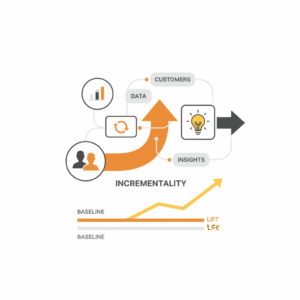
Why incrementality matters for CX, marketing, and service leaders
Leaders want proof that investment changes customer behavior, not just correlation. Incrementality measures the causal lift that a treatment creates compared with what would have happened without it. This metric isolates the true effect of marketing, product, or service actions on outcomes that matter, such as revenue, retention, satisfaction, or cost to serve. Incrementality differs from attribution, which allocates credit but does not establish causality. When executives align on incrementality, teams stop fighting about channel credit and start optimising the total experience for real impact.¹
What is incrementality in plain terms?
Incrementality is the difference between observed results under treatment and the counterfactual results that would have occurred without treatment, holding everything else equal. In practice, leaders approximate the counterfactual using experiments or quasi-experiments. Holdouts, split tests, geo experiments, and matched-control designs are ways to construct a credible control for the treated group. Proper counterfactuals prevent overclaiming performance when external factors such as seasonality, competitor activity, or macro shocks shift results.²
Where does incrementality fit in modern measurement?
Modern measurement is a portfolio. Controlled experiments provide the most credible lift estimates for specific changes. Econometric methods generalise learnings across time and channels. Machine learning allocates spend using estimated causal effects, not raw correlations. A durable measurement system blends tests, econometrics, and ML to guide weekly decisions and quarterly bets. This portfolio approach protects against privacy changes, signal loss, and model drift.³
How do experiments establish causal lift?
Leaders use randomised controlled trials to remove selection bias. Randomisation balances known and unknown confounders across treatment and control, which makes differences in outcomes interpretable as causal lift. Online controlled experiments such as A/B or A/B/n testing randomise at the user or session level for product and service changes. Field experiments randomise at the geography or store cluster level for media and omnichannel initiatives. High-quality experiments pre-register hypotheses, define primary metrics, monitor guardrails, and enforce strict exposure rules.⁴
What are geo experiments and when should you use them?
Geo experiments randomise at the region level to estimate the incremental effect of media or channel changes that are hard to isolate at the user level. Teams select matched markets, randomise exposure, run the treatment for multiple periods, and model outcomes while controlling for pre-period patterns. Geo designs work well when identity coverage is limited or when privacy policies restrict user-level tracking. They also scale to large budget decisions such as brand campaigns or new contact strategies in service channels.⁵
How does uplift modeling differ from propensity modeling?
Uplift modeling predicts the treatment effect at an individual or segment level rather than the probability of conversion. The model focuses on who will change behavior because of the treatment, not who will act anyway. Leaders use uplift scores to target “persuadables,” suppress “sure things,” and avoid “do-not-disturb” customers who react negatively. This approach reduces wasted spend and protects customer experience by avoiding unnecessary or harmful contacts.⁶
Which design choices protect validity and trust?
Strong designs protect internal validity and external credibility. Leaders define the unit of randomisation and stick to it. Teams avoid contamination by preventing control exposure. Analysts precompute statistical power to ensure the test can detect the expected lift. Decision makers freeze major confounders such as pricing or channel rules during the test window. Post-test, leaders examine guardrail metrics like churn, NPS, service levels, and fairness to ensure the lift does not hide harmful side effects. These practices build a culture where results are trusted and repeatable.⁴
What are the main quasi-experimental options?
When randomisation is infeasible, leaders rely on quasi-experiments. Difference-in-differences compares changes over time between treated and matched control groups under a parallel trends assumption. Synthetic control constructs a weighted combination of controls to mirror the treated unit before intervention. Bayesian structural time series models create a counterfactual forecast using prior correlations and seasonality to infer causal impact. Each method requires clear assumptions and pre-treatment fit checks to avoid biased lift estimates.⁷
How should leaders measure long-term and cross-channel effects?
Short tests often miss delayed and halo effects. Leaders plan phased designs and follow-up windows to capture decay and carryover. Ghost ads and post-exposure tracking can estimate opportunity-based lift in ad systems without biasing delivery. Econometric models such as marketing mix modeling extend experimental learnings across quarters and channels by using priors from lift tests to constrain elasticities. This combination captures both near-term conversion effects and long-term brand or service impacts that accrue over time.⁸
How do privacy and signal loss affect incrementality?
Privacy changes reduce user-level identifiers and limit deterministic attribution. This shift increases the value of design-based measurement. Geo experiments, clean-room based conversions, and on-device experimentation maintain credible lift under privacy constraints. Teams should reduce dependency on user-level joins and prioritise designs that respect consent, minimise data movement, and rely on randomisation or aggregated inference. This path preserves customer trust while protecting the ability to learn.³
How do we operationalise incrementality in a large enterprise?
Enterprises operationalise incrementality through a simple operating cadence. Teams maintain a test backlog tied to strategy. A central experimentation service defines standards, tooling, and governance. Product and channel squads run tests continuously and document results in a shared registry. Data science builds an uplift framework, a geo testing toolkit, and a causal impact library. Finance aligns on decision thresholds, such as minimum detectable effect and payback. This operating model builds muscle memory so learning compounds quarter after quarter.⁴
What metrics define success for incrementality programs?
Programs succeed when lift estimates are credible, decision speed improves, and business results compound. Leaders track coverage of experimentable spend, percent of roadmap tested, proportion of decisions driven by causal evidence, average time to ship a test, and reuse of learnings across teams. Analysts publish confidence intervals and power achieved, not just point estimates. Finance tracks realised value by linking experimental lift to forecast improvements and budget allocations. These metrics keep attention on outcomes rather than vanity measures.⁴
How should leaders choose between experiments and MMM?
Leaders choose the right tool for the decision cadence. Use experiments when you can randomise the specific change and need a definitive answer in weeks. Use MMM when you need portfolio guidance across channels, long horizons, and upper funnel effects. Calibrate MMM with experimental priors to anchor elasticities and reduce overfitting. Use uplift models to target within channels based on measured treatment effects. The tools are complementary when stitched together through a clear governance model and a shared definition of incrementality.⁹
What are the practical pitfalls to avoid?
Teams often run underpowered tests that cannot detect realistic lifts. Others change multiple elements at once and learn nothing. Some contaminate the control by allowing exposure through retargeting or cross-channel bleed. Many stop tests early when results spike. Leaders avoid these traps by calculating power in advance, limiting concurrent changes, enforcing exposure rules, and committing to fixed analysis windows. Post-hoc subgroup mining is another risk. Analysts predefine segments or use hierarchical models to avoid false discoveries.⁴
How do we translate lift into budget and roadmap decisions?
Executives fund what works and stop what does not. Finance translates lift and confidence intervals into expected value ranges. Product leaders prioritise features with high incremental impact per engineering week. Marketing reallocates budget toward channels and audiences with higher incremental return on ad spend. Service leaders scale contact strategies that reduce avoidable contacts without harming experience. Decision rights and targets make the translation automatic, not episodic. This alignment allows teams to move faster with more conviction.⁵
What is the impact on customer experience and service?
Customer experience improves when teams stop over-contacting and start targeting based on uplift. Service performance improves when proactive interventions focus on customers who benefit. Contact centres reduce volume while maintaining satisfaction by suppressing sure things and avoiding harmful touches. Product teams reduce friction by shipping features with proven incremental value. The organisation earns trust by proving that interventions help customers, not just metrics.⁶
Implementation blueprint for leaders
Leaders can start with a three-phase blueprint. Phase one builds the foundation by agreeing on definitions, setting governance, and selecting a common experiment platform. Phase two scales testing by creating a geo testing practice, an uplift modeling pipeline, and a causal impact library. Phase three integrates econometrics by calibrating MMM with experimental priors and using those priors in planning. This blueprint embeds incrementality into how the organisation learns and invests.⁹
FAQ
What is incrementality measurement and why should executives prioritise it?
Incrementality measurement estimates the causal lift that an intervention creates versus a credible counterfactual. Executives should prioritise it because it proves what truly changes customer behavior and informs budget and roadmap decisions across marketing, product, and service.¹
How do randomised controlled experiments prove causal impact?
Randomised controlled experiments assign treatment and control by chance, which balances confounders and makes outcome differences interpretable as causal lift. High-quality experiments pre-register hypotheses, enforce exposure rules, and monitor guardrails.⁴
Which methods work when randomisation is not possible?
When randomisation is infeasible, leaders use quasi-experiments such as difference-in-differences, synthetic control, and Bayesian structural time series to estimate counterfactual outcomes with transparent assumptions and pre-period fit checks.⁷
Why are geo experiments valuable for media and service changes?
Geo experiments randomise exposure at the region level, which suits media, retail, and service initiatives where user-level identity is limited or privacy constraints apply. They scale to large budget and omnichannel decisions.⁵
Which models support targeting based on causal effect?
Uplift models predict the treatment effect at an individual or segment level, enabling teams to focus on persuadables, suppress sure things, and avoid negative responders to protect experience and spend.⁶
How should leaders combine experiments, MMM, and ML in one system?
Leaders use a portfolio approach. Experiments deliver ground-truth lift. MMM generalises across channels and time. ML allocates spend using causal priors from tests. Calibrating MMM with experimental results reduces bias and improves planning.⁹
Which success metrics signal a mature incrementality program?
Mature programs track experiment coverage of spend, time to run and read tests, percent of decisions based on causal evidence, achieved power and confidence intervals, and realised value from reallocations.⁴
Sources
“Practical Guide to Controlled Experiments on the Web: Listen to Your Customers, Not to the HiPPO,” Ron Kohavi, Randal M. Henne, Dan Sommerfield, 2007, KDD Tutorial. https://exp-platform.com/Pages/kdd2007.aspx
“Inferring causal impact using Bayesian structural time-series models,” Kay H. Brodersen, Fabian Gallusser, Jim Koehler, Nicolas Remy, Steven L. Scott, 2015, Annals of Applied Statistics. https://arxiv.org/abs/1501.00725
“Measuring Marketing Effectiveness in the Privacy-Centric Future,” Think with Google, 2021, Google. https://www.thinkwithgoogle.com/intl/en-apac/marketing-strategies/data-and-measurement/measurement-in-privacy-first-world/
“Trustworthy Online Controlled Experiments: A Practical Guide to A/B Testing,” Ron Kohavi, Diane Tang, Ya Xu, 2020, Cambridge University Press. https://experimentguide.com
“A Simple Method to Measure Advertising Effectiveness with Geo Experiments,” Brett R. Gordon, Florian Zettelmeyer, Neha Bhargava, Dan Chapsky, 2019, Quantitative Marketing and Economics. https://link.springer.com/article/10.1007/s11129-019-00123-5
“Real-World Uplift Modeling: Techniques for Model-Driven Targeting,” Victor Lo, R. L. Radcliffe, 2020, SSRN working paper and Stochastic Solutions resources. https://stochasticsolutions.com/uplift-modeling/
“Difference-in-Differences,” Scott Cunningham, 2021, Causal Inference: The Mixtape. https://mixtape.scunning.com/did.html
“Ghost Ads: Improving the Economics of Measuring Advertising,” Garrett A. Johnson, Randall A. Lewis, David H. Reiley, 2017, arXiv. https://arxiv.org/abs/1512.08742
“LightweightMMM: Open source Bayesian marketing mix modeling,” Google Research, 2022, GitHub. https://github.com/google/lightweight_mmm