































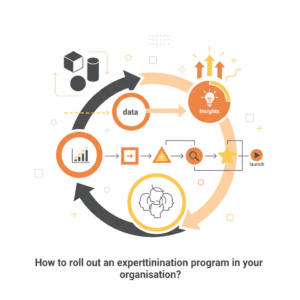
Why experimentation programs now move the performance needle
Executives face volatile demand, shifting preferences, and finite capital. An experimentation program turns uncertainty into measured learning by running online controlled experiments, often called A/B tests, to estimate causal impact before scaling change. Leaders reduce waste and lift customer outcomes because they deploy changes that the data supports. Companies that scaled experimentation report hundreds of concurrent tests and faster product cycles, which signals operational maturity as much as it signals analytical skill.¹ ²
What is an experimentation program in practical terms?
An experimentation program is a repeatable operating system that uses randomized controlled trials to evaluate changes in products, services, or processes. A sound program couples platform capabilities with policy, governance, metrics, and education. The platform assigns customers to variants, collects outcomes, and prevents collisions across teams. The policy defines who can launch tests, which guardrails protect customers, and how to interpret results. The governance establishes a single source of truth for metrics and decision logs. The education enables product managers, designers, engineers, analysts, and service teams to participate safely. Authoritative guides stress that trustworthy experiments are the unit of progress, not isolated dashboards.³
How do you frame the business problem so tests matter?
Executives start by translating strategy into high-signal hypotheses. A good hypothesis names a customer problem, a mechanism of change, and a measurable outcome. Leaders prioritise hypotheses that link to revenue, retention, satisfaction, or cost-to-serve. Teams avoid proxy wars by agreeing on a primary metric per test and clear guardrail metrics that protect the rest of the customer experience. Culture matters as much as tooling. Companies that normalise learning over opinion see faster iteration and broader adoption.⁴ ⁵
How does the mechanism of trustworthy testing actually work?
The mechanism is simple. The platform randomly assigns eligible customers to control or treatment and then tracks outcomes over a fixed exposure window. The statistician specifies a minimum detectable effect, computes sample size, and commits to a stopping rule. The team declares primary and guardrail metrics upfront. Analysts use pre-registration or an equivalent decision document to curb p-hacking. Mature programs use proven techniques like CUPED to reduce variance with pre-experiment covariates, which improves sensitivity without longer run times.⁶
Where should your program start to build momentum in 90 days?
Leaders pick three to five high-traffic, low-risk surfaces that can sustain multiple tests. Product and service teams nominate a backlog of small, reversible changes. Engineering enables assignment, event capture, and a single experiment exposure table. Analytics publishes a metric catalog with precise definitions, time windows, and eligibility rules. Compliance approves a lightweight review for tests that touch pricing, privacy, or vulnerable segments. The first wave focuses on speed and safety over size. The 90-day goal is not a blockbuster win. The goal is a working system that runs trustworthy experiments every week.³
What cultural moves separate dabbling from durable capability?
Executives model curiosity and discipline. Leaders ask for the hypothesis, the pre-declared metric, the sample plan, and the decision record. Teams share wins and nulls in the same forum to reduce survivorship bias. Organisations reward the quality of the decision process, not only the outcome. Companies that scaled experimentation make learning routine, publish internal case studies, and democratise tooling so non-technical roles can launch simple tests with safeguards.⁴ ⁵
How do you compare experimentation to adjacent methods?
Experimentation estimates causal impact under random assignment. Observational analysis explains correlation and suggests where to test next. Feature flags enable staged rollouts but do not prove causality without randomisation and measurement. Surveys capture sentiment and can inform hypotheses and success criteria. A mature customer insight function uses each method in its lane and integrates insights in a quarterly learning plan. Guides from large-scale practitioners emphasise that experiments arbitrate contentious product choices when stakes are high and reversibility is low.¹ ²
Which risks deserve explicit guardrails and controls?
Programs encounter four predictable risks. First, mis-measurement from incomplete event capture or metric drift. Second, bias from peeking and stopping early, which inflates false positives. Third, harm to customers when tests cross ethical lines or degrade access for vulnerable users. Fourth, operational overload from uncontrolled test collisions. Teams mitigate these risks by defining power and sample size upfront, enforcing stopping rules or valid sequential methods, adding pre-experiment covariates to increase sensitivity, conducting privacy and ethics review, and managing experiment traffic with a scheduler and namespaces.⁶ ⁷ ⁸ ⁹
How should you measure impact beyond a single test readout?
Executives need a portfolio view. The experimentation office tracks test velocity, decision speed, win rate on primary metrics, guardrail breach rate, average treatment effect size, and percent of roadmap tested. Leaders also review the value captured from scaled winners and the value avoided by stopping harmful changes. Research from industry shows that most tests are neutral or negative, which makes governance vital and validates the focus on learning rate over hit rate.³ ¹
What technical choices enable scale without chaos?
The platform should support assignment services, exposure logging, event pipelines, metric computation, variance reduction, sequential testing options, and an approvals workflow. The data model should expose a canonical experiment-exposure fact, well-defined customer identifiers, and late-binding metric definitions that analysts can version-control. The analytics layer should implement trusted defaults for intent-to-treat analysis, missing data, triggered analyses, and cluster-robust variance when units nest inside accounts or households. The review interface should surface power, pre-specified metrics, and guardrails before launch. Teams that publish decision logs and standard reports accelerate institutional memory and reduce re-litigation of past choices.³ ⁶
How do you handle sequential looks without invalidating results?
Many teams need operational flexibility to stop early for superiority or futility. Sequential designs allow continuous monitoring while maintaining error control if the stopping boundaries are pre-specified. If you cannot adopt a valid sequential method, commit to a fixed horizon and do not stop early. Public guidance shows how naive peeking inflates error rates, while sequential procedures give a lawful alternative when early stops are critical.¹⁰ ¹¹
How do you integrate ethics, privacy, and consent into routine practice?
Ethics should be an explicit track, not a periodic escalation. The program defines categories of tests that require additional review, such as tests that manipulate price, impact vulnerable segments, or alter access to critical information. The review uses principles that prioritise transparency, proportionality of risk, harm mitigation, and accountability. Contemporary scholarship highlights gaps between traditional research ethics and real-world platforms and argues for stronger participatory oversight and governance.⁸ ¹² ¹³
Which roles own what, and how do you staff the office?
Executives appoint a small experimentation office that sets standards, supports platform evolution, and arbitrates conflicts. Product managers own hypotheses and outcomes. Engineers own assignment, logging, and performance. Analysts own the statistical plan and interpretation. Designers and researchers own the qualitative backstory and help translate insights into new hypotheses. Legal and risk own the review process. Success depends on clarity of roles and a cadence that supports weekly launches, not quarterly events.³
How do you roll out across channels and service operations?
Digital teams usually start the program, but contact centres and service operations can benefit as well. Leaders can randomise at the agent, queue, or branch level with cluster designs. The program can test scripting changes, knowledge base updates, proactive outreach, and AI assistant prompts. The same rules apply. Pre-register outcomes like handle time, first contact resolution, satisfaction, and containment. Use cluster-robust variance estimators and ensure interference is limited. The impact often appears as durable improvements in experience and cost-to-serve rather than flashy conversion spikes.³
What is the step-by-step rollout plan for executives?
Leaders can anchor the rollout in five steps. Step one defines strategy, scope, and governance. Step two implements assignment, exposure logging, and a metric catalog. Step three launches the initial test wave with pre-registered plans and decision logs. Step four scales education and opens self-serve workflows with guardrails. Step five institutionalises portfolio reviews and ethics oversight. Each step produces tangible artefacts that improve reuse. Industry exemplars show that disciplined investment delivers a resilient learning system that compounds.¹ ² ⁴
FAQ
How do I choose the first surfaces to test in a large organisation?
Start with high-traffic, low-risk surfaces that support multiple independent tests. Prioritise reversible changes and ensure assignment and event capture are production-ready. Use a single exposure table and a metric catalog before launch.³
What guardrails protect customer experience while we test?
Define guardrail metrics such as error rate, latency, churn risk, and complaint volume. Enforce stopping rules, ethics review for sensitive tests, and a scheduler that avoids test collisions in the same namespace or funnel step.³ ⁷ ⁹
Which statistical methods improve sensitivity without longer tests?
Use CUPED to reduce variance with pre-experiment covariates where correlation is strong. Consider sequential designs with pre-specified boundaries if you must monitor continuously. Avoid ad hoc peeking and early stops without control of error rates.⁶ ¹⁰ ¹¹
Why do many experiments show neutral or negative results?
Most ideas do not beat well-optimised baselines. Programs that value learning over opinion and run many small tests compound gains over time. Leaders should track decision quality, not chase sporadic wins.¹ ³
Who should own the experimentation program and governance?
Create a central experimentation office to set standards and arbitrate conflicts. Assign clear ownership to product, engineering, analytics, design, and legal. Publish decision logs and metric definitions to reduce drift and re-litigation.³
Which companies demonstrate a durable culture of experimentation?
Public case studies from Netflix and Booking.com describe strong experimentation cultures that integrate testing into routine decision making across roles and levels.⁴ ⁵
What ethical considerations should executives formalise from day one?
Executives should formalise transparency, proportionality of risk, harm mitigation, and accountability. Sensitive tests require extra review, and programs should adopt participatory oversight where appropriate.⁸ ¹² ¹³
Sources
Tang, D., Agarwal, A., O’Brien, D., & Meyer, M. 2010. “Overlapping Experiment Infrastructure: More, Better, Faster Experimentation.” Google; and Kohavi, R., Longbotham, R., Walker, T., & Henne, R. 2012. “Online Controlled Experiments at Large Scale.” Microsoft. PDF via exp-platform.com
Kohavi, R., Tang, D., & Xu, Y. 2020. Trustworthy Online Controlled Experiments: A Practical Guide to A/B Testing. Cambridge University Press. Cambridge
Kohavi, R., Tang, D., & Xu, Y. 2020. “Trustworthy Online Controlled Experiments.” Book overview and resources. ResearchGate
Netflix Tech Blog. 2022. “Experimentation is a major focus of data science across Netflix.” Netflix Tech Blog
Thomke, S. 2020. “Building a Culture of Experimentation.” Harvard Business Review. HBR
Deng, A., Xu, Y., Kohavi, R., & Walker, T. 2013. “Improving the Sensitivity of Online Controlled Experiments by Utilizing Pre-Experiment Data (CUPED).” Microsoft. PDF
Kohavi, R., & Longbotham, R. 2017. “Online Controlled Experiments and A/B Testing.” Encyclopedia of Machine Learning and Data Mining. Springer. PubMed overview
Mollen, J., Essink, D., van de Sandt, S., & Helberger, N. 2024. “Towards a research ethics of real-world experimentation on digital platforms.” Patterns. Elsevier. ScienceDirect
Netflix Research. 2022. “Experimentation & Causal Inference.” Netflix Research
Miller, E. 2010. “How Not To Run an A/B Test.” Evan Miller
Miller, E. 2015. “Simple Sequential A/B Testing.” Evan Miller
Polonioli, A., & von Schomberg, R. 2023. “The Ethics of Online Controlled Experiments (A/B Testing).” Minds and Machines. Springer. SpringerLink
Straub, V. J., et al. 2025. “Use participatory approaches for social media ethics.” Nature Human Behaviour. Nature Portfolio. Nature